
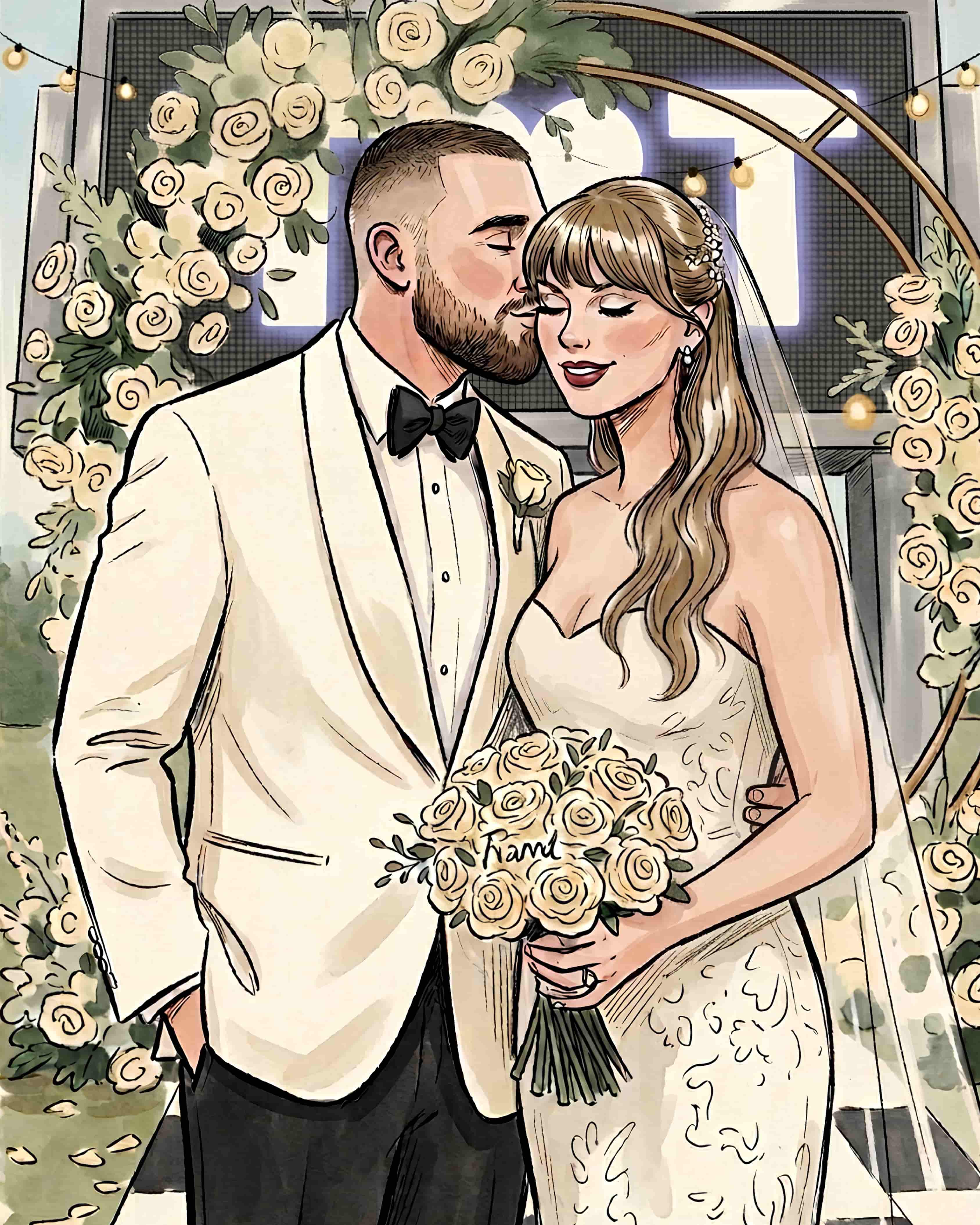
Madison Square Garden, a raffled Chevrolet, and a guest list read like a ballot. What the backlash to Taylor Swift’s wedding really reveals is not a lapse in taste, but a quiet and increasingly confident belief that the public, not the wealthy, now gets to decide what good taste looks like.
So, Taylor Swift got married.
Yes, the Taylor Swift. Fourteen-time Grammy winner, the only artist in the award’s history to win Album of the Year four times, and the songwriter whose last stadium tour was credited with measurable bumps to local GDP in the cities it passed through. Her new husband, Travis Kelce, is a future Hall of Fame tight end for the Kansas City Chiefs and a three-time Super Bowl champion. The pair married on 3 July at Madison Square Garden, in both pomp and circumstance and custom Christian Dior Haute Couture designed personally by the house’s Creative Director, Jonathan Anderson, custom Christian Louboutin and Cartier from head to toe, before a guest list that ran into the thousands. Guests had apparently been asked to bring no gifts, but they left with a Cartier watch apiece and a raffle ticket for a 1970 Chevrolet Chevelle, the same model Kelce had been driving the night the two were first photographed leaving Swift’s Chiefs game in 2023, for their alleged first date.
Within hours, a public that had spent a decade elevating Swift as culture‘s most “relatable billionaire” delivered its verdict on the nuptials. “Tacky.” Despite the absence of official photographs, every rumoured detail has been litigated, fuelled largely by AI-generated images circulating across Instagram and an endless stream of commentary videos dissecting them. The internet is simultaneously aghast, enchanted and amused by a wedding that almost none of them were invited to.
Take the venue, for starters: Madison Square Garden. MSG is a place that sells hot dogs. It hosts basketball games where grown men foul each other beneath a Jumbotron, and has, by any literal measure, seen more beer spilled across its floors than rose petals. It’s a building where your shoes are more likely to stick to the ground than vows are to the air. So why would a woman who could probably buy her own island choose a stadium of bleachers for the wedding she’d spent the better part of a decade writing about? And why top it off with a glowing “JusT&T Married”, looking less like a declaration of love than a brand campaign?
Swifties were quick to push back. New York isn’t incidental to Swift’s story; it’s one of the few places she’s repeatedly written about as a refuge. From her album 1989 to “Be my New York when Hollywood hates me” on “Elizabeth Taylor” from The Life of a Showgirl, the city has long represented safety, belonging and reinvention in her work. Nor was the stadium choice hers alone to defend. Kelce has spent his adult life inside arenas of this scale, while Swift has spent the past decade filling them. To them, Madison Square Garden is less spectacle than familiar ground. Besides, most people have never had the means to transform a venue like MSG, and often mistake the limits of their own imagination for a flaw in someone else’s vision. And if, in the very same week, Swift and Kelce donated US$26 million to charity, why shouldn’t they spend the rest of their money exactly as they please, they argued?
Naysayers remained unconvinced. They pointed to the closure of some of New York’s busiest streets over the July Fourth weekend as evidence of entitlement, dismissing the wedding as selfish, tacky and ostentatious in equal measure. They mocked the hot dogs, the stadium setting and what they saw as a lack of originality, assigning blame by turns to Kelce or to Swift’s all-American sensibilities. The verdict, they protested, was that she’d always been this girl. She’d always craved attention. Why then, had anyone expected anything different?
Then came the guest list, which turned the same instinct on people rather than objects. The attendance of model and former close friend Karlie Kloss, alongside her husband Josh Kushner, was read less as a reunion than as a political statement inferred from his surname and affiliation with the current administration. Kloss and Swift were once inseparable, before a years-long falling out, fuelled by fan speculation, alleged personal betrayals and Kloss’ continued association with Scooter Braun following his acquisition of Swift’s masters. A more conspicuous absence circulated in the opposite direction. Blake Lively, once close enough to have Swift named godmother to her children, was reportedly nowhere near Madison Square Garden that weekend. The pair are understood to have drifted after Swift’s name surfaced in Lively’s legal dispute with Justin Baldoni, with some media outlets reporting conjecture that Lively felt publicly “humiliated” by the omission.
Then photographs emerged of Steven Demetriou, Executive Chairman of Amentum, arriving at the ceremony. Demetriou is the adoptive father of Reggie King, one of groom Kelce’s closest childhood friends. Within hours, attention had shifted almost entirely to Amentum, the government contractor that operates Camp East Montana, an ICE detention facility that has faced scrutiny over detainee treatment, medical care and record-keeping. Demetriou’s attendance quickly became a broader debate about what it means to invite, or be seen alongside, figures connected to institutions under such scrutiny. In a country deeply divided over immigration, human rights and political accountability, it’s a fair question to ask how far personal relationships should outweigh corporate or political affiliations.
At last came what many had hoped would be the wedding’s saving grace: the dress! On paper, Swift and Kelce had checked every box a couture wedding demands, Dior Haute Couture, designed personally by Jonathan Anderson, Louboutin and Cartier from head to toe. For a brief moment, it looked like vindication.
It didn’t hold for long. Guests reportedly left with Cartier gifts of their own, while games throughout the reception offered the chance to win Dior and Chanel handbags and luxury golf bags, prompting an obvious question: why was there a designer raffle at a wedding at all? Particularly one hosted by a billionaire, inside a closed Madison Square Garden, where more than 1,000 affluent guests, dressed in couture and fine jewellery, competed for prizes while the streets outside remained closed to accommodate the celebration. At what point does a celebration of extraordinary wealth become a performance of it?
So, what does the internet’s outrage over a wedding it was never invited to—watched, judged and litigated from the outside, as a kind of phantom guest—actually tell us about where we’ve landed, socially, culturally and commercially, in our relationship with celebrity and luxury?
For one, none of this is unprecedented. Long before Instagram and TikTok turned celebrity weddings into global discourse, the marriages of Gilded Age heiresses and industrial dynasties were treated as public theatre. Newspapers lingered over Vanderbilt weddings, scrutinised the fortunes on display, and dissected unions less as love stories than as symbols of wealth, status and social ambition. Lavish weddings have long served as proxies for larger conversations about class, power and taste. More than a century later, Jeff Bezos and Lauren Sánchez Bezos’ recent reported US$50 million-plus Venice celebrations attracted many of the same accusations: excess, spectacle and vulgarity. Celebrity weddings have always invited conjecture. Guest lists have always been mined for meaning. Every generation has found a new way to accuse the rich of confusing wealth with taste.
What feels different today isn’t the scrutiny itself, but the entitlement behind it. The larger the fortune, the stronger the conviction that the public deserves a say in how it’s spent. Social media has dissolved the veil that once separated celebrity from spectator, replacing mystery with the illusion of access. We see the kitchens, the weddings, the holidays, the wardrobes, until watching starts to feel indistinguishable from participating. We’ve become more interested in being privy than in privacy. A dress becomes a moral statement. A guest list becomes a political document. A venue becomes a declaration of character. Every detail is judged not for what it is, but for whether it conforms to an increasingly collective idea of how immense wealth ought to behave. After all, if the commentariat helped build this fame and fortune, why shouldn’t we have some claim on what it does with itself?
Perhaps that says as much about this economic moment as it does about Swift herself. As wealth inequality widens and the cost of living continues to climb, luxury has become less something to experience than something to observe. For most people, extraordinary wealth exists not as aspiration but as content, encountered through the endless scroll of someone else’s life. If we cannot inhabit it, we can at least interrogate it. We become invested not only in what the wealthy own, but in whether they deserve to own it, whether they spend it well, and whether they perform it with sufficient taste.
But somewhere between accountability and aesthetic arbitration, perhaps we forgot that not every lavish wedding is trying to make a statement. Sometimes, beneath all the symbolism, is an unapologetically corny duo who just happen to be very, very rich.
But that returns us to the more difficult question: who gets to decide what taste is? Is it the billionaire, whose wealth affords the freedom to indulge almost any vision? Is it the peanut gallery online, whose collective approval can elevate or dismantle reputations overnight? Is it the editors, critics, curators and tastemakers who have historically shaped aesthetic standards? Or is taste something slower and more elusive, formed over generations through craftsmanship, originality and cultural consensus? More importantly, who appointed any of them? None of this is to dismiss accountability. Extraordinary wealth invites legitimate questions about inequality, philanthropy, labour and the ethics of accumulation. Those conversations matter. But they are not always the same conversation as whether a wedding looked tasteful.
If we strip away the billionaire, the discourse and the algorithm, what remains is remarkably ordinary. A woman married the man she loved after years of writing songs about wondering whether she ever would. Could parts of it have been gauche? Absolutely. Do I have plenty to say about Swift’s cultural influence, her politics and the contradictions of her public persona? Also yes. None of this absolves extraordinary wealth from scrutiny. Those questions remain fair. But somewhere between accountability and aesthetic arbitration, perhaps we forgot that not every lavish wedding is trying to make a statement. Sometimes, beneath all the symbolism, is an unapologetically corny couple who just happen to be very, very rich. And in a world increasingly short on reasons to believe in happy endings, maybe that’s the greatest luxury of all. It’s a love story, baby just say yes.