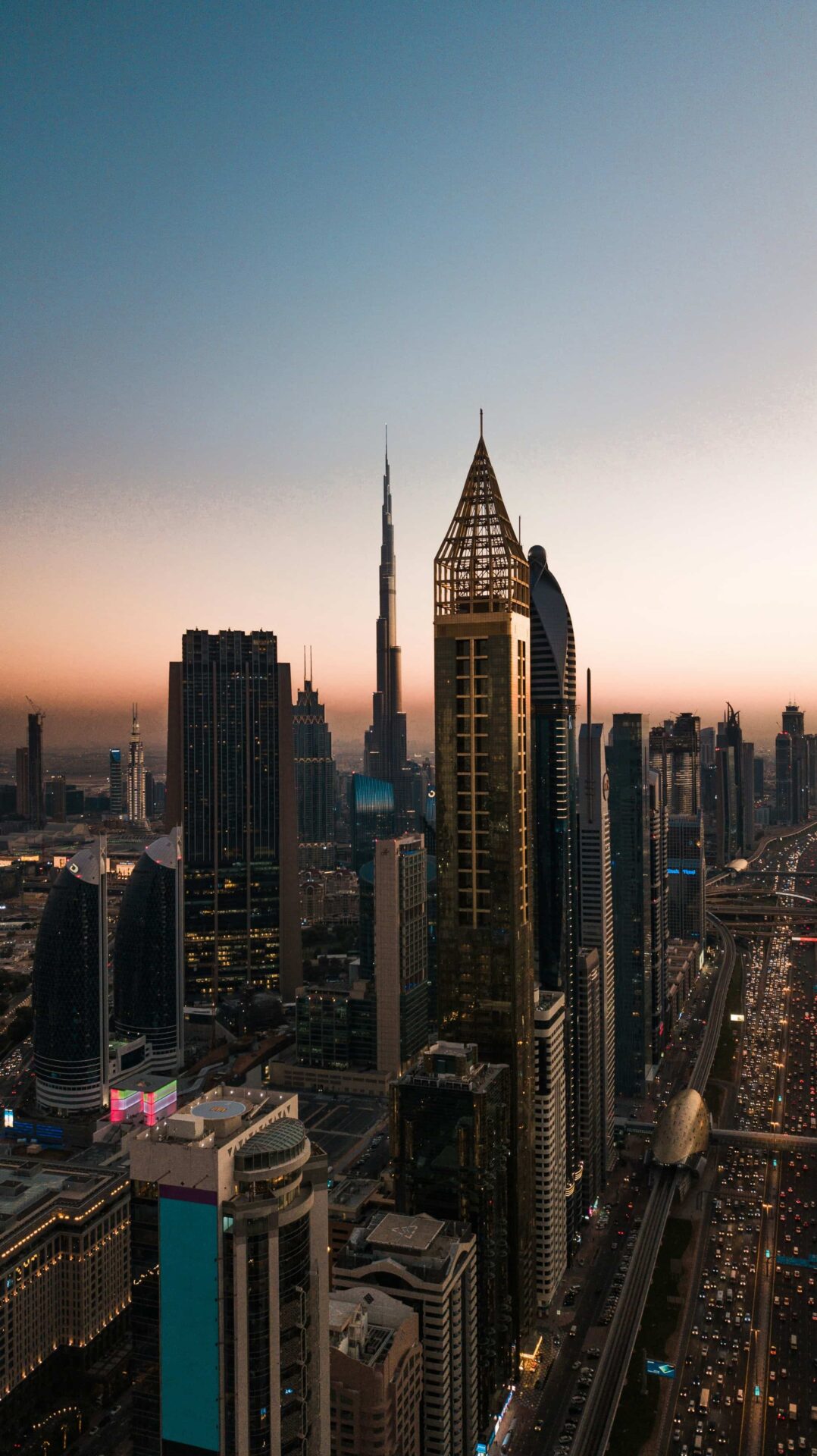
From record-breaking penthouses to soaring branded residences, Dubai’s luxury property market continues to attract extraordinary amounts of global capital despite growing regional uncertainty. But beneath the headline transactions lies a deeper shift underway, one that suggests the UAE is increasingly being viewed not simply as a speculative real estate play, but as long-term infrastructure for wealth, stability and global mobility.
The initial reaction was sharp. In March, the Dubai Financial Market’s real estate index fell by roughly 20-30% dropping from above 16.6 points at the end of February to around 11 by mid-month. Market experts would later clarify that the decline did not reflect weakness in the underlying property sector itself. At the time, however, sentiment shifted abruptly. Active buyers paused searches. Viewings were delayed. WhatsApp threads between high-net-worth clients and their advisers filled with questions that, for the moment, had no clear answers.
But the panic never fully arrived.
“The dominant sentiment at the peak of uncertainty was not panic, but there was a great deal of concern,” says Ben Crompton, Managing Partner of Crompton Partners, an Abu Dhabi real estate agency. Within days, the country’s leadership had demonstrated something that data alone cannot capture. The ability to project stability from inside a region in active conflict.
Transactions resumed faster than many expected. Dubai’s real estate market recorded US$18.67 billion (AED 68.56 billion) in April transactions, an increase of over 20% compared to March, according to the Dubai Land Department. Residential prices grew 21.1% year-on-year as of April 2026, averaging US$600,000 (AED 2.21 million), according to Property Finder data.
A recent sentiment report from Christie’s International Real Estate tells a similar story. While uncertainty is being felt, many are approaching the market with a confident rather than retractive mindset, with sellers holding firm on pricing and buyers remaining open to opportunities. “We see an overarching resilience in a market prepared to endure adversities, especially in the ultra-luxury segment,” says Jackie Johns, Managing Partner at Christie’s International Real Estate Dubai. “The past two months recorded some of the most significant transactions in Dubai’s history.”
The numbers bear this out. A single apartment at Aman Residences sold for US$115 million (AED 422 million), the third most expensive apartment in Dubai’s history. A beachfront plot on Naïa Island changed hands for US$102 million (AED 377 million), setting a new benchmark for ultra-prime land values. On the Palm Jumeirah, multiple villa transactions exceeded US$13.6 million (AED 50 million), including one brokered by Christie’s valued at over US$16 million (AED 60 million). Former UFC heavyweight champion Francis Ngannou purchased a residence at Armani Beach Residences for US$25 million (AED 92.5 million), a signal, if one were needed, that appetite for branded luxury in Dubai remains global in reach.
Abu Dhabi’s luxury segment produced its own headline figures. Several Four Seasons villas on Saadiyat Island changed hands at asking prices from US$19 million. A penthouse at Nobu Residences signed at US$42 million. Baccarat Residences, with direct views of the Louvre Abu Dhabi and the soon-to-open Guggenheim, launched with two-bedroom units from US$3.8 million.
“The ultra-prime may have momentarily paused, but within days it fully resumed,” says Felicia Agmyren, Founder and Managing Partner of REX Real Estate, whose firm brokered some of those deals. “Family offices are still opening up here, and similar confidence is being shown by some of the world’s largest hedge funds.”
“Branded residences and waterfront products held up because those buyers are typically end users or long-term holders, not flippers,” adds Christopher Veinbaums, founder of Royale Stays, a property management company in the UAE. “That gap between the top of the market and the mid-tier is something I’d expect to persist through the rest of 2026.”
Beneath the Headline Numbers
Not everyone reads the ultra-luxury data with such confidence. Reza Motalebpour, Founder and CEO of INGWE Global Investments & Mobility, which advises high-net-worth clients from China, Vietnam, the US, the Middle East, and Africa, offers a corrective to the prevailing narrative. “That market is simply less transparent. A buyer stepping back from a US$1.36 million (AED 5 million) apartment is visible in transaction data much faster than a family office quietly delaying a branded residence allocation or renegotiating terms.” The ultra-prime segment may look more resilient because wealthy buyers carry less leverage and top-tier assets remain scarce, but decision-making timelines, Motalebpour argues, have extended there too.
The segment where cracks are most visible is off-plan resale, properties bought during the 2022 to 2025 boom with the intention of flipping before handover. In a softening sentiment environment, that exit strategy has become significantly harder. Secondary market transactions fell 19% year-on-year, showing greater pricing sensitivity in the ready market.
For long-term investors, however, the volatility has also opened opportunity.
“If a buyer has job security and genuinely believes in the long-term prospects of a project or location, this is absolutely a reasonable entry point,” says Crompton. “What is not sensible is overstretching financially or chasing short-term gains in riskier segments.”
Agmyren frames it more bluntly. “In the long term, this is still one of the best places in the world to invest right now, so to borrow a term from the crypto crowd, HODL (hold on for dear life) is our recommendation: a strong belief in the asset’s future value.” Naturally, this advice will vary depending on an individual’s financial profile.
What the Policy Layer Did
Part of the market’s resilience is driven by regulatory support and institutional flexibility, rather than sentiment alone.
Most notably, the UAE government removed the US$204,000 (AED 750,000) minimum property threshold previously required for investor visa eligibility, a move that broadens residency-linked ownership to a significantly larger pool of international buyers.
For globally mobile investors weighing the UAE against competing jurisdictions, the alignment of property ownership with residency has become an increasingly decisive factor in the investment calculus.
There are more sellers in the market now, but few price reductions below pre-February values, according to Crompton. “We are seeing regular investors continue deploying capital, but in smaller, less risky bites. There are rumours of UAE investors turning to other markets such as the UK, Georgia, and Latvia, but we haven’t seen much of that materialise.”
Other advisers suggest the rotation may already be happening, just not publicly. Maureen Li, Founder and CEO of ABIEL Property Investment Fund, points to a quiet increase in Middle East-linked capital entering Singapore commercial real estate. “This is not necessarily visible in public transaction data yet,” she says. “A significant amount of it is moving through private co-investment structures and family office mandates.”
Motalebpour has observed similar caution among some international clients. Several Chinese investors, he says, exited pre-construction positions and redirected liquidity toward Hong Kong and Singapore. Some North American buyers exploring UAE property for relocation or investment began inquiring about politically quieter jurisdictions instead. “The other half,” he says, “remains invested, but in a clear waiting mode.”
What Resilience Actually Looks Like
The UAE entered 2026 as one of the world’s defining real estate momentum stories. It exits the first half of the year having undergone, not without consequences for more speculative participants, a genuine stress test. The data, imperfect in a fast-moving market, still points toward cautious optimism.
Savills, the global real estate services provider and consultancy operating in the UAE, frames the shift as a period of price adjustment rather than market collapse. Strong momentum is giving way to a more selective environment, with buyers taking longer to commit, transaction volumes softening, negotiations increasing, and off-plan sales likely slowing without meaningful developer incentives. Secondary apartments face the most immediate pressure, while villas and prime assets are expected to remain comparatively resilient.
So far, the market has absorbed the shock without systemic damage. Whether that resilience holds through the second half of 2026 will depend on variables no broker can fully model. The trajectory of regional conflict, the durability of capital flows, and the speed at which confidence returns to signed contracts.