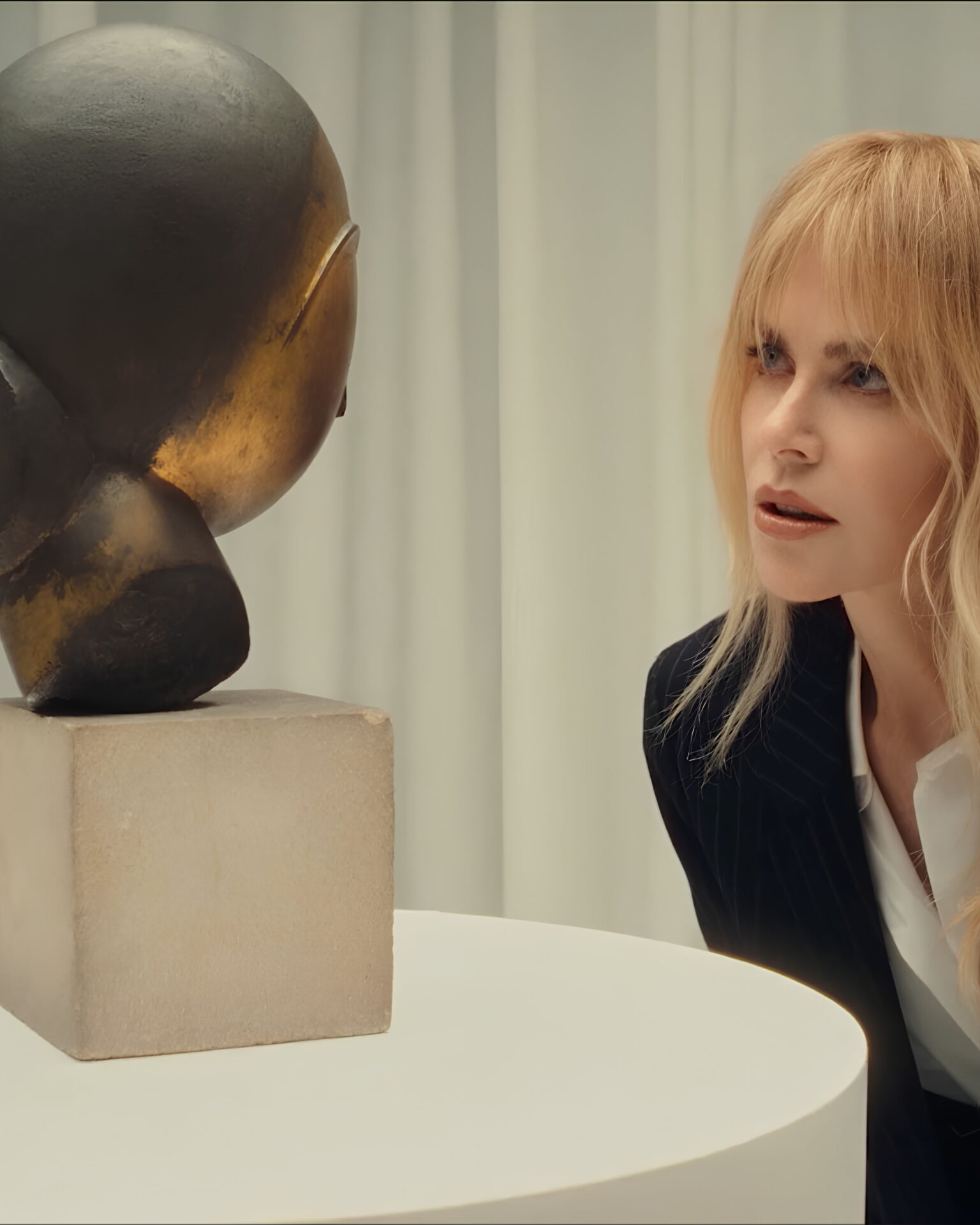
BTB Brand Spotlight: Partnering with creative studio 11F, Christie’s enlists Nicole Kidman to front a campaign for Constantin Brancusi’s Danaïde, a sculpture that sells for US$107.6 million. More than a marketing exercise, the film underscores how auction houses are increasingly borrowing the tools of luxury branding to compete for attention.
What does an Oscar-winning actress have to do with a century-old bronze sculpture?
On the surface, very little. Yet last month, Nicole Kidman became the face of Christie’s campaign for Danaïde, a 1913 sculpture by Constantin Brancusi, the French-Romanian artist often regarded as the most important sculptor of the 20th century, whose sleek, abstract forms redefined the boundaries of figurative art. Expected to fetch more than $100 million at auction, the work became the centrepiece of one of the year’s most talked-about art marketing moments: a case study in how cultural institutions are borrowing from the luxury playbook. What looked, at first glance, like an auction house publicity stunt was, in fact, the auction world’s clearest admission yet that scarcity alone no longer sells itself.
Shot inside Christie’s Rockefeller Center headquarters and inspired by a Surrealist film by Man Ray, the campaign shows Kidman slowly circling the sculpture as David Bowie’s Golden Years played beneath her. It’s less advertisement than atmosphere, closer in spirit to a fragrance campaign or luxury fashion film than an auction catalogue.
By the time the hammer fell on May 18, Danaïde had sold for $107.6 million, shattering Brancusi’s previous auction record of $71.2 million. The entire first session of the evening, 16 works from the collection of S.I. Newhouse, the late media magnate and co-owner of the Condé Nast publishing empire, cleared $630 million in forty minutes. Before the night was through, Christie’s had generated $1.1 billion in sales in a single evening. The arithmetic alone tells a story of demand; what the campaign tells us is how that demand was cultivated and presented for public consumption.
The campaign cannot take credit for the bids. The buyers who signed those cheques had almost certainly already made up their minds long before the video went live. Kidman did not create the demand. What she helped create was visibility, and in a market increasingly organised around attention as much as scarcity, visibility has become its own form of currency.
The Luxury Playbook Comes to Art
Luxury brands have long understood that marketing is rarely about explaining a product, it’s about constructing a world around it.
Fashion houses sell narratives of aspiration. Watchmakers sell heritage. Jewellery brands sell emotion. Increasingly, auction houses are adopting the same grammar, a sign that the goods themselves are no longer assumed to sell on merit alone.
Christie’s campaign illustrates the shift. Its creative concept drew inspiration from Self-Portrait, or What We All Lack (Autoportrait ou Ce qui manque à nous tous), a Surrealist short film made by Man Ray, a pioneering American avant-garde visual artist, around 1930. The film famously features his muse, Lee Miller, slowly unveiling Brancusi’s sculpture Princess X. Christie’s translated that art-historical reference into contemporary celebrity culture: the artist’s studio became Rockefeller Center; the Surrealist muse became one of Hollywood’s most recognisable faces.
“Look at my sculptures until you manage to see them,” Brancusi once said. The endless orb transfixes the gaze, the circular forms unending as they take the viewer on a journey around the sculpture. The line is instructive, Brancusi asked for sustained attention, not instant recognition. Christie’s campaign delivered the latter in abundance, which is precisely where the tension in this strategy begins.
The campaign is closer to what luxury creative directors call a brand film, content engineered to generate cultural conversation rather than communicate practical information. In luxury marketing, desire consistently outperforms explanation.
From Auction House to Popular Culture
Over the past decade, major auction houses have experimented steadily with celebrity partnerships, fashion collaborations and cultural adjacency. The shift accelerated as the industry confronted a challenge: how to attract younger audiences to a market historically dominated by older, established collectors, an existential question for any market reliant on the continuous arrival of new capital.
Sotheby’s collaborated with A$AP Rocky, partnered with Victoria Beckham to display artworks inside her London boutique, and enlisted Robert Pattinson as guest curator for its 2022 “Contemporary Curated” sale in New York. The response was mixed. Some headlines read simply: “Art world rolls eyes as Sotheby’s names Robert Pattinson as curator.”
The criticism is not without merit. Responding to Christie’s Instagram post featuring Kidman and Danaïde, one commenter asked: “Do we need celebrities to promote art now? Did such a wonderful sculpture by Brancusi need Nicole Kidman to attract buyers? I fear this speaks volumes about the new wave of collectors and investors and their ability to understand or appreciate a piece.”
The tension the comment captures is real and longstanding. To traditionalists, celebrity involvement risks reducing art to décor, a backdrop for personal branding rather than an object of serious inquiry.
Seeding the Next Generation
To the auction houses however, such campaigns are rarely addressed to the handful of collectors capable of spending nine figures on a single lot. They are addressed to everyone else, to the cultural ecosystem that shapes who walks through the door a decade from now. Rather than waiting for future collectors to discover the auction room on their own terms, the houses are placing art inside the cultural environments where those future buyers already live: fashion boutiques, music communities, social media platforms, celebrity-adjacent content.
The film attracted nearly one million views online, a modest figure by Hollywood standards but a significant one within the art world’s comparatively contained universe. Most of those viewers will never bid at auction. Many will never set foot inside Christie’s. That is entirely beside the point. Luxury businesses have long understood that the most valuable customer relationship often begins years before the first transaction. Fashion brands cultivate aspiration long before a first purchase. Auction houses are beginning to operate according to the same logic.
The audience for the Kidman campaign was not today’s billionaire collector. It was tomorrow’s, the entrepreneur, the trustee, the inheritor, and the cultural patron still assembling their identity, their references and their taste.
The Limits of Borrowed Glamour
Yet the strategy carries its own risks, ones the industry is only beginning to reckon with.
Celebrity adjacency can generate reach without generating depth. A viewer captivated by Nicole Kidman’s presence in a darkened room may leave with a stronger impression of Nicole Kidman than of Constantin Brancusi. Awareness is not the same as affinity, and affinity is not the same as collecting. Brancusi asked viewers to look until they could see; the risk of this model is that audiences stop at looking.
There is also the question of institutional credibility. Auction houses occupy a special position in the cultural economy, they are simultaneously commercial enterprises and custodians of artistic legacy. That duality is the source of their authority. When the marketing vocabulary of luxury business becomes indistinguishable from the vocabulary of the auction room, something of that authority may quietly erode.
The most sophisticated luxury brands have always understood the danger of chasing attention at the expense of mystique. Hermès famously doesn’t have a traditional marketing department. The company doesn’t have ambassadors either. The house doesn’t splurge on celebrities and influencers. Instead of traditional advertising, Hermès marketing focuses on craftsmanship, heritage and storytelling in the quietest way possible. It commissions artists to construct entire worlds around its products, and then lets those worlds speak for the brand. Christie’s chose visibility; Hermès has built an empire on withholding it. Both are coherent strategies. They are not, however, the same strategy, and auction houses borrowing from luxury’s playbook would do well to know which page they are on.
What Christie’s achieved with Danaïde was, by any measure, a success. But a record-breaking Brancusi is not proof of a transferable model, Danaïde could carry the spectacle because the object itself was rare enough to justify the attention. Most lots are not. The real test of the luxury playbook in the auction room will not come with the next $100 million sculpture. It will come on an unremarkable Tuesday, with no Kidman, no Bowie soundtrack and no story strong enough to survive contact with an ordinary lot.
That is where this strategy either earns its keep or quietly comes undone.
Credits:
Agency: Studio 11F
Video Director: Stephen Tyler
Director of Photography: Paul Theodoroff
Photography: Hunter Abrams