In an era defined by the scroll, the skip, and the algorithmically optimised impression, luxury’s most quietly radical act has been its refusal to abandon the printed page not out of sentimentality, but existential strategy.
Step through the sliding glass door at 7 Rue de Lille in Paris and you find yourself inside the sumptuous psyche of one of fashion’s most prodigious figures. Karl Lagerfeld founded Librairie 7L in 1999, converting a former art gallery in the 7th arrondissement into a photographic studio, bookshop, and library. Its cavernous atrium was lined with printed matter spanning Balthus to David Bailey, Goethe to Andreas Gursky, slow diets to fast food (some 300,000 volumes in total) shelved with rolling ladders and spiral staircases, with books displayed horizontally so their spines could be read like paintings on a wall. Lagerfeld was known, among other things, for buying several copies of the same book. One to annotate, one to keep pristine, and others to give as gifts. He also worked there late into the night, two or three times a week after days spent on Rue Cambon. Speaking to curator Hans Ulrich Obrist in 2014, Lagerfeld said: “My paradise is a library. I am a paper freak. I was born a paper freak. I was not interested in anything else but books, books, books and drawing paper.”
The man who for 36 years defined what Chanel meant to the world was also making an argument about what print meant to luxury. Not as a distribution channel or a as media spend, but rather as a philosophy. One that held that the physical object, held in the hands rather than glimpsed on a screen, and carrying a kind of authority that no other medium could replicate.
Innovation, Not Nostalgia
It’s no secret that luxury has always relied on physical cues to communicate worth. Weight, texture, rarity, finish, detail: these are the codes that tell us something is exceptional before we have fully engaged with it. Print still does this better than almost any other medium.
At a moment when most media is designed to be skimmed, swiped past or forgotten, the printed object has become something else entirely—slower, rarer and more deliberate. The magazine, catalogue or collector’s edition is no longer simply a vehicle for content, it is the content. This is one of the reasons why, even as the wider media landscape continues to contract around digital, the world’s most influential publications have not abandoned print, but rather, refined it. As of 2026, Vogue shifted to eight print issues a year in the United States, with each edition becoming thicker, more considered and more closely tied to major cultural moments such as fashion month and the Met Gala, rather than filling a routine monthly slot. Bloomberg Businessweek reintroduced a monthly print edition after nearly a century of weekly publishing. NME, Nylon and I-D all launched or revived print editions across 2024 and 2025, positioning the physical issue less as a disposable monthly product and more as something collectible.
Closer to home in Singapore, the symbolic value of print remains unusually potent. Vogue Singapore, for example, has treated print not as a recurring commodity but as a prestige object, producing covers and editorial packages intended to be kept, displayed and remembered. Since its relaunch, the title has consistently approached print less as a monthly magazine and more as a canvas for experimentation. Its September 2021 issue featured what was billed as the world’s first Vogue NFT cover, marked by a silver QR code that unlocked digital-only covers and collectible artworks in the metaverse. Two years later, its September 2023 issue arrived with a heat-reactive cover featuring Shin Hyun-ji that changed colour at 33 degrees through the use of thermochromic ink. More recently, the March 2026 issue introduced a glow-in-the-dark collector’s cover designed to reveal itself in low light.

The idea that luxury print is somehow static or resistant to change has become one of the industry’s more persistent myths. In reality, luxury has long understood that print can take many forms. For brands built on craft, storytelling and sensory experience, the printed object has always been an extension of the brand itself.
Hermès has spent decades treating print as a space for artistic patronage as much as marketing, commissioning illustrators, photographers and writers for everything from its Le Monde d’Hermès newspaper to its beautifully produced annual themes and silk catalogues. Chanel has consistently experimented with oversized invitation formats, collectible books, art-led campaign materials and limited-edition magazines that feel closer to coffee table objects than advertisements. Prada has commissioned writers, artists and filmmakers to create printed matter that exists somewhere between editorial, literature and brand mythology. Even brands such as Louis Vuitton and Dior have turned travel books, exhibition catalogues and artist collaborations into extensions of their broader cultural worlds.
The innovation is not new. What has changed is the form it takes. Covers now incorporate NFC technology, augmented reality, audio storytelling, thermochromic inks and glow-in-the-dark finishes, turning the printed page from a static object into something immersive, interactive and increasingly collectible. The point is no longer simply to produce something to read. It is to produce something worth keeping.
As Anthony Reeves, a global brand and creative leader who has led teams and transformation at companies including Amazon, Airbnb, LVMH and Kohler Co., puts it: “Luxury did not cling to print out of nostalgia. It kept print because print still carries gravity. In luxury, not everything should feel fast, disposable, and optimised. Print slows the brand down in the right way. It signals confidence, craftsmanship, and permanence. Today, print works less as a mass channel and more as a halo channel, but in luxury, halo matters.”
The Algorithm Cannot Hold a Story Still
In the era of what many are deeming the “fourth industrial revolution”, luxury is contending with an entirely new media context. TikTok, AI and algorithmic feeds have flattened many of the old distinctions that once separated the aspirational from the ordinary. Today, a $20 hair clip can now generate the same cultural conversation as a $20,000 handbag. A well-placed influencer video can propel a micro-brand into relevance overnight and render it irrelevant again just as quickly. In many ways, this new landscape has created a strange kind of consumer democracy, one where mass-market brands, emerging labels and fast fashion players can compete for attention on almost equal footing with heritage houses.
@elizabeth_obuks Affordable vs Luxury Mini Bags. Be honest 👀 which one are you choosing? #affordableluxury #luxury #minibag #lv #coach @Coach @Burberry @Gucci @Louis Vuitton ♬ original sound – Elizabeth✨
That is far more complicated for luxury because luxury has never operated according to the logic of abundance. Its value lies precisely in the opposite: scarcity, selectivity, patience and controlled access. The algorithm doesn’t particularly care about any of those things. It rewards immediacy over permanence, novelty over meaning and virality over discernment. A couture gown, a Zara dress and a novelty Amazon purchase can all occupy the same scroll, subject to the same flattening effect. Print offers luxury brands one of the few remaining environments where they can still control pace, context and perception. A magazine doesn’t refresh every three seconds. A beautifully produced catalogue cannot be interrupted by a push notification. A collector’s edition book does not disappear beneath an avalanche of new content five seconds later.
Amanda Jane Valentine, founder of AJ Valentine Consulting and former designer for brands including Marc Jacobs and Coach 1941, sees print as an antidote to the relentless sameness of digital culture. “In a time of AI-slop, doom-scrolling and endless algorithms grasping to categorise the consumer, print media offers not just to be glanced at, but for the viewer themselves to be seen and treated as human,” she unpacks. “For luxury customers, especially those who appreciate the arts, print feels less like marketing and more like a handwritten letter from an old friend.”
Reeves agrees with this sentiment. “Print can establish tone and authority, while digital, social, events, and experiences extend the narrative and create interaction. Luxury stayed with print because print still signals intention,” he says. “In a world of speed and endless scroll, print feels curated, permanent, and culturally weighty.”
In that sense, print functions almost like a selective algorithm of its own. It filters rather than floods, and chooses rather than overwhelms. And for luxury brands built on the idea that not everything should be available to everyone, all at once, that kind of controlled environment isn’t just valuable, it’s existential.
It’s Just Good Business
As it so often does with anything worth paying attention to, the proof is in the commercials.
Kantar’s latest 2026 Media Reactions data shows that consumer trust in print advertising remains roughly double that of social media advertising around 60% versus 30%. At a time when digital environments are increasingly associated with bots, misinformation, ad-clutter and low-quality inventory, print still benefits from a level of credibility that most digital channels struggle to command.
That trust matters because trust has a direct relationship to commercial performance. Research from Temple University’s Fox School of Business found that physical advertising activates the brain’s ventral striatum, often described as the brain’s “valuation centre”, more effectively than digital advertising. In simple terms, consumers are more likely to want what they see in print. They’re also more likely to remember it. Large-scale meta-analyses involving more than 171,000 participants found that reading on paper produces stronger memory encoding than reading on screens, partly because physical pages create spatial cues that digital scrolling cannot replicate. Consumers remember where they saw something in a magazine spread or catalogue in a way they rarely do on a phone screen. Some studies suggest this can increase recall by as much as 20%.
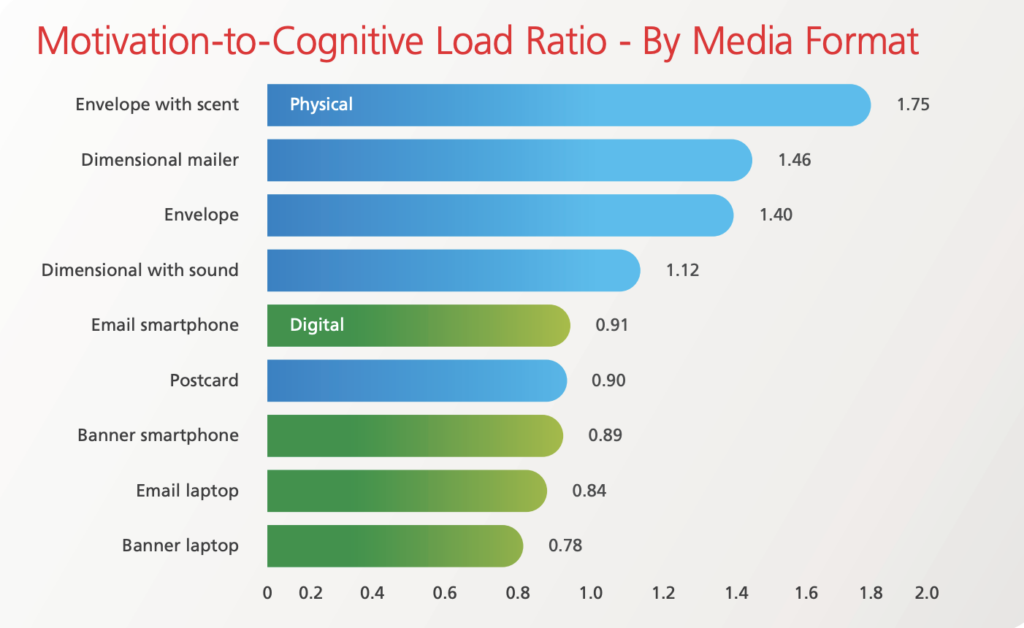
That difference becomes particularly important in luxury, where the goal is not immediate conversion so much as long-term desirability. Customers acquired through physical media, including direct mail, premium inserts and print-led campaigns, have been found to generate lifetime values around 10% higher than those acquired through digital-only channels. They are more loyal, more likely to return and more inclined towards repeat purchases. Print also tends to drive higher average order values. Retail campaigns built around catalogues and premium publications often generate order values closer to US$185, compared with around US$120 for social-driven purchases. The medium still lends itself to slower, more considered buying behaviour rather than impulse.
Valentine believes this is partly because print encourages a more emotionally engaged relationship with the brand. “Print offers an oasis for our dry eyes beyond the straining screen,” she explains. “The bond between viewer and image is stronger this way, the message delivered like a handwritten letter from an old friend.”
There is also the simple question of longevity. A digital ad disappears in seconds. A beautifully produced lookbook, coffee-table magazine or private client catalogue can remain in a home for weeks, sometimes months, generating repeated brand impressions long after the initial moment of delivery. In B2B environments, the same principle applies. A hand-delivered luxury lookbook is still far more likely to reach a chief executive’s desk than yet another digital newsletter filtered by an assistant or buried in an inbox. Even when print is used alongside digital rather than instead of it, the results are stronger. Integrated “phygital” campaigns that combine print with digital retargeting have produced conversion rates of more than 8%, compared with just over 1% for email-only campaigns.
It’s not remiss to recall that all of this is happening against a backdrop of profound digital fatigue. Nearly 69% of consumers now report some form of digital eye strain, while affluent consumers increasingly seek out tactile, experiential forms of engagement. Bain estimates that the global luxury market reached US$1.68 trillion (€1.44 trillion) in 2025, with demand for high-end physical experiences particularly strong in markets such as Japan and Southern Europe.
If commercial instinct is ultimately about recognising where enduring value still lives, then there is perhaps no better example than Lagerfeld himself, a man who built one of fashion’s most successful modern empires while surrounding himself with paper, books and printed matter.
As he once put it: “I’ve only wanted paper and beautiful colours. And books. They’re all I need, and the rest I can do without.”