As Eastern contemporary art enters a new era of global and commercial influence, Chinese artist Ma Dongmin is emerging as one of its most compelling figures. Ahead of his Singapore debut, we sit down with the Venice Biennale laureate to discuss Zen philosophy, the psychology of colour, the rise of Eastern art as a blue-chip asset class, and why the pursuit of beauty may ultimately be a pursuit of stillness itself.
There is a particular quality of light that exists just before a gallop begins, the gathering of energy, the held breath, the moment before everything ignites in motion. Ma Dongmin has spent the better part of three decades trying to paint it.
It’s a pursuit that feels almost philosophically impossible, which is perhaps precisely why it’s so distinctly Ma’s. The Beijing-born artist—one of China’s most internationally recognised contemporary painters and a two-time laureate of the Venice Biennale—has spent more than three decades building a visual language capable of carrying the meditative interiority of Eastern Zen philosophy through the material weight of Western oil paint. A graduate of Beijing’s prestigious Central Academy of Fine Arts, the same institution that shaped artists including Zeng Fanzhi and Xu Bing, Ma’s work exists within a conceptual space where atmosphere overtakes form, boundaries dissolve and subjects seem to breathe.

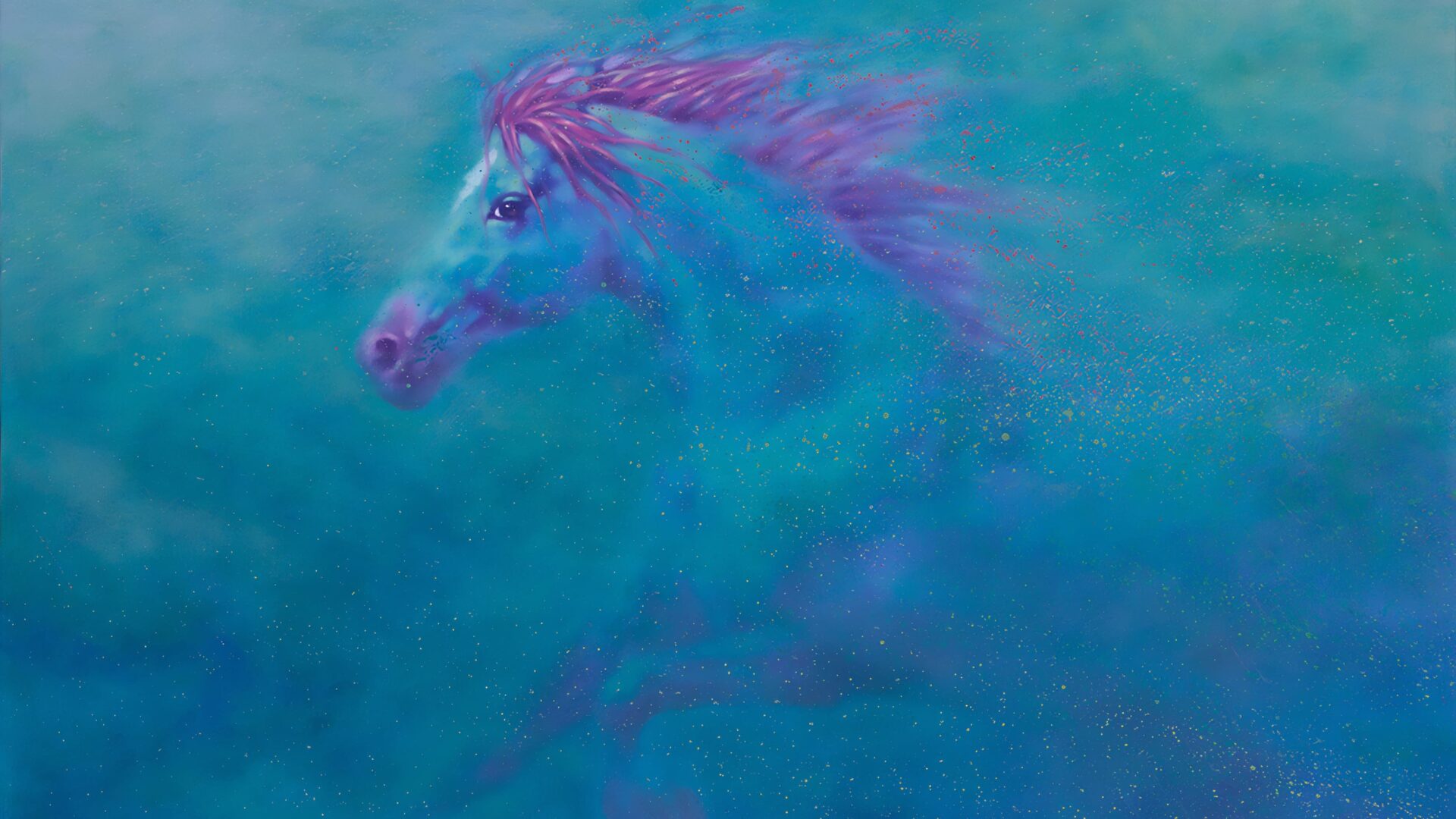
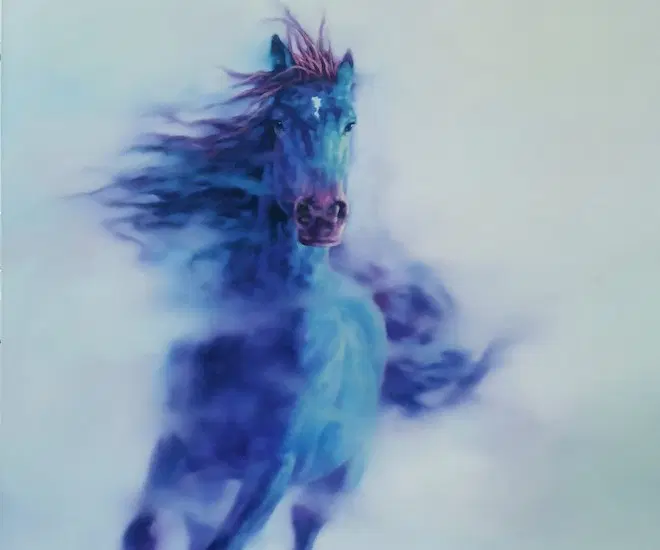
His now-signature Blue Horse series, layered in complex tones of Prussian, cobalt, ultramarine and cerulean blue, has made him a fixture on the international contemporary art circuit, attracting collectors including Steven C. Rockefeller Jr. and commanding auction results exceeding half a million dollars. Yet what distinguishes Dongmin is not merely market momentum, but the philosophical tension embedded within the canvas itself. Here, horses (always horses) emerge through veils of blue haze suspended somewhere between stillness and motion, realism and memory, presence and disappearance.
The timing of his Singapore debut is also no accident. Fire Horse—The Decisive Moment, presented at the Leica Store South Beach Quarter in partnership with Art Vault Asia and Leica Singapore, arrives during the rare Year of the Fire Horse, a cyclical alignment that occurs just once every 60 years and is associated in Chinese cosmological tradition with passion, intensity and extraordinary vitality. For an artist who has spent more than two decades painting horses in layered shades of cerulean blue, the convergence feels less like coincidence and more like inevitability.
The exhibition gathers 23 oil-on-canvas works from Ma’s Blue Fire Horse Collection 2026, including the Singapore premiere of Registered Kiss, his reimagining of Alfred Eisenstaedt’s iconic 1945 V-J Day photograph through his signature atmospheric palette. It is, by any measure, one of the most anticipated cultural luxury events on Singapore’s calendar this June.
The moment also arrives amid a broader shift within the global art market itself. Eastern contemporary art is having a surge that is not merely cultural, but economic. Driven by the rise of Asian ultra-high-net-worth collectors, the repatriation of cultural capital and a growing international appetite for work rooted in Eastern philosophy, artists like Ma are increasingly commanding serious market conviction. His paintings now regularly clear US$500,000 at auction, with a 160 centimetre canvas achieving US$533,520 at privately held American Queen’s Auctions as recently as September 2025. Art Vault Asia, which exclusively represents him in Singapore, is openly positioning him among the most significant rising figures in Eastern contemporary art, and the secondary market appears increasingly inclined to agree.

Beyond the Boardroom sits down with Ma ahead of his Singapore exhibition to discuss the intersection of Eastern philosophy and Western technique, the business of beauty in an increasingly financialised art world, and the deeply personal 20-year pursuit of the colour blue that has come to define his work.
You trained at Beijing’s prestigious Central Academy of Fine Arts before spending decades refining your practice. How did that early academic foundation shape the visual language you would eventually build for yourself?
My training at CAFA was focused strictly on modelling skills and fundamental techniques. Building that foundation gave me the technical freedom to paint whatever I desired with ease. After graduation, I spent over a decade researching and exploring to establish my own personal visual language. My process now is to first identify the core philosophy I want to convey, and then select the specific painting techniques needed to express it. This structural approach is how my distinct style was formed.
Your work exists between two distinct artistic and philosophical traditions, Eastern Zen thought and Western oil painting. How did those worlds begin to converge within your practice?
During my time at the academy, I was trained entirely in Western painting methodologies. Over years of practice, I continuously integrated Eastern philosophy into that framework. Fundamentally, I use Western oil painting materials to convey Eastern philosophical concepts. The initial synthesis occurred when I was painting landscapes, it was while trying to capture the sky and the atmosphere that I first discovered this specific conceptual state and visual feeling.
You’ve cited artists ranging from Lucian Freud and Gerhard Richter to J. M. W. Turner and Claude Monet as important influences. What drew you to their work, and what did you ultimately absorb from them as an artist?
Every successful master has predecessors they admire and study, just as Monet was deeply inspired by J.M.W. Turner. When I look at their paintings, I perceive a distinct Eastern atmospheric quality, Yijing (a Chinese aesthetic concept referring to the emotional atmosphere or spiritual resonance a work evokes beyond what is physically depicted). They achieved this using oil materials, which creates a very different visual impact and weight compared to traditional Chinese artists working in ink. Building upon their foundations, my objective was to push the boundaries further, forging my own visual language, and communicating my distinct philosophy.
Your paintings have a soft, atmospheric quality where boundaries of objects are deliberately dissolved. What does this allow you to express that traditional realism cannot?
My recent works deliberately dissolve boundaries to emphasise formlessness. What I am conveying is an integrated, seamless Zen state. I am no longer focused on concrete realism, the canvas projects concepts of Wuji (the limitless void or state of infinite potential that exists before form, separation or movement), an ethereal emptiness, and Zen philosophy.
Horses are central to your work, yet your paintings often feel less concerned with the animal itself than with something more emotional and intangible. What are you truly trying to capture through them?
Through observing horses, I have witnessed both majestic power and quiet moments, such as two horses embracing. In reality, I’m not painting horses. I use the horse as a vessel to depict the spectrum of human emotion. The warmth and coldness of humanity. I have anthropomorphised the subjects in my work. When depicting two horses together, I title the piece The Temperature of Emotion. It’s fundamentally about human empathy. This exhibition is focused on the decisive moment, which is about freezing a single instant into an eternal reality. Once captured, it enters history. As it flows through the river of time, it stands as a permanent, unforgettable symbol of peace and the beauty of life.
The horses often appear suspended between stillness and movement, as though caught within a fleeting psychological moment rather than a physical one. How do you create that tension on the canvas?
When I paint, the spatial composition in my mind is vastly larger than the physical canvas. The brushwork flows naturally and freely from within, the internal spiritual state dictates the physical technique. Within the painting, there is a profound interconnectedness, a blending of subjects where “you are within me, and I am within you.”
You’ve also spent more than two decades exploring blue through your work, pushing it far beyond colour into atmosphere and emotion. What keeps drawing you back to it?
The Blue Horse series does not rely on a single blue. I use a complex spectrum—Prussian blue, ultramarine, cobalt, cerulean, marine blue. Painters know that blue is the most difficult and challenging colour to master. I have persisted with this series for over 20 years to push the colour to its absolute limit. Blue is mysterious and melancholic. It represents the sky and the ocean, the vast elements humanity interacts with most. It’s deeply rooted in my mind as the colour of eternity, which is why it is the ideal vehicle for my philosophical concepts.
As your work has travelled internationally, have you observed differences in the way Eastern and Western audiences perceive concepts like stillness, atmosphere and Zen philosophy within the paintings?
Western audiences appreciate my work very much, and the reaction is equally strong across Asia. In Singapore, Hong Kong, and Japan, for example. Japanese collectors in particular, deeply resonate with my new works; they immediately recognise the underlying Eastern philosophy, the Zen qualities, the tranquility, the deeper conceptual layers. The response was similarly strong during my exhibitions in Dubai and Saudi Arabia.
After decades of artistic practice, what have you come to believe about the relationship between tradition and innovation within contemporary art?
Both tradition and innovation must be embedded within the canvas. My goal is to extract the essence of thousands of years of tradition, there are profound depths in Daoism and Zen Buddhism that operate behind the surface of the painting. Innovation meanwhile, connects the work to the present; the canvas must breathe the spirit of its time. By harmonising Chinese and Western cultural frameworks, the ideas conveyed become much more profound. Ultimately, my highest pursuit is to achieve a state of Wuwo— selflessness, ego-less creation during the painting process.
“Fire Horse—The Decisive Moment” by Ma Dongmin will take place from 6–7 June 2026 at the Leica Store South Beach Quarter. Public viewing runs from 10:00am to 5:00pm, with a Meet the Artist session taking place from 2:00pm to 4:00pm. The exhibition is presented by Art Vault Asia in partnership with Leica Singapore, with Beyond the Boardroom serving as an official content partner. RSVP here to secure your spot, with limited complimentary tickets available.