OFF THE RECORD: After seven years away, von Schlippe returns to Milan Design Week to uncover an industry in transition, where objects give way to systems, aesthetics to meaning, and individual authorship to something more collective.
The M1 line at Rho Fiera during Salone del Mobile week is not a metro, it’s a compression chamber. At peak hours, the carriage operates somewhere between a sardine tin and a philosophical experiment about personal space, and then it releases you, blinking, into the April light beneath the iconic canopy of the fairgrounds. After seven years away, I had forgotten what it feels like to be spit out of a tunnel and straight into beauty. So when I did return this April, I stood there for a moment longer than was probably socially acceptable., tearing up with a big smile. I was back.
Design has always been close to my heart, maybe even more so than fashion. In my next life, I hope I come back as an interior designer. In this one, I spent 17 years helping build Salone del Mobile in Moscow. Then came Covid. Then the Russia-Ukraine war. Then Vogue Singapore, and six years of building a fashion legend. And just like that, seven years had passed without Milan in April. Time, as Horace knew, waits for no one, not even for publishers with very good excuses.
I came back because we are launching Vogue Living Singapore in October. I needed to see the industry with fresh eyes. What I did not expect was to see it through emotional ones.
The Salone covers the equivalent of 56 football fields. Prepare accordingly, both in spirit and in footwear. Good shoes are not a style choice here; they are a survival strategy. In the city, the Fuorisalone counted over 1,600 events this year. The art of queuing is not a side skill; it’s a prerequisite. I clocked 27,000 steps on a slow day. On a fast day, I stopped counting.
At the Fair
The new management of Salone del Mobile carries a noticeably different quality. Maria Porro—young, direct, and genuinely visionary—helms the institution with a willingness to take risks and invite the industry into the process of change rather than simply presenting its results. Alongside her, Marva Griffin, the mind and soul behind SaloneSatellite since its founding in 1998, continues to represent something the industry needs more of: a long-term, unconditional commitment to emerging talent. Two women, two different mandates, a shared conviction that design is built on ideas, not just products. The conversation between them gives the whole institution a different quality. In a week dominated by the word “disruption” what they are doing is rarer, they’re building something that lasts.
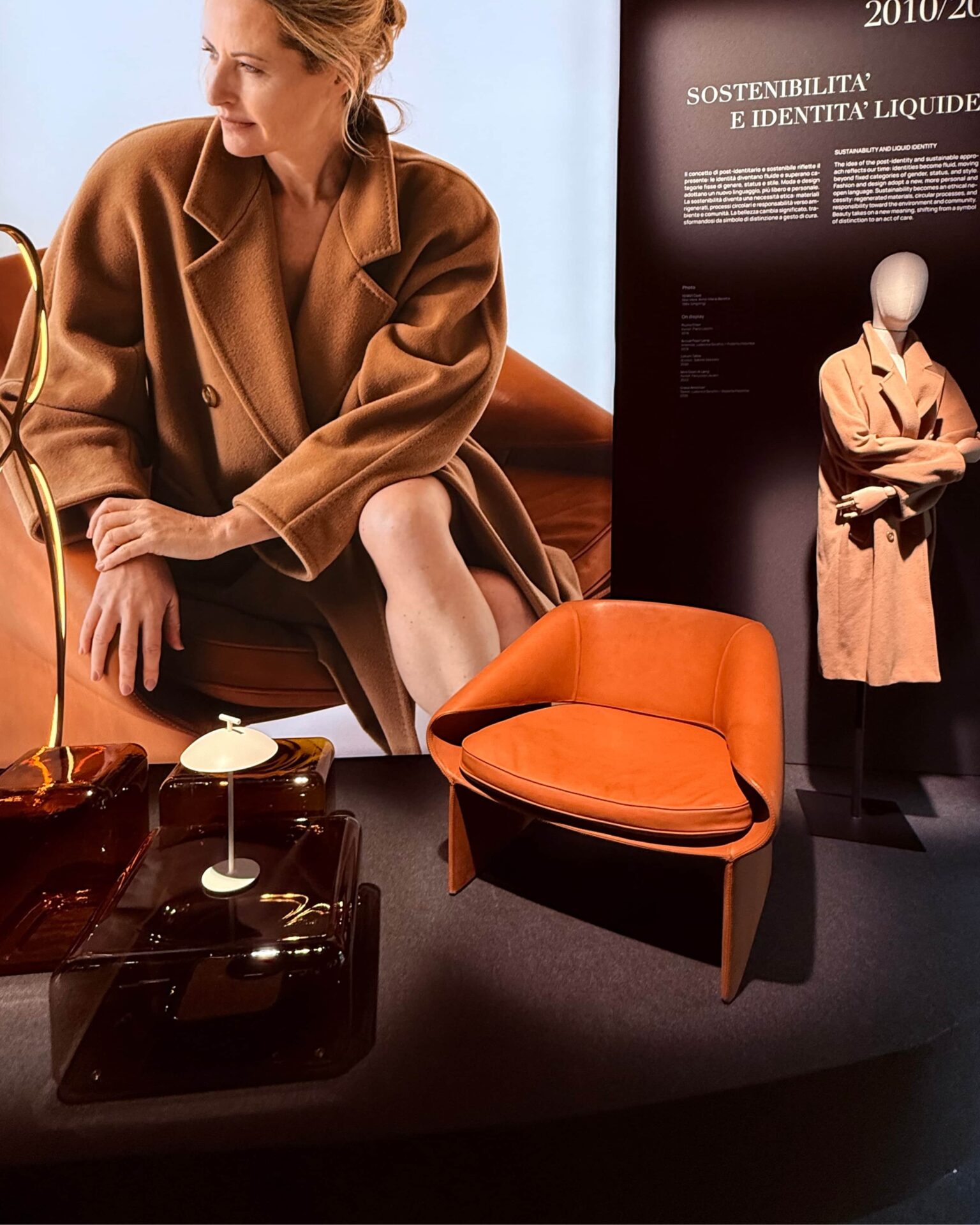
One of the most quietly powerful exhibitions at the fair was ABITO, tucked into a separate pavilion, easy to miss, impossible to forget once found. The title means both “to wear” and “to inhabit,” and the exhibition held both meanings simultaneously: a history of female liberation told through the relationship between fashion and furniture, between the body and the space it occupies. That double meaning did a lot of work.


This year the fair introduced two initiatives that signal where the industry is heading. Salone Raritas, curated by Annalisa Rosso and designed by Formafantasma, made its debut as the fair’s first dedicated platform for collectible design. Limited editions, antiques, high-end craftsmanship, and one-of-a-kind pieces from galleries and makers across geographies, periods, and disciplines. It responds to a clear shift in how the most ambitious residential and hospitality projects (think Raffles-level commissions) are now being conceived. Not around standard product ranges, but around rare objects that carry cultural meaning and assert a distinct identity. Statement pieces as strategy, not decoration.
The second announcement was Salone Contract, led by Rem Koolhaas and David Gianotten of OMA, with a full exhibition planned for 2027. Koolhaas’ lecture, which opened with Rockefeller Center as a masterclass in the genius of collaboration between design, architecture, and client, made the case that the most significant value in design today is created not through individual products but through integrated systems and long-term project thinking. The room was standing. The industry is paying attention.
Also impossible to miss was Aurea, an Architectural Fiction and immersive scenography conceived by Paris-based designer Oscar Lucien Ono of Maison Numéro 20. Not a hotel in any functional sense, but a choreography of rooms and atmospheres, each one the projection of a different dream: the Hall of Dreams, the Velvet Salon, and the Midnight Bar. What made it more than spectacle was its material logic: furniture produced from ocean-recovered plastic, combined with precious materials and master craftsmanship. The argument was direct, luxury is not about consumption, it’s about conscious beauty. That a piece of recycled plastic can become something of genuine refinement is precisely the kind of provocation the Salone does well. One left wanting to check in immediately.


SaloneSatellite is always the most hopeful part of the week for me. Over 700 designers under 35, from 37 countries, filling two pavilions with work that is free of commercial pressure and full of genuine conviction, a playground of ideas at the point before the market gets involved. I always walk those stands with the slightly guilty feeling of a talent scout who arrived too late to the party. This year’s theme was “Skilled Craftsmanship and Innovation”, and the award ceremony, chaired as always by Paola Antonelli of MoMA, delivered on its promise. The first prize went to Russo Betak from Denmark for NIPPON, a pendant lamp from the Ark collection, 3D printed from seashells and then sculpted by hand. Material experimentation translated into something luminous and refined. Watching young designers receive recognition for work that began as pure curiosity reminded me of what Marva Griffin has always understood: that the ideas never stop. Another perpetual moment. The invention of the human mind, renewing itself, edition after edition.
I needed to see the industry with fresh eyes. What I did not expect was to see it through emotional ones.
In the City
The Fuorisalone belongs to a different rhythm, more personal, more scattered, and more surprising. Also more dangerous for the feet.
The week began with Jaeger-LeCoultre’s Atmos exhibition, the perpetual timepiece designed in collaboration with Marc Newson. A quiet reminder that some ambitions outlast their creators. The perpetuum mobile, mankind’s oldest engineering fantasy, alive and ticking inside a glass case. The question it poses has never been fully answered: what is the source of energy that endlessly renews itself? After a week in Milan, I had my answer. The fuel for perpetual movement is us, the human impulse to create, invent, and begin again.
Two days later, a young creative pressed a travel notebook into my hands at the Gucci Memoria installation. I had just stumbled into a group of stylish Singaporeans positioned photogenically in front of the Gucci garden, two of whom turned out to work for our teams at Buro. Malaysia and Robb Report. The design world, it turns out, is a village. A very well-dressed village. When he asked me to write something that would commemorate the moment, I thought of Horace: carpe diem, quam minimum credula postero —seize the day, trust as little as possible in tomorrow. A clock that runs forever and a moment that does not repeat itself. Milan has a way of reminding us what really counts.


Palazzo Litta in Corso Magenta was one of those stops that earns its queue. Lebanese-born, Paris-based architect Lina Ghotmeh had transformed the palace’s grand Baroque courtyard, the Cortile d’Onore, into Metamorphosis in Motion, an immersive pink labyrinth of curved geometries and shifting pathways that pressed against the symmetry of the 17th-century façade without touching it. Hot pink against Baroque stone. Warmth against grandeur. Ghotmeh described it as architecture that “evolves from a threshold to a common good”, a space completed not by its form but by the people moving through it. In a week defined by visual overload, it was one of the few places that made you slow down.

On the staircase leading up to the furniture exhibition, there was another kind of invitation, an interactive installation asking visitors to leave a message. I stopped. In a week of 27,000 steps and a thousand impressions, it was the moment that asked for something personal. I left one for Vogue and one for Beyond the Boardroom, my two big work loves. I have the photo to prove it, and no, I will not be sharing what I wrote.
The Uzbekistan pavilion, “When Apricots Blossom” brought a yurt into a palazzo courtyard and bread stamps presented like jewelry. It was also a quiet document of the Aral Sea’s disappearance, of climate catastrophe made legible through craft. This is what design can do that a policy paper cannot.


At Palazzo Serbelloni, Louis Vuitton staged one of the week’s most considered presentations: a retrospective of Pierre-Émile Legrain, the Art Deco designer who created the house’s first piece of furniture for Gaston Louis Vuitton in the 1920s. The courtyard, painted by students from the Brera Academy, functioned as a living archive. Archive as aspiration, not nostalgia. The queue to get in, I should add, was an act of devotion.
Singapore was present too, and visibly proud. Prototype Island—curated by my good friend Hunn Wai of Lanzavecchia and Wai—brought 15 designers to Foro Buonaparte 54 in the Brera Design District, addressing care, technology, and the future of urban living. The exhibition received a Special Mention at the Fuorisalone Award, recognised for embodying the theme Essere Progetto, “Be the Project”. Seeing young Singapore talent recognised on this stage matters. The mission is clear, the execution rigorous, and the ambition is growing.
The dinner arranged by W Atelier from Singapore, held at a small fish restaurant near the main station, was the social evening of the week. I will confess: arriving as someone associated with Vogue, I could feel the host’s anxiety about expectations. It lasted exactly as long as it took to open the first bottle of wine, which turned out to be extraordinary. The host’s knowledge was the kind that makes you feel educated without feeling lectured. Then a fish baked in salt crust arrived at the table and was set on fire not dramatically, but very excitingly. And so was the audience. What followed was a dancing challenge. The music shifted to Dancing Queen and other reliably excellent selections, and within minutes other guests in the restaurant were on their feet, waving napkins, singing along. Ten top Singaporean designers, strangers to me at the start of the evening, now orbiting a dinner table that had become, without ceremony, the most important piece of furniture in the room.
The dinner table. So obvious. So underrated. As a case study in La Dolce Vita and what design actually does for human connection, I could not have scripted it better. Miranda Priestly would not have approved. That is exactly the point.
And then, threading through all of it. The Devil Wears Prada 2. Andy and Miranda, everywhere. On the T-shirts at La Rinascente. In the perpetual loop of the Vogue song, which followed me on my way to and from the metro like a faithful and slightly exhausting companion. “Suddenly I see what I wanna be.” The song from a sequel promoting a film about fashion and power, playing on loop at the world’s most important design fair, during a week when fashion houses have taken over half the city. The line between the industries is not blurring. It has already dissolved.
Next time, I am bringing my team. We divide and conquer. One pair of feet is not enough, and the fish only catches fire once.
Five Things to Take Home from Milan 2026:
1. When the world turns chaotic, design turns inward. Round shapes, deep sofas, no edges, no hard corners. Cocooning is not a trend. It’s a response.
2. Design is not decoration. It shapes your daily life, your mood, and your sense of safety. That argument is getting louder, and it deserves to be.
3. Fashion once dressed the body. Now it dresses life. The boundary between the two industries has dissolved, and the best collaborations are the ones with genuine roots.
4. When the future feels unreadable, the past becomes the most reliable source. Archives are not nostalgia, they are infrastructure. Every major house that stood out that week understood this.
5. The industry is rethinking itself from the ground up, from products to projects, from transactions to systems. Salone Contract, led by Rem Koolhaas and OMA, is the clearest signal yet of where the serious money and the serious ideas are heading.
Welcome to Off the Record, your new pass into the margins of luxury leadership. Each fortnight, Bettina von Schlippe, Co-founder of Beyond the Boardroom and Publisher-at-Large at Vogue Singapore, distills what’s shaping the region’s luxury landscape, from closed-door perspectives, to unfiltered insights, and the quiet shifts that haven’t made the headlines just yet.