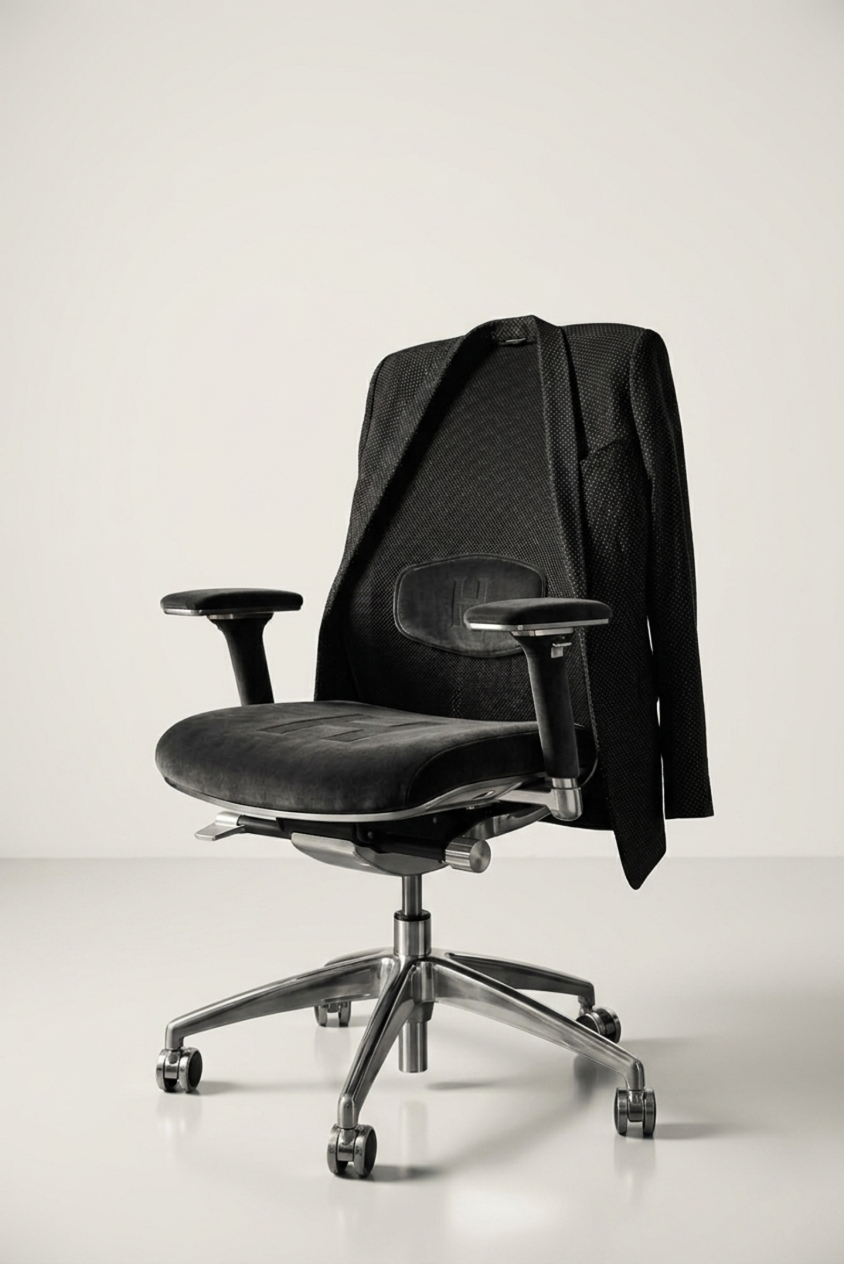
As women continue to leave an undeniable mark on business, culture and leadership, the challenge is no longer whether they deserve a seat at the table. At a recent HER MARK event in partnership with Beyond the Boardroom, the conversation turned to something more complicated: why so many accomplished women still struggle to fully believe they belong there, and what it really takes to step forward, be seen and take their place.
I stepped out of the elevator and felt it before I saw it.
Forty women in a room generate a frequency all their own, warm, high-energy and slightly conspiratorial, immediately distinguishable from any other professional gathering. The room was buzzing. Then I spotted the a gentleman who had joined us, standing with the particular composure of someone who had assessed the situation and decided to commit fully. Brave heart, I thought, with genuine admiration. It occurred to me (not for the first time), that I live this contrast every day. I have two desks. One I share with my board members: two gentlemen, excellent company, but the register firmly professional. The other places me in the middle of what I can only describe as sisterhood central. The marketing department where we integrated our start-up, and where the energy on any given morning resembles less a corporate function and more a highly organised force of nature. The distance between those two desks is not great in physical terms. In atmospheric terms, it is vast.
Which made the theme of the morning—from leadership to leadershift—feel less like a conference topic and more like a lived reality.
The photographs sprawled across the room were the first signal. They were part of “HER MARK”, a photography and advocacy initiative founded by some of the marketing and communications industry’s most vocal voices, Anna Shatilova, Naomi Michael, Severine Vauleon, Gerri Hamill and Hinoti Joshi. Together, they set out to celebrate the women shaping the marcomms industry by doing something deceptively simple: placing them in front of the camera, on their own terms, as the subject rather than the supporting cast. The first HER MARK series features 20 women from across the industry, with each woman’s story and portrait set to be released weekly. The photographs themselves are shot by Shatilova, whose work has long centered on telling women’s stories with greater depth, nuance and visibility. There is also an open call for nominations, allowing the industry to put forward women they believe deserve to be seen, recognised and featured.
The women in those frames had spent entire careers making other people’s stories land. For many, it was the first time anyone had pointed a lens at them with the express intention of saying: this one is yours.
In partnership with Beyond the Boardroom for its soft launch, the morning was organised around a central theme “From Leadership to Leadershift.” The external pressures framing the conversation were familiar to anyone working in the industry right now. A workforce that increasingly values purpose over hierarchy, AI reshaping creative and operational processes faster than most organisations can adapt, and a growing sense that the leadership playbook written a decade ago is no longer entirely fit for purpose. These are real pressures. But as the morning unfolded, they proved not to be the most interesting tensions in the room.

The more interesting pressure was the internal one. McKinsey, Bain and Harvard Business Review research—shared during the briefing—describes what might be called the invisible tax that high-performing women pay regardless of seniority. Women are 50% less likely than men to apply for a role unless they meet 100% of the stated criteria, while men apply at 60%. Nearly two thirds of high-potential women seek expanded responsibility only after receiving external validation, compared with men who more typically create the conditions for that validation themselves. And a striking 20% of women are more likely to attribute their professional success to luck or hard work rather than innate ability or leadership skill.

Let that last point sit for a moment. Luck. These are not junior employees finding their feet. They are senior, accomplished women who have navigated complex organisations, led large teams and delivered results for major brands. Yet a significant proportion still file their own success under “good fortune” rather than judgment, capability or earned expertise. It is, in the driest possible sense, quite an achievement.
The truth is, as women, we often do not lack capability. We lack permission, and most of the time, we are the ones withholding it from ourselves.
This is precisely what made the HER MARK photographs such a pointed backdrop to the conversation. Each woman in those frames had, at some point, agreed to be seen fully, intentionally and without apology. That may sound like a small thing. It is not. For women who have spent entire careers maximising other people’s visibility, being asked to occupy the centre of the frame themselves requires a muscle that, in many cases, has been quietly atrophying for years. The photograph is not vanity, it’s practice.
The panel discussion that followed, featuring Rahat Kapur, Editorial Director of Beyond the Boardroom, alongside Valerie Madon, former Chief Creative Officer at McCann WorldGroup APAC, Amrita Randhawa, Chief Executive Officer of Publicis Groupe Singapore and Southeast Asia, and Kylene Campos, Senior Vice President for Brand and Growth Strategy for Tapestry Asia, made the argument tangible. The conversation circled around self-doubt, the specific exhaustion of performing competence while privately questioning it, and the challenge of stepping forward to be seen when so much professional conditioning has been built around stepping back. What emerged, consistently, was that the shift—the leadershift—does not begin with a structural change inside the organisation, but with a change in perspective.
Your own.
Imposter syndrome doesn’t simply disappear with seniority. It evolves, it becomes more sophisticated, more deeply internalised, and far harder to name.
The moment that stayed with me came after the formal programme had ended. Three women approached separately, senior, polished, and the sort of people who appear entirely composed. Each said, with varying degrees of surprise at themselves, that the McKinsey statistics had described them exactly. Not their junior colleagues. Not women earlier in their careers. Them. Now. Still.
This is the part leadership literature still tends to underestimate. Imposter syndrome doesn’t simply disappear with seniority. It evolves, it becomes more sophisticated, more deeply internalised, and far harder to name. Which means helping women overcome it requires more than telling them to be more confident. It means shifting perspectives. Moving from managing to inspiring. From directing to enabling. Combining strategic thinking with self-awareness. Building confidence that is rooted not in performance, but in identity, clarity and a stronger understanding of one’s own value.
A “leadershift” is not something that can simply be taught in theory. It has to be practised, embodied and reinforced over time. That embodiment extends beyond how women speak, lead or make decisions. It also shapes how they present themselves to the world. In an industry like fashion, there is a growing recognition that appearance is not merely a vanity tool. What women wear, and how they choose to present themselves, can influence confidence, presence and the way they are read in a room. Used thoughtfully, it becomes part of the wider toolkit women need not just to succeed, but to thrive.
What is clear, however, is just how much of a mark women continue to leave: on businesses, on culture, on the people around them and on the industries they help shape. The issue is no longer whether women deserve a seat at the table. The challenge is no longer hesitating to pull out the chair and take their rightful place.
Until next time, stay off the record.
Welcome to Off the Record, your new pass into the margins of luxury leadership. Each fortnight, Bettina von Schlippe, Co-founder of Beyond the Boardroom and Publisher-at-Large at Vogue Singapore, distills what’s shaping the region’s luxury landscape, from closed-door perspectives, to unfiltered insights, and the quiet shifts that haven’t made the headlines just yet.