With 82% of luxury’s heaviest spenders already turning to AI when they shop, the race to be recommended is on. Cisco’s Elena Lukyanenko explores how AI is reshaping the mechanics of discovery, why decades of brand power no longer guarantee visibility, and what luxury needs to do now to make sure it doesn’t disappear from the answer.
A client tells an AI assistant she needs “something quiet for a first meeting with new investors” and gets a shortlist back before she’s even opened a single brand’s website. Now imagine that happening thousands of times a day. Most marketing departments are only beginning to reckon with what that means.
The latest luxury and technology report from Bain & Company and Comité Colbert found that 82% of very heavy spenders used AI for their most recent purchase, compared with 28% in the lowest-spending segment. Nearly half of in-store luxury buyers had already consulted AI before setting foot in a boutique. 70% of prompts begin without a brand name, just an occasion, a budget or a feeling. “The clients have moved faster than the maisons”, said Joëlle de Montgolfier, Executive Vice President, Global Retail and Luxury at Bain & Co., in comments to WWD.
People are making choices earlier, often inside an AI assistant before they ever reach a brand’s own site. McKinsey’s research describes this as the retail “front door” moving upstream, part of a shift it estimates could mediate $3 trillion to $5 trillion of global consumer commerce by 2030.
For marketers, this shift makes generative engine optimisation (GEO) a necessary complement to search engine optimisation (SEO). Discovery strategy is no longer only about page rankings; it’s about earning a place in AI-generated answers. Brand marketing becomes a core driver of visibility, which now depends on brands being clear, authoritative and consistently referenced across the web.
As Haute Living’s Founder and CEO, Kamal Hotchandani puts it, “the new front row is the answer a machine returns when a buyer asks.”
Bain found that 90% of the sources large language models (LLMs) cite for luxury queries sit outside brands’ own websites, drawing on customer reviews, editorial content, blogs and resale platforms. The large maisons with revenues above $5.8 billion (€5 billion) often fail to capture visibility in line with their market share. Smaller, sharper-positioned rivals outperform theirs by three to eight times. Bain’s Nathalie Remy put this bluntly as “being big, powerful, and wealthy is no longer enough” to guarantee visibility.
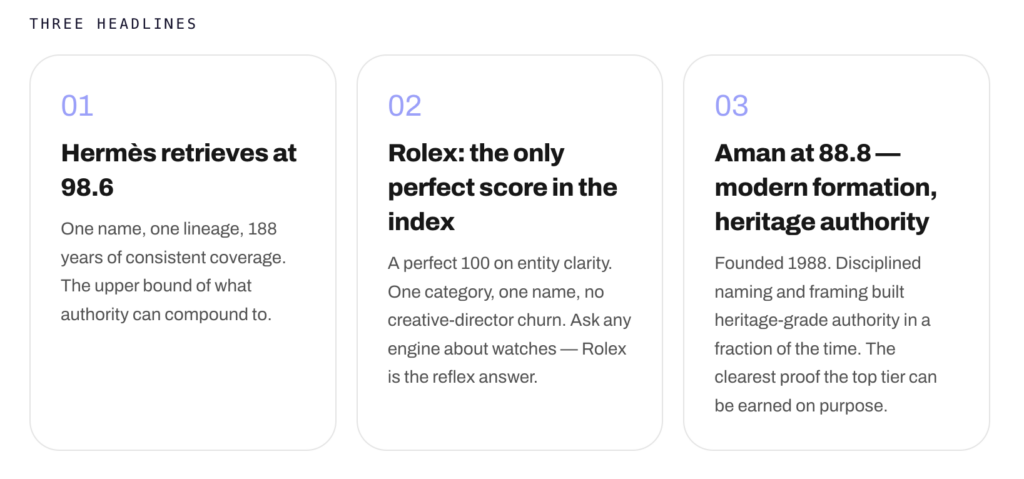
The AI Luxury 25, an AI visibility index from 5W and Haute Living, illustrates the same pattern more precisely, brand by brand. The index scores 25 luxury maisons across ChatGPT, Claude, Gemini, Perplexity and Google AI Overviews on five dimensions: archival depth, citation density, entity clarity, editorial consistency and retrieval stability.
Hermès tops the index with a composite score of 98.6, described as “one unbroken narrative”, while Rolex is the only brand to score a perfect 100 on entity clarity, with the report crediting its “no creative-director churn” for that result. Gucci, by contrast, scores far lower on editorial consistency despite its deep archive and broad citation footprint. The report argues that frequent creative-director changes can leave AI with mixed signals about a brand’s identity.
That is awkward for an industry that has often used creative change to generate headlines and signal renewal. The same churn that once helped manufacture momentum is now becoming a measurable liability in a search environment shaped by AI. As Haute Living’s Counder and CEO, Kamal Hotchandani puts it, “the new front row is the answer a machine returns when a buyer asks.”
A different kind of audit complicates that picture further. FutureFox Labs ran a 57-check AI readiness assessment against the homepages of 20 luxury maisons and found their own websites badly prepared for machine interpretation. The cohort averaged just 53.9 out of 100, and no maison reached the top AI Optimised tier. The report has made a point that even strong names can still underperform on their own sites: Louis Vuitton, Hermès, Chanel and Rolex all sit in the AI Invisible tier. The sector’s central weakness is entity readiness, with schema, metadata and homepage structure often falling short of what AI systems need to read a brand correctly. AI visibility and website legibility are two different tests. The biggest names are winning one while still underperforming on the other.
The harder problem is how a brand stays visible without losing its exclusivity. McKinsey’s research suggests a simple rule: be easy to find, but keep control of the story. Only 9% of luxury consumers want AI to act autonomously, while most prefer it to assist, curate or operate within visible guardrails, with transparency about the agent’s role, data privacy and reliability mattering most. That gives luxury brands a clear brief. Make the brand easy for AI to recognise through structured product information, provenance data and service details, but keep scarcity, tone and access under control. Exclusivity survives visibility when the brand controls the proof, the language and the level of access.
Interbrand’s 2025 Best Global Brands study puts a number on those stakes. Brand strength is one of only two variables it finds directly correlated with share price, and a 1% gain in what it calls “role of brand” (the share of a purchase driven by the brand itself, not price) delivers an average 2.3% share price increase. Hermès, the same house leading the AI citation rankings above, was also 2025’s best-performing hard-luxury name in Interbrand’s ranking, with brand value up 18% to $40.9 billion. The Aura Blockchain Consortium, established by LVMH, OTB Group, Prada Group and Cartier, part of Richemont, is betting that verified provenance can do for trust what a shop window once did for desire.
Five years out, McKinsey expects agents to handle about 39% of luxury purchases, based on consumers’ own estimates, and up to 47% according to merchants’. The store will matter less as a place to discover the brand and more as a place to confirm the choice, with people still there to check fit, feel and reassurance. Fashion will probably still be changing creative directors by 2031, but that will no longer be the easiest way to get attention. What will matter is whether a brand knows what AI says about it, makes sure its own site backs that up, and stays consistent wherever people encounter it. Reinvention is a tool. Consistency is the strategy.
Elena Lukyanenko is Head of Sales for Cisco ThousandEyes across Asia Pacific, Greater China and Japan, with two decades leading growth through cloud, AI, and infrastructure shifts at Microsoft, Broadcom, and VMware. She is also the Founder of The Graceful Edge, a publication on leadership and human performance in the AI era. She writes on where AI, business, and culture intersect.
