Welcome back to fortnightly roundup of the most important innovation stories from the luxury world. AI has become a boardroom priority for luxury houses, China is preparing to test one of the world’s first robot-operated hotels, and Sotheby’s is already looking at AI-generated wealth as the next force that could reshape the art market. Meanwhile, Saudi Arabia is emerging as a model for female-led technological transformation, and Geneva is calling for innovations in luxury that deliver “proof over promise”.
1. AI emerges as a strategic priority for luxury: Bain & Company and Comité Colbert
The clearest data point of the fortnight came from a spreadsheet. The latest Luxury and Technology report from Bain & Company and the Comité Colbert reveals how dramatically attitudes have shifted. Just two years ago, only 5% of luxury executives ranked AI among their top three corporate priorities. Today that figure stands at 22%, with 61% placing it in their top ten.
Consumers are driving the change. Nearly half of in-store shoppers (47%) now use AI before visiting a boutique, and 97% say they’d do so again for their next luxury purchase. Yet adoption remains concentrated behind the scenes. Large-scale deployment in back-office functions has jumped from 6% to 31% since 2024, while customer-facing applications have edged up only from 16% to 21%.
A first-of-its-kind analysis conducted with meikai.ai as part of the report points to a new competitive battleground and a new challenges. As chatbots and AI search tools become a genuine discovery layer for luxury shoppers, the fight is shifting from search-engine rankings to how a brand gets surfaced when someone asks an LLM for a recommendation. Around 70% of luxury-related AI prompts don’t mention a specific brand, and 90% of the URLs cited by LLMs originate from sites outside the brands themselves. Many of the biggest luxury names underperform in AI search visibility, while smaller houses punch disproportionately above their weight. Multi-category luxury groups appear structurally disadvantaged relative to specialized, single-category competitors, a wrinkle conglomerates will need to reckon with as AI becomes a discovery channel in its own right.
2. China Prepares to Open a Hotel of Tomorrow Almost Nobody Will Staff
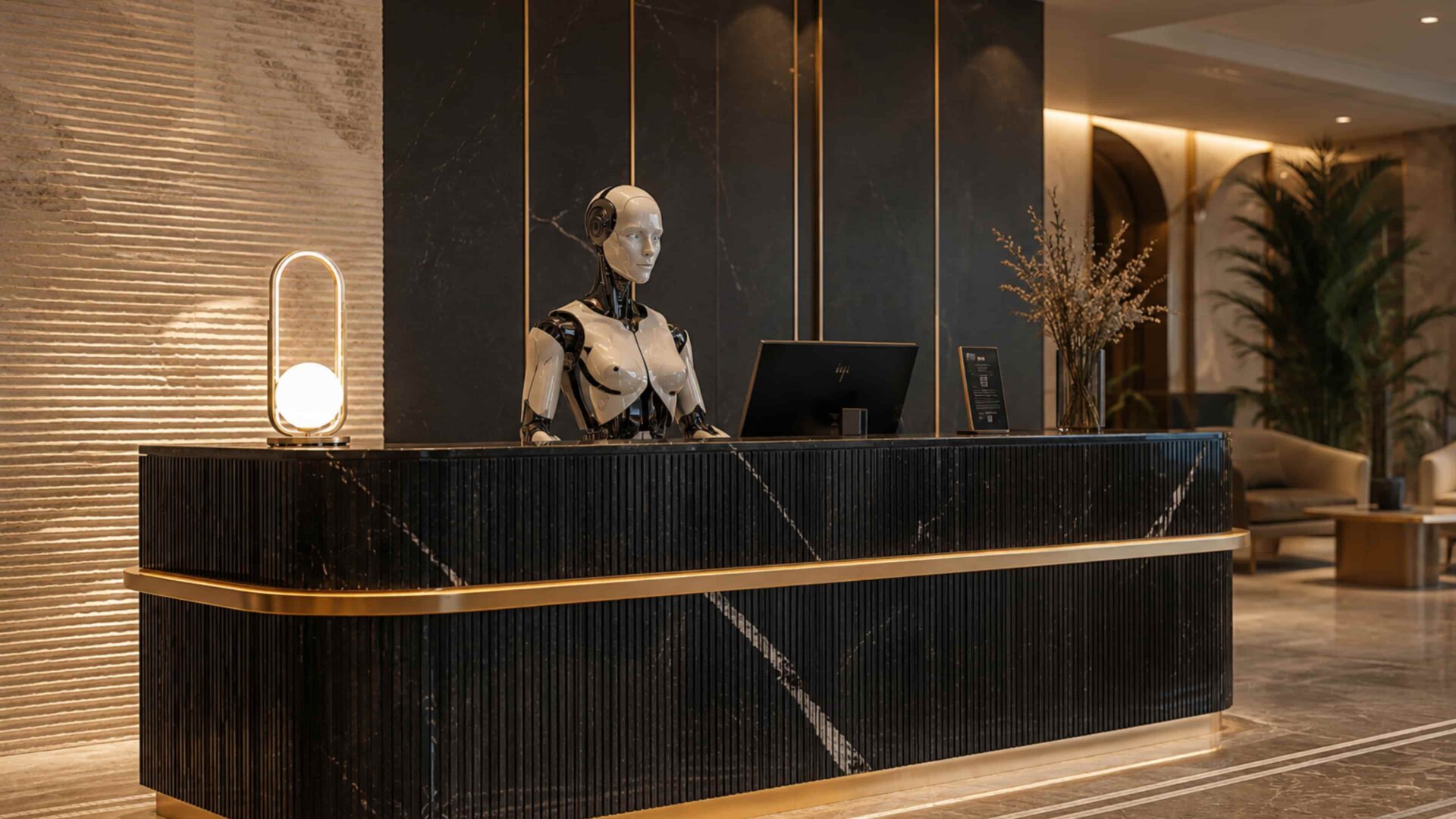
Chinese robotics company Pudu Robotics and Shenzhen Culture and Tourism Industry Development Co. Ltd have announced what they’re billing as the world’s first hotel run end-to-end by robots. It’s a 44-room property on West Artificial Island, part of the Shenzhen–Zhongshan Link, one of the more ambitious infrastructure projects underway in the Guangdong–Hong Kong–Macao Greater Bay Area.
Every layer of the guest experience—from reception and room service to luggage handling, housekeeping, and even food preparation—runs on a single shared “embodied intelligence” platform. So that a check-in robot, a 300-kilogram luggage-hauler, and a cleaning unit are all, in effect, speaking the same language. “This partnership represents an important step toward large-scale deployment of embodied intelligence in premium hospitality environments,” said Pudu co-founder and CTO Cong Guo. Tthe project as a real-world test of whether AI and robotics can coordinate a full-service stay without a human orchestrating it behind the scenes.
Until now, AI has transformed hospitality through quieter, less glamorous applications, dynamic pricing, staff scheduling, and predictive maintenance. The guest-facing robot experiments of the past decade (IBM and Hilton’s Watson-powered concierge “Connie” among them) charmed reporters but received mixed reception from actual guests. Pudu’s bet is that a fully integrated system, rather than a single robot standing in for a person, is what separates a novelty from an operating model. A trial run is scheduled to begin by the end of 2026, opening select rooms and robot-powered services to the public.
3. Sotheby’s Auctioneer: AI Wealth Could Reshape the Art Market
Sotheby’s London evening sale brought in a record US$520.7 million (£393.4 million), marking what the auction house described as the highest total ever achieved in a single night at auction in Europe. The milestone comes as Sotheby’s predicts a new generation of AI-created wealth will reshape the auction market, with executives telling the Telegraph that tomorrow’s bidders may look very different from today’s.
Aristocrats gave way to industrialists, who were followed by entrepreneurs and hedge fund managers. Now, Sotheby’s Europe Chairman Oliver Barker believes AI could produce the art market’s next generation of major collectors. Having watched successive waves of new wealth reshape the auction room, from hedge funds to cryptocurrency, Barker argues that AI-created fortunes may soon follow. Speaking to the Telegraph, Barker recalled a lunch where someone observed that “if you’re employee number 250 at Anthropic, you’re probably a multi-multimillionaire,” prompting a broader question: will this new class of AI-made millionaires simply have the means to buy art, or will they develop the knowledge and desire to collect it? For Barker, the future of the market depends on cultivating taste and long-term engagement, not merely attracting new capital.
4. Saudi Arabia’s Female-Led Tech Boom
Saudi Arabia’s technology sector is increasingly being shaped by women, who are taking on leadership roles across AI, cybersecurity, digital government, telecommunications and venture capital. Backed by the Kingdom’s Vision 2030 strategy, female executives, founders and researchers are helping drive digital transformation, with figures such as Deemah AlYahya, Secretary-General of the Digital Cooperation Organization; Mona Almehaid, Vice President at Humain, the AI company backed by the Public Investment Fund (PIF); and Moudhi Al Jamea, Vice President of STC Group and head of the company’s innovation centre. And then there’s Her Royal Highness Princess Maha Al Saud, a senior manager of emerging technology at one of the country’s giga-projects.
Women now account for 35% of Saudi Arabia’s technology workforce (well above many global markets) while the country has become a regional hub for digital talent. Universities, government-backed programs and organisations including the Saudi Data and Artificial Intelligence Authority (SDAIA) and the Misk Foundation are expanding the pipeline of female talent in AI and emerging technologies. Industry leaders argue that Saudi Arabia’s next challenge is moving beyond representation toward long-term leadership.
5. Luxury Innovation Summit Geneva Opens Applications Under the Theme “Proof Over Promise”
The Luxury Innovation Summit Geneva 2026 has opened applications for its 2026 Luxury Innovation Awards, inviting startups and emerging brands developing solutions across AI, sustainability, craftsmanship, customer experience and digital transformation. Finalists will pitch live before a jury of luxury executives during the summit in Geneva on 1–2 October.
This year’s edition is built around the theme “Proof Over Promise: The New Luxury Playbook” signaling a broader shift in luxury from experimentation to technologies and business models that deliver measurable commercial impact. Organised by Maison LVG, the summit has become one of the industry’s key forums for exploring how innovation is reshaping the future of luxury.
Innovation Digest is BTB’s fortnightly briefing on the innovations shaping luxury’s next chapter, from emerging technologies to new business strategies.