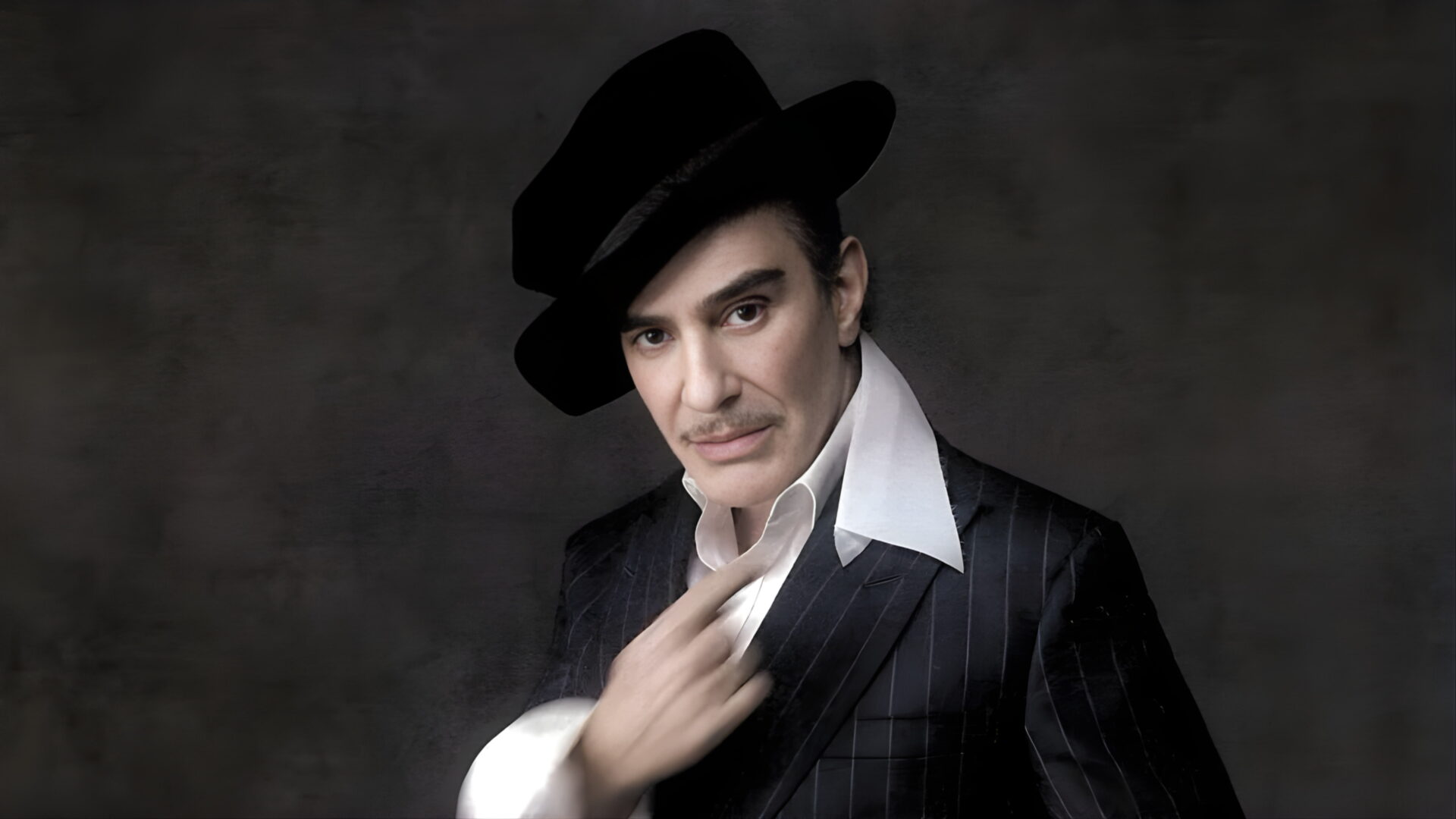
Last week’s announcement that John Galliano would take a two-year creative residency at Zara has prompted one of the more searching debates the fashion industry has had in some time. The question is not simply why two such different worlds would converge, it’s what the union reveals about the state of fashion, and whether the industry is in the middle of a creative renaissance or something closer to a structural reckoning.
In January this year, John Galliano—couturier, cautionary tale, and perhaps fashion’s most compelling second act—returned to the Dior couture show under Jonathan Anderson, taking his place front row for the first time since his now-infamous dismissal in 2011. He arrived with a simple offering: a small posy of cyclamen, bound with black silk ribbon. Anderson would later cite the flowers as the primary inspiration for a collection that quite literally bloomed from the ceiling of the Musée Rodin, interpreting the gesture as something close to a baton pass.
The moment carried a distinct charge. Galliano was swiftly encircled, greeted, embraced, and closely observed, the kind of reception reserved for figures whose absence has only deepened their mythology. For months, the industry had been circling a single question: what comes next? Following his departure from Maison Margiela in 2024, the possibilities felt deliberately open-ended. A retrospective at the Costume Institute? A return to his namesake label, still held within LVMH? Something commensurate, at least, with both the scale of his reputation and the weight of everything that had passed?
What came next on 17 March 2026, was Zara.
More precisely, a two-year structural creative residency with one of the world’s largest commercial retail groups in an arrangement that at first glance, reads as a quiet provocation. Galliano will work directly with Zara’s archive, combing through 50 years of past-season inventory and accumulated excess reconsidered through a couturier’s eye. The output will be a genderless and seasonless collections beginning in September. No trend brief. No capsule logic. Instead, a process he has described with characteristic precision as “re-authoring.”
The internet arrived first, as it always does. Memes of Galliano rifling through fast-fashion detritus surfaced within hours; thinkpieces followed with equal speed (the irony of ours is not lost, don’t worry). But as the noise begins to recede, a more substantive question comes into view. Because on the surface, this is familiar territory. The high-low collaboration is not new; it has a 20-year history, a well-worn playbook, and a graveyard of collections that sold out in minutes only to be forgotten by the following season. So, the question is not whether this is any more exciting, but why it feels so different, and what it reveals about fashion’s current state of play that is maybe more significant than the partnership itself.
The Lagerfeld Playbook
It began (as so many things in fashion do) with Karl Lagerfeld. In November 2004, the then-creative director of Chanel launched a collection with H&M. Stores in Manhattan sold between 1,500 and 2,000 pieces an hour. The range was gone globally within a day. “This was supposed to last two weeks, and it’s over in 25 minutes,” Lagerfeld said at the time. “I’m sorry for the clients because I like the idea that everyone could wear Lagerfeld.” He set the template for the next two decades: marquee name, high street platform, frenzy, sell-out, then a return to business as usual. However, the hierarchy crucially remained intact. Prestige still flowed in one direction only.
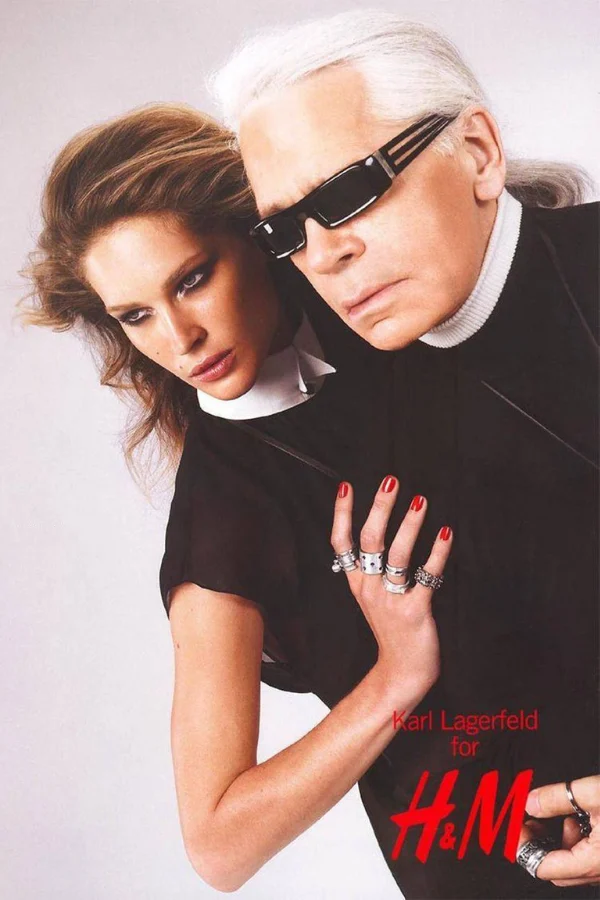
What followed was a procession that reads like a roll call of fashion’s establishment: Stella McCartney, Comme des Garçons, Versace (whose 2011 collection crashed H&M’s website and whose garment bags were reselling on eBay for hundreds of dollars within hours), Balmain, Kenzo, Moschino and more regionally, Sabyasachi x H&M. Each arrival was an event. Each departure left both brands exactly as they were. The logic was immovable: luxury lent its name, the high street provided distribution, and consumers received a brief, managed encounter with something otherwise out of reach. Nobody’s position changed, the game continued.
The paradigm has shifted. Brands like UNIQLO, Topshop, and increasingly Zara are no longer just democratising fashion, they’re engaging in the construction of cultural capital. Collaborations are less about access alone and more about storytelling, authorship, and positioning within a broader cultural ecosystem.
By the mid-2010s, something shifted. Consumer fatigue was setting in, the queues shorter, the cultural moment briefer with each iteration. A younger generation of shoppers was asking questions the collaboration format was structurally ill-equipped to answer about sustainability, the ethics of fast production cycles, and whether the thrill of a ‘designer’ piece at high street prices was worth its true cost. The model hadn’t quite run its creative course, but it had begun a values shift that no amount of marquee names could resolve. And yet it continued, because even a diminished version of the business case still held. By the early 2020s, a designer collaboration announcement generated a fraction of the cultural energy it once had. The model had become infrastructure rather than event, background noise in an industry that had moved on without quite acknowledging it.
The Transparency Reckoning
Consider the numbers. Luxury prices have risen by an average of 54% since 2019. A Chanel handbag that retailed for around US$3,000 that year now commands nearly US$10,000, not because the materials or craftsmanship have changed proportionally, but because scarcity and exclusivity have been repositioned as the product itself. For the aspirational consumer, the demographic that sustained the industry’s growth for two decades and filled the department stores that luxury brands now barely bother with, the door has been firmly and perhaps permanently, closed.
The industry decided it no longer needed them, but it failed to anticipate what they would do next.
They turned to the internet. Take Volkan Yilmaz—better known as “Tanner Leatherstein”—who has built a cult following by cutting open luxury bags and assigning a visible cost to their construction. His “Is It Worth It?” series dismantles the opacity brands have long relied on. In 2025, a viral clip of a Chinese factory owner allegedly revealing the production cost of a Hermès Birkin, said to be a fraction of its US$30,000 retail price, sparked global scrutiny no brand narrative could contain. What links these moments is access. The democratisation of information is eroding luxury’s control over what consumers know, collapsing the distance between cost and price, story and reality. As that gap narrows, mystique weakens, and aspiration shifts from blind reverence to informed judgement. Luxury doesn’t disappear, but it is forced to justify itself in ways it never had to before.
Then there’s what the market itself is saying. When Shein—roundly dismissed by the fashion establishment, mocked in group chats, and often treated as the industry’s inconvenient embarrassment—announced a strategic partnership with the Singapore Fashion Council in 2025, the cognoscenti largely looked away. They shouldn’t have. Whatever the rhetoric online, the wallet tells a different story. With the brand eyeing a nearly US$2.6 billion profit in 2025, an entire generation of consumers priced out of aspirational luxury and increasingly skeptical of its value claims, has been voting with their spending. Cultural authority, as it turns out, is not protected by price point. The keyboard may object, but the checkout page disagrees.
“Early collaborations, such as Karl Lagerfeld, Versace, and Balmain with H&M, operated within a logic of democratisation. They brought luxury aesthetics to the mass market, allowing consumers access to designers who were otherwise financially or culturally out of reach. These partnerships were largely product-driven and centred on accessibility, novelty, and scale,” explains Circe Henestrosa, Head of the School of Fashion at LASALLE College of the Arts, University of the Arts Singapore to Beyond the Boardroom.
“Today, however, the paradigm has shifted. Brands like UNIQLO, Topshop, and increasingly Zara are no longer just democratising fashion, they’re engaging in the construction of cultural capital. Collaborations are less about access alone and more about storytelling, authorship, and positioning within a broader cultural ecosystem,” she adds.
From Democratisation to Cultural Orchestration
For all its novelty in the week’s news cycle, Galliano is neither the first in this newfound era of cultural migration and doubtfully, the last. However, the context is essential. Former Givenchy maverick Clare Waight Keller is now Creative Director at UNIQLO. Zac Posen, once the boy wonder of New York Fashion Week, has taken the creative lead at Gap. Jonathan Saunders is Chief Creative Officer at & Other Stories. Taken individually, each might read as a personal career pivot. Taken together, they constitute something more considered: a quiet exodus of serious creative talent toward platforms the old luxury hierarchy would never have imagined as destinations.

The driver is not difficult to identify. Luxury houses, under mounting shareholder pressure and constrained by the weight of heritage brands now valued in the billions, have become increasingly complex environments for designers seeking genuine creative latitude. Think of the atelier itself, once the site of experimentation, now often the site of preservation. The mass market offers something it increasingly cannot: scale, immediacy, and a brief that is honest about who it is dressing.
For designers who have already navigated the upper tiers of the industry, the question is no longer one of compromise. It’s one of relevance. The shift underway is also not simply commercial, it’s fundamentally cultural. For the better part of two decades, luxury assumed that cultural authority flowed downwards, from the runway to the high street, from scarcity to scale. Quiet luxury was the first signal that this logic was beginning to fracture, a move away from overt markers of wealth towards something more coded, more referential, more dependent on cultural literacy than price alone. Then came “affordable luxury”, bridging the gap even further still.
But today if you own culture, you may very well own luxury.
The harder truth is structural. Luxury cannot move down without eroding its own premise. The mass market, however, can move up, not by imitation, but by building its own authority through authorship, narrative, and meaning at scale. That shift is already visible. Within days of the Galliano announcement, Zara has confirmed VATÍSIMO with Willy Chavarria—CFDA Menswear Designer of the Year for 2024 and 2025. This is not surface-level collaboration. Chavarria’s work is rooted in Chicano identity and queer community, with a visual language shaped by politics, belonging, and lived experience. The collection, spanning multiple categories and accompanied by a telenovela-inspired campaign, signals something more deliberate. Zara is not approximating luxury, it’s repositioning where cultural authority can sit.
“You Only Get a Short Life, So Take Chances”
If this is a play for cultural authority, Galliano becomes an obvious instrument. His credentials need little rehearsal. A Central Saint Martins graduate whose 1984 collection was acquired wholesale by Joan Burstein at Browns (the doyenne of British fashion retail, who at 100 years old still says simply that Galliano “still has it”) he went on to spend 15 years at Christian Dior producing work the auction market has since validated with unusual force. When collector Mona Ayoub sold her Dior archive, every piece that exceeded US$115,000 (€100,000 and there were 18 of them) was from the Galliano era, with one gown realising US$550,000 (€637,500). His archive hasn’t only held its value, it’s appreciated.
Galliano is a genius that seems to be an antithesis of what Zara is, and this perception is perhaps what makes it perfect. Especially at a time where fashion is everywhere and anywhere, where the lines are blurred, and culture demands meaning and purpose.
That he sits in apparent opposition to Zara is precisely the point. The tension between couturier and mass retailer is not a contradiction to resolve, but a strategy to deploy, especially at a moment when fashion is ubiquitous, hierarchies are blurred, and cultural value is increasingly tied to meaning rather than price. In Galliano, Zara isn’t just acquiring a designer; it is acquiring a system. One that turns deadstock, long treated as a balance-sheet liability, into authored product with provenance. Every retailer carries excess; few know what to do with it. The moment Galliano’s name is attached, a leftover garment becomes something else entirely: not surplus, but story, imbued with authorship, and therefore, value.
“This will make a strong impact for the real possibility of circularity in fashion and add value and desirability to what is re-made, upcycled and reimagined,” says Clara Goh, a luxury industry expert and advisor with over 20 years of experience, formerly leading marketing for brands including Fendi and Christian Louboutin in Southeast Asia. “Galliano is a genius that seems to be an antithesis of what Zara is, and this perception is perhaps what makes it perfect. Especially at a time where fashion is everywhere and anywhere, where the lines are blurred, and culture demands meaning and purpose.”
Maya Menon, Associate Deputy Editor at Vogue Singapore, places the shift in a broader recalibration of how consumers engage with fashion itself.
“I think the way people interact with luxury fashion has changed drastically, shaped by factors like rising prices and a growing desire for one-off pieces through vintage shopping. This engagement is likely a signal of how we participate in fashion and culture more broadly. What that ultimately means and will convert to, only time will tell.”
A Complicated Homecoming
Amid the buzz, a more skeptical reading persists. Galliano is not at Zara by choice, but by exclusion. Following his departure from Margiela in December 2024, the major conglomerates—LVMH, Kering, Richemont—did not reappoint him. On this view, Zara is less triumph than consolation, and the industry’s enthusiasm a familiar tendency to romanticise Galliano while sidestepping a more complicated reality.
It’s not a new argument. Galliano’s fall in February 2011, filmed making antisemitic and racist remarks in a Paris bar, led to his swift dismissal from Dior and a hate crime conviction in France. What followed was treatment, a widely documented rehabilitation, and a return at Maison Margiela in 2014, where he delivered a decade of commercially significant work.
What complicates the matter is not the absence of facts, but the inconsistency with which the industry applies them. Fashion has never been a neutral arbiter of consequence. Karl Lagerfeld made racist, fatphobic and misogynistic remarks across decades, yet remained celebrated until his death. Tom Ford built a career on imagery that would now invite scrutiny, and is regarded as a statesman. Marc Jacobs’ personal struggles were met with institutional patience and a full return to LVMH. Which is to say, the question of whose failures are remembered (and for how long) has never been answered coherently. The weight of Galliano’s actions is real and should not be diminished. But 15 years on, with a legal process concluded, a documented rehabilitation, and a decade of serious work behind him, the disparity in how his case continues to be held up remains difficult to ignore. It is a conversation the industry continues, pointedly, to defer.
The final irony sits in the nature of the Zara residency itself. A master couturier hired to re-author the discarded. In 2000, Galliano’s ‘Clochard’ collection for Dior, widely criticised as “Homeless Chic”, was accused of aestheticising poverty, and turning marginalisation into spectacle for the elite. Today, the axis has shifted. Galliano is no longer operating from the remove of an LVMH atelier, but inside the machinery of the world’s largest fast-fashion engine. What was once criticised as a stylised engagement with scarcity is now a literal one. He is not referencing waste, he is working with it.
Authorship is the New Exclusivity
Pull the threads together and the picture is clearer. The high–low collaboration model hasn’t failed, the mechanics still work. Celebrity capsules sell. Limited drops still create urgency. What’s shifted is the meaning. Borrowed prestige, leased for a season, is no longer enough. A generation shaped by resale, algorithmic transparency, and a wider conversation around access no longer defers to inherited hierarchies of taste, it constructs its own. Value is moving away from price and postcode towards authorship and intent. Exclusivity, in turn, is being redefined; less about scarcity, more about credibility. The foundations of luxury haven’t disappeared, but they’ve shifted, and for the first time in decades, ownership of them is less certain.
As Goh puts it, “The future of fashion remains to be seen, but with this it feels like the people in power are driving brands with intent on making a difference.”
Luxury’s old guard may still hold the archives, but can it still hold the narrative? Only time will tell.