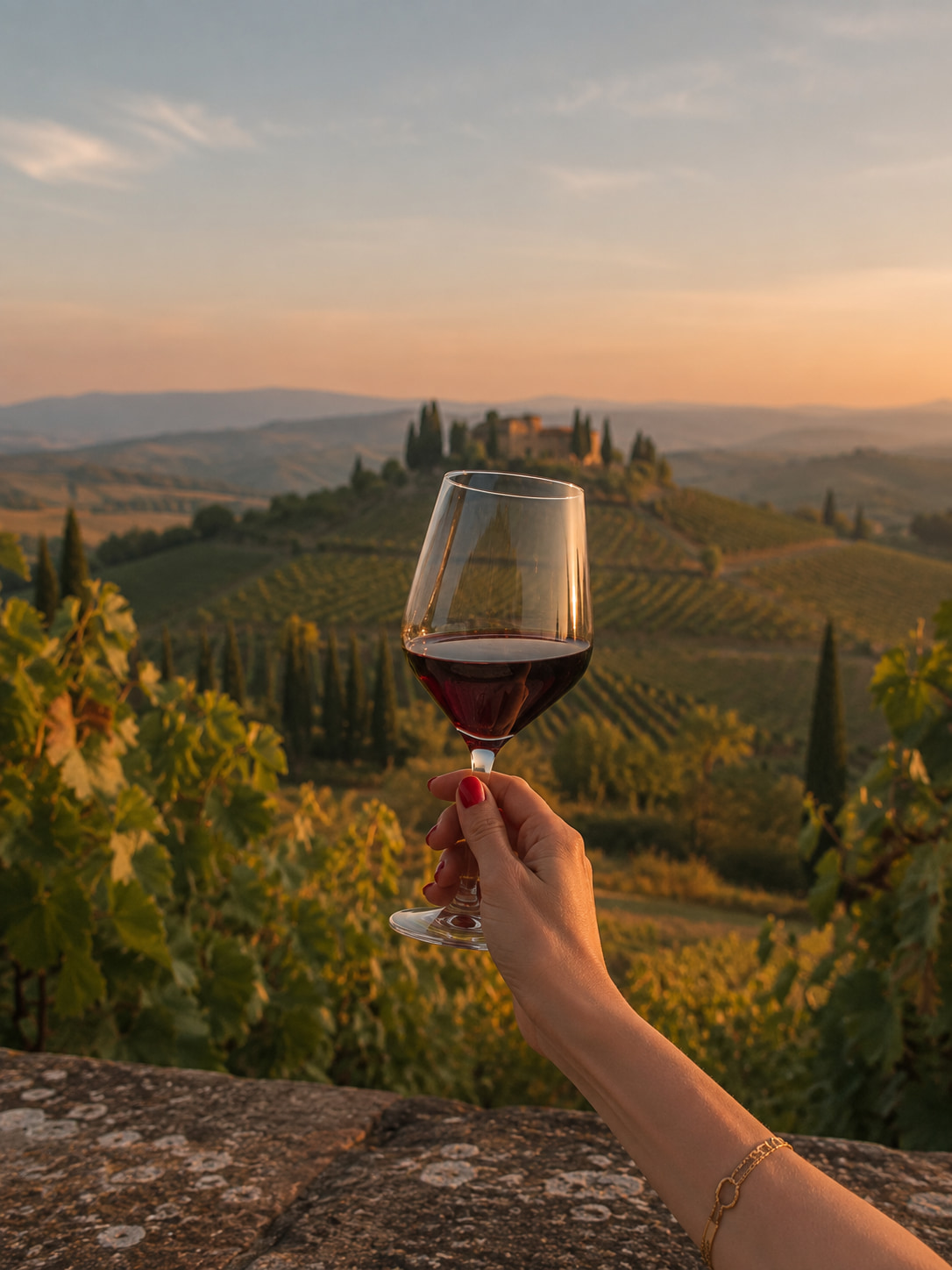
OFF THE RECORD: Fresh off her summer break, von Schlippe reflects on what it takes to be an executive off duty, seven days in a Tuscan villa, 11 accomplished friends, and a hard lesson in the difference between managing a holiday and actually having one.
I didn’t send an ‘Out of Office’ notification. Not because I forgot. For a company owner, the out of office is largely an administrative fiction: you can announce your unavailability, but the business (rather inconsiderately) continues. Clients call, decisions appear, and Monday morning shows very little respect for the fact that you are currently in Italy.
The real luxury is not turning on your out of office. It’s having someone you trust enough that you don’t need one.
For seven days, I had that. A partner who held the fort, a villa in Tuscany, 11 friends, and a title ambitious enough to suggest something meaningful might happen: pasta and promises. The promise, although nobody had formally agreed to it, was to stop managing everything.
This sounds easy until you put 11 accomplished people around a table. We are not very good at doing nothing anymore. We monitor our sleep while sleeping, count our steps while walking, photograph our food before eating it. Even holidays now come with objectives. We return rested, detoxed, culturally enriched, and ideally three kilograms lighter.
The only people who seem to have escaped this system are the sciure (Milanese for ladies) of Milan, those wonderfully dressed women, 60 and above, who have become social-media stars simply by walking through the city in excellent coats and the unmistakable expression of someone with no intention of explaining herself. A sciura does not count steps. She walks because there is somewhere worth going. She does not practise mindful eating. She has lunch. She has already achieved what an entire wellness industry is trying to sell us: enjoyment without turning it into a project.
I thought about the sciure often in Tuscany. On the first evening, everyone found a handmade notebook in their room, so that for one week we might write things down instead of forwarding them. Admittedly, this was itself a form of organisation. You can take the woman out of event management, but apparently not out of the villa.
My husband Michael opened the wine, I poured water, somebody mentioned carbohydrates, and everyone laughed. By the second evening, we had stopped optimising. We ate pasta, bread, more pasta. Food became conversation again rather than fuel. Nobody asked whether dinner supported tomorrow morning’s performance. Tomorrow morning, it turned out, was perfectly capable of looking after itself.
We spend years building organisations and then seem surprised when they occasionally manage to function without us. Perhaps this is why executives find it so difficult to rest: we’ve been trained to believe that value comes from intervention. If nothing requires our attention, we grow suspicious. There is, naturally, an entire industry ready to help us with this problem: retreats, detoxes, apps that notify us to stop looking at notifications. We have turned relaxation into another performance category.
The sciura would find this exhausting. She has already understood what takes most executives several leadership seminars and one minor crisis to learn: not everything improves when you manage it. A conversation does not need an outcome. A meal does not need to be efficient. And a company that cannot survive your absence is not proof of your importance. It is a management problem.
For seven days, I had that. A partner who held the fort, a villa in Tuscany, 11 friends, and a title ambitious enough to suggest something meaningful might happen: pasta and promises. The promise, although nobody had formally agreed to it, was to stop managing everything.
I returned to Singapore to an inbox full of decisions that had been made, problems that had been solved, and a business that had continued rather impressively without waiting for my return. This should not have surprised me. The great privilege of being in charge is discovering how little you can achieve alone.
Perhaps that is the real executive test: not how quickly you answer your emails, but whether you have built relationships strong enough to occasionally make yourself unnecessary.
I had. And so I ate when I was hungry, talked until midnight, wrote badly by hand, and stubbornly enjoyed the moment without trying to improve it.
Somewhere in Milan, a sciura was doing exactly the same. No out of office. Just trust, and dessert.
Off the Record is your new pass into the margins of luxury leadership. Each fortnight, Bettina von Schlippe, Co-founder of Beyond the Boardroom and Publisher-at-Large at Vogue Singapore, reflects on leadership lessons and what’s shaping the executive industry—from personal to closed-door perspectives, to unfiltered insights, and the quiet shifts that haven’t made the headlines just yet.