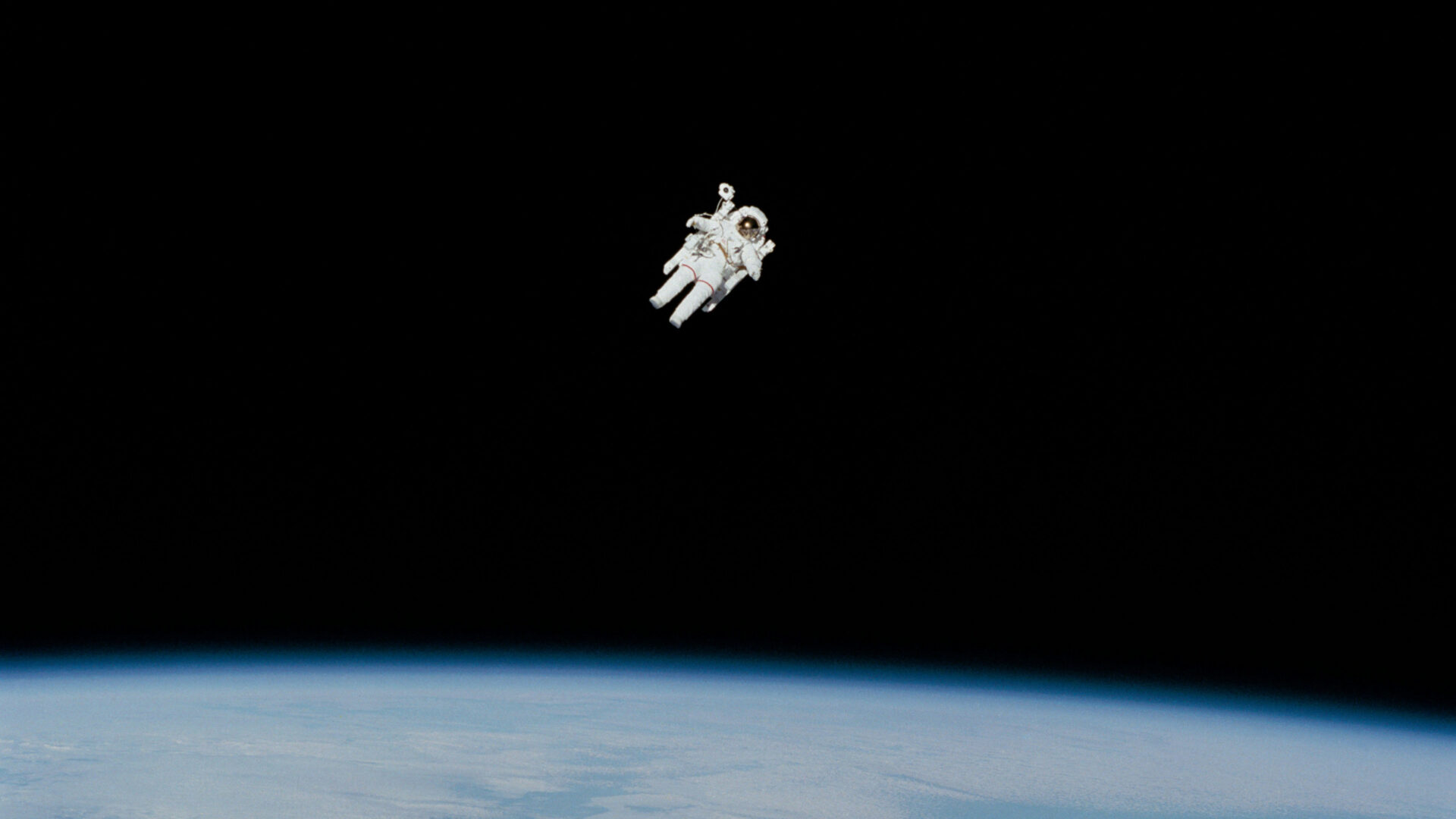
OFF THE RECORD: From orbital bone loss to Prada spacesuits, this fortnight von Schlippe’s dinner with astronaut Koichi Wakata offers an unexpected lesson: the further humanity travels from our planet, the harder we fall for it.
There’s a distinct kind of exhaustion that comes with modern business dinners. Usually, they revolve around the word “disruption.” Retailers, media executives, and luxury brand owners gather over lukewarm coffee to collectively wonder which part of their industry will be affected by AI and will vanish overnight. We have turned the future into a threat, and ourselves into its anxious targets.
Space, meanwhile, appears refreshingly unconcerned with our terrestrial panic.
The antidote to this existential dread arrived in the form of an intimate dinner party overlooking Singapore’s shimmering skyline. It was hosted by Lynette Tan, CEO of Space Faculty Private Limited and a Vogue leader, a connection that usually guarantees a discussion on cultural shifts, but rarely on orbital mechanics. The guest of honour at our table of six was the Japanese astronaut Koichi Wakata. A mechanical engineer by training, he was selected by JAXA in 1992 and has since completed five space missions spanning three decades, logging exactly 504 days in orbit—a staggering feat that makes him Japan’s absolute record holder for time spent in the cosmic void, and one of the most experienced astronauts alive.
As a child, I was convinced that adulthood would involve either becoming an astronaut or living on a Bavarian horse farm. Life, having more mundane plans, steered me into industries where “lifting off” usually just means launching a double page spread. Yet, sitting next to a man who’s spent six months staring at the topography of continents from above, my inner child woke up with a flurry of questions.
What does a person actually do when the rocket stops shaking?
The answer, it turns out, is delightfully ordinary. When he isn’t executing highly complex manoeuvres and the “do what an astronaut must do routine”, Wakata relaxes much like the rest of us: he reads books and watches TV. There’s no streaming in the cosmos—bandwidth is a terrestrial luxury—so the entertainment must be painstakingly downloaded from Netflix and sent into orbit on demand.
Naturally, this triggered a specific Vogue-thought experiment. At the magazine, our job is to curate cultural moments and assemble the perfect ensembles. If I were tasked with casting the ultimate crew for a Mars mission, the manifesto practically writes itself: George Clooney for charm, Sandra Bullock for survival instincts, and Tom Hanks because, frankly, he has already survived Apollo 13 and a deserted island. Wakata, with his calm demeanour and 504 days of cosmic wisdom, would be the undisputed commander.
But behind this cinematic fantasy lies a terrifying physical reality. I spent decades overcoming a paralysing fear of flying, achieving peace only by accepting that once the cabin doors close, you control absolutely nothing. Whenever things get bumpy, I still recite a secular prayer, as long as there’s air under the wing, we’re good. A conversation with Wakata multiplies that complexity by a factor of a million. Space travel leaves zero room for error or cynicism; the laws of physics remain stubbornly indifferent to human opinion.
Consider our collective mental meltdown during the 14-day Covid quarantines. Now imagine half a year in a sealed, floating metal cylinder. Forget about showering; water is so rare it must be rigorously recycled, meaning yesterday’s espresso is inevitably tomorrow’s Earl Grey. Your entire hygiene routine is reduced to a “wet vibe” sponge bath. Yet space feels remarkably clean.
And it demands a brutal toll. High-speed orbital travel technically makes you a fraction of a millisecond younger due to relativity, but gravity-free living immediately claws that cosmic discount back with interest. Without resistance, bones rapidly lose density. A gruelling two-hour daily gym session in orbit isn’t a vanity project for a better silhouette; it’s a strict medical necessity to stop your skeleton from dissolving into mush.
Even a “basic” task during a spacewalk, like tightening a loose screw, becomes an adrenaline-infused marathon. You’re floating in a vacuum, fighting the stubborn internal pressure of a spacesuit, trying to do precise mechanical work with only one hand. When the visor is down, there’s no food supply for the next 11 hours, the average duration of a spacewalk, according to Wakata. It makes earthbound intermittent fasting look like a minor dietary oversight.
Fortunately, back on Earth, our table was filled with the finest Italian food, fuelling a discussion about the future. Prada is now designing spacesuits for the next lunar mission, ensuring that humanity’s next giant leap will be undeniably chic. Oakley is engineering high-tech visors. Thanks to reusable rockets slashing costs, orbit is fast becoming the ultimate playground for billionaires who have grown bored of mega-yachts.
Yet this cosmic commercialisation doesn’t feel defensive or fearful. Preparing for a space mission, a nine-month physical and mental bootcamp, requires the absolute evaporation of the ego. It forces a person to step seamlessly between being a fierce commander and a loyal follower. It turns out that if you spend your days looking at our planet from 400 kilometres above, our favourite terrestrial anxieties begin to look remarkably small.
Ultimately, the true value of space travel isn’t that it offers us a way to escape our world, but that it forces us to look back at it with a wild, renewed affection. We don’t push boundaries into the dark to find a replacement for Earth; we do it to realise how incredibly lucky we are to have it. Who would have thought that a conversation about leaving the planet would be the very thing that makes you fall in love with it all over again?
Until then, stay off the record.
Welcome to Off the Record, your new pass into the margins of luxury leadership. Each fortnight, Bettina von Schlippe, Co-founder of Beyond the Boardroom and Publisher-at-Large at Vogue Singapore, distills what’s shaping the region’s luxury landscape, from closed-door perspectives, to unfiltered insights, and the quiet shifts that haven’t made the headlines just yet.