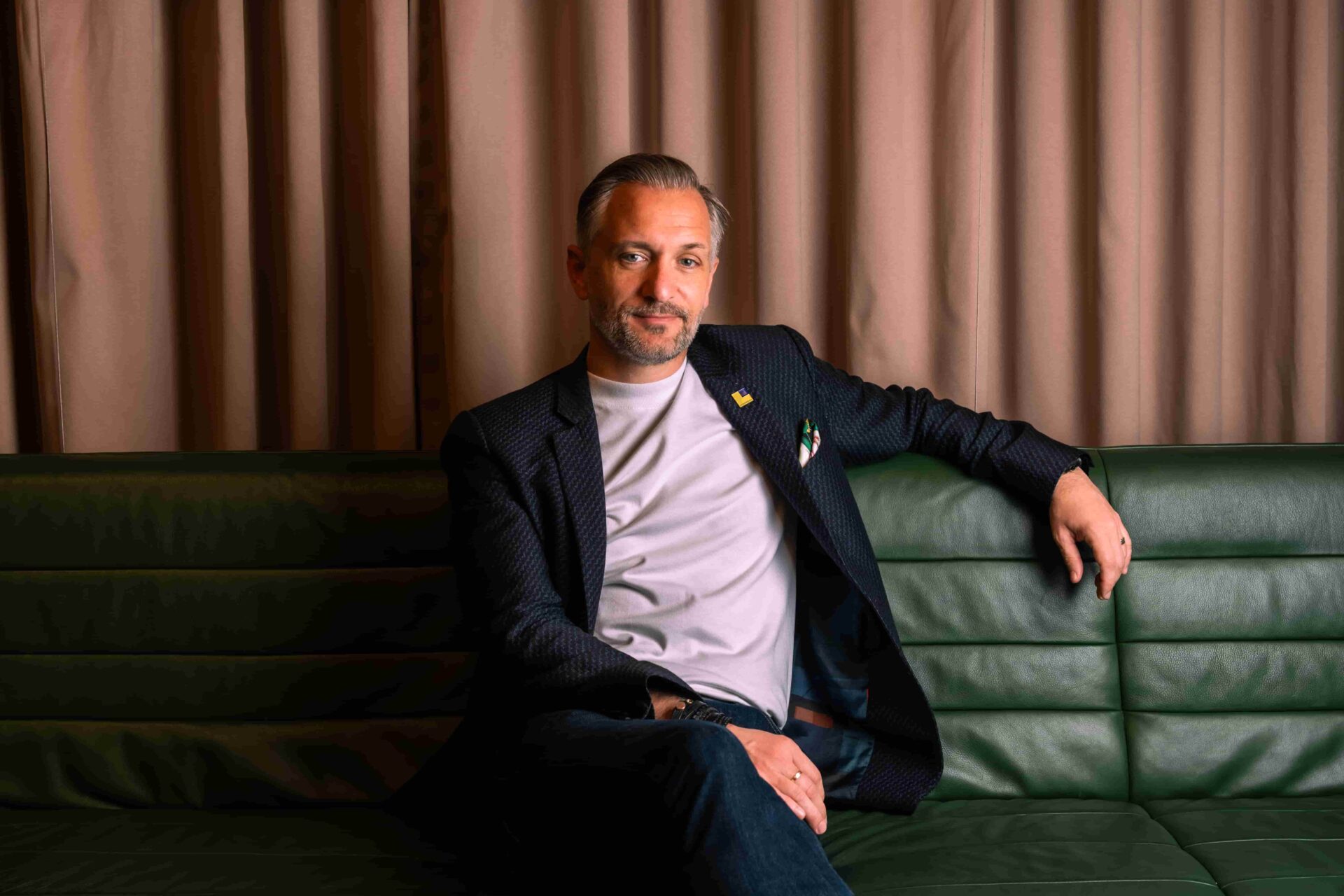
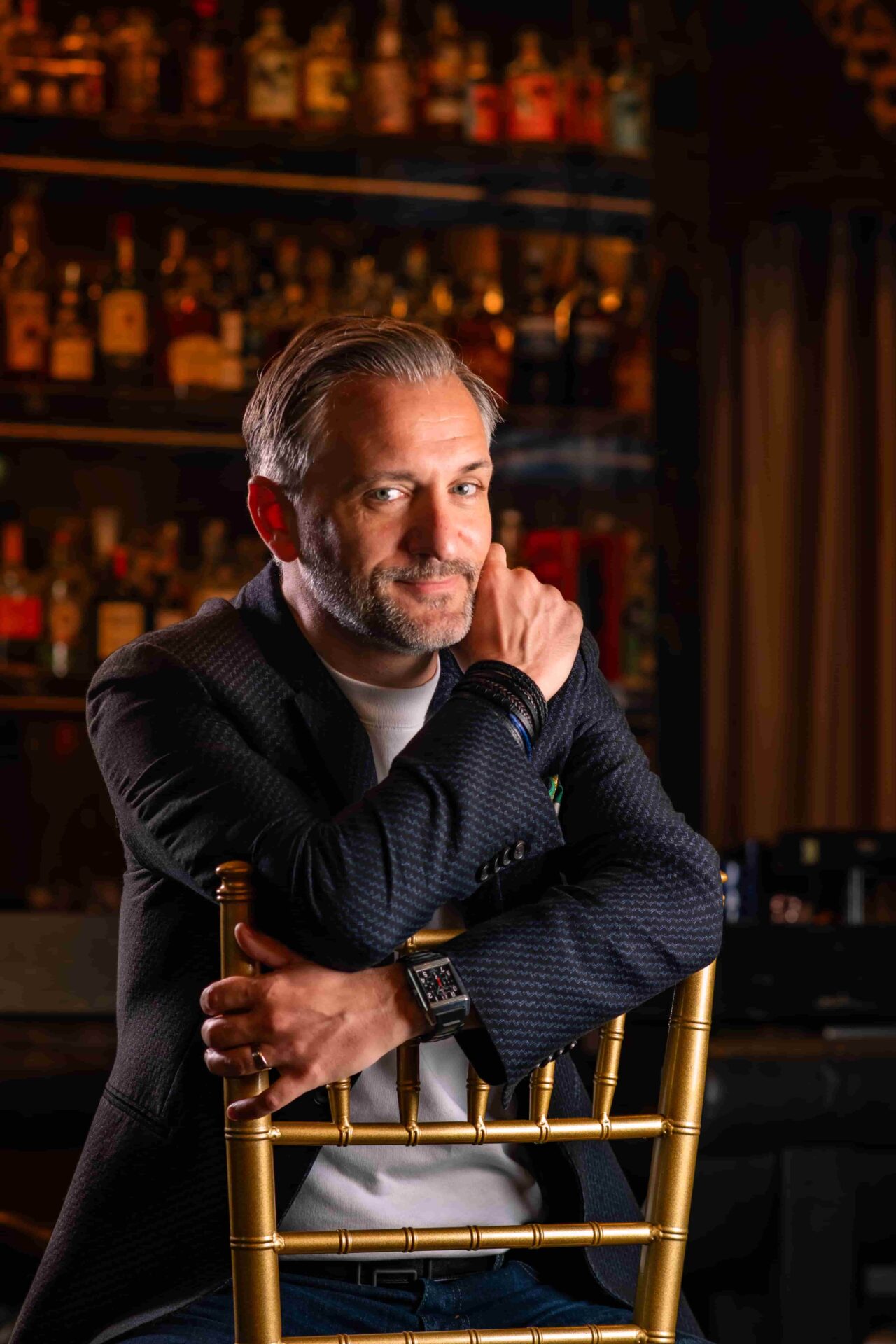
In an exclusive conversation with Beyond the Boardroom, the General Manager of Mondrian Singapore Duxton gets candid about why he no longer believes in luxury’s old rulebook, the inherited assumptions about property, service and exclusivity he has spent two decades quietly discarding, and why the next era of the industry belongs to whoever is willing to break rank first.
We meet at the Canyon Club, the rooftop bar and pool at the top of the Mondrian in Duxton. Somewhere behind the counter, ice cracks into a shaker. A burst of laughter cuts through the afternoon before dissolving into the steady soundtrack of clinking glasses, quiet conversation and music that never quite demands attention. Guests drift between the pool, the cabanas and the bar in that loose, unhurried choreography peculiar to rooftop hotels, some still damp from a swim with towels slung over their shoulders, others arriving straight from the city for their first drink of the afternoon, carrying the easy confidence of people with nowhere else to be. Beyond the glass, sunbathers stretch along the deck, seemingly indifferent to the pace of Singapore below. Few rooftops in the city capture its contradictions quite so starkly: terracotta roofs and preserved shophouses spilling across Duxton Hill before giving way, almost without warning, to the glass and steel of the Central Business District. Two centuries of Singapore sit comfortably within the same frame.d
Marchenay himself is exactly as one might expect of an experienced hotelier: animated, precise, candid, well informed, speaking with his hands almost as often as his words, and pausing occasionally before a sentence he wants to land. He is unmistakably French by birth and voice, though more than two decades spent working across Belgium, England, France, Singapore, the Philippines, China, Hong Kong and South Korea have made his understanding of hospitality decidedly borderless. His career has carried him through some of the industry’s most recognisable names, Raffles, Shangri-La and Kerry Hotels among them, before Sofitel and, more recently, Mondrian Seoul Itaewon, where he spent four years turning the property into one of the city’s most talked-about lifestyle hotels. A graduate of Cornell University’s Nolan School of Hotel Administration, he now leads Mondrian’s first Southeast Asian outpost, bringing with him a philosophy shaped as much by restaurants, nightlife and culture as by traditional hotel operations.

Luxury No Longer Begins with the Room
There was a time, not so long ago, when luxury was defined entirely by the property itself: the gilded awning, the marble lobby, the sweep of a vast driveway. It was a physical vocabulary so widely understood that one could photograph it anywhere in the world and know instantly what it was meant to signal. Marchenay’s argument is that this vernacular has quietly stopped working, that luxury is no longer a matter of the room one could stay in, but of where one feels one truly belongs.
“In the old days, luxury was a very heavy, very big process, and it was the customer who suffered through it rather than being the one who was driving it,” he explains. “The new generation wants less intimidating products, something that looks more like themselves. They want to feel relaxed. They want to wear jeans and a T-shirt. They don’t want a jacket for dinner, which used to be a must.”
It’s also the clearest way to understand the brand Marchenay now runs. Mondrian was never conceived by a traditional hotelier. When Ian Schrager, the Studio 54 co-founder and pioneer of the boutique hotel movement, transformed the West Hollywood property in 1996, he was not interested in building another luxury hotel. He imagined such spaces as cultural stages, where restaurants, bars, music and atmosphere mattered as much as the rooms upstairs, and where hospitality was something to be experienced rather than simply consumed. That philosophy made Marchenay an unusually natural fit. Long before Cornell, Raffles or Seoul, his career began in restaurants and nightclubs, an apprenticeship that shaped an instinct to blur the line between hospitality and culture rather than reinforce it.
Opened in 2023, Mondrian Singapore Duxton sits at the crossroads of old and new Singapore, where preserved shophouses meet the city’s glass and steel skyline, and even its arrival sequence carries the same argument. Reception is tucked quietly beside the ground floor Italian restaurant, a small design decision that signals, without needing to say so, that the hotel’s social heart lies not behind a check-in desk but in the life unfolding around it. For Marchenay, that inversion, the guest as author of the experience rather than its subject, is the foundation everything else rests upon. A beautifully designed room can still leave a guest feeling managed rather than met. What he’s chasing instead is something closer to hospitality in its oldest sense: being made to feel like a person, in a specific place, by other specific people, rather than processed through a global brand standard that could be lifted, unchanged, into any city on earth.
The same instinct extends beyond the lobby and into the kitchen. For decades, dining inside a hotel was a function of obligation rather than desire, particularly in Asia, where food safety concerns once kept guests eating in house out of necessity. As that necessity has faded, competition has sharpened, and hotels have been forced to make the restaurant a genuine cultural destination rather than an amenity, built for the neighbourhood first and the guest room second.


Marchenay believes this shift has fundamentally altered the economics of luxury hospitality. Hotels can no longer rely on a captive audience; instead, they must build restaurants that locals choose on their own terms, turning food and beverage into the social engine of the property rather than a supporting service.
“The luxury industry realised it had to rethink itself around the restaurant,” he says. “A restaurant isn’t for hotel guests, it’s for locals. If the locals come, the hotel guests will come too.”
The figures increasingly bear this out. Asia Pacific’s consumer foodservice sector reached US$1.3 trillion in value sales in 2025, already accounting for 40% of global foodservice revenue, and is forecast to keep growing at close to 5% a year through 2030, according to Euromonitor. Singapore’s own food and beverage services industry, tracked monthly by the Singapore Department of Statistics, posted sales of S$1.6 billion in February 2026 alone, keeping annual turnover comfortably within the S$15 billion-plus range the sector has held in recent years. Research from JLL, meanwhile, has found that hotels with destination restaurants achieve occupancy 6.7 percentage points higher, average daily rates 8.8% higher and revenue per available room 18.6% higher than comparable luxury hotels without one. For operators, the implications extend well beyond food and beverage. Restaurants are no longer designed to serve the guests already asleep upstairs; they are built to draw in the people who live just down the street, turning hotels from places people simply stay into places they actively seek out.
Marchenay puts it more plainly still: “Little by little, the hotel becomes a restaurant with rooms on top, and not a hotel with restaurants.”
The Business of Being Remembered
For Marchenay, the restaurant is only one expression of a broader philosophy. The product, in his account, is not food, nightlife or accommodation in isolation. It’s culture.
“It’s not really the restaurant experience,” he unpacks. “It’s more eatertainment. You eat, but you’re entertained at the same time.”
That philosophy runs through the hotel most vividly at Jungle Ballroom, a space concealed behind an entrance so unassuming that most passers-by would walk straight past it without a second glance. There is no signage worth mentioning, no velvet rope, nothing that announces itself as a destination. Step through, and the room opens into something closer to a rainforest reimagined as a nightclub: dense foliage, low light, a DJ booth tucked into the greenery, and, on the right night, three or four hundred people dancing in a space that gave no warning it existed. “You go to a place with a very small door,” Marchenay says. “You don’t know what’s happening inside, and suddenly you have three or four hundred people all dancing together with a curated DJ. You don’t expect it, but that’s what you find.”

The hotel’s art collection works on the same principle of concealed weight. Curated with The Artling, Asia’s leading art consultancy, it runs to a six-metre bronze KAWS sculpture, WHAT PARTY, standing sentinel at the Craig Road entrance, Tracey Emin’s neon I Longed for You inside Bottega di Carna, Ian Davenport’s poured “puddle paintings,” and Dawn Ng’s Waterfall IV, a time-lapse film of a pigmented block of ice slowly dissolving into entropy, alongside work by Singaporean artists André Wee and tobyato woven into guest rooms and the hotel’s staircase.
None of it is dressed up as spectacle, yet none of it is decorative either. “It’s not decoration,” Marchenay says. “It’s a genuine artwork. It belongs to us, but it has the same standing here as it would in a museum.” That distinction is not rhetorical. Guests can join guided tours through the property, and the pieces are catalogued and discussed with the same seriousness a curator might bring to a gallery wall, never flattened into a photo backdrop or treated as an amenity to be consumed and forgotten.


Attention itself, in this account, is the scarcest resource a hotel now competes for, and design is the tool used to reclaim it. “People have zero attention,” Marchenay laughs. “We try to create details that catch their eye because it’s something outside their ordinary, outside their Instagram feed. Then they’ll remember it, and so they’ll remember the hotel.” Whether the trigger is a meal, an artwork, a nightclub behind a discreet door, or a single design flourish that makes someone glance up from their phone, the aim is never spectacle for its own sake. It is discovery, engineered carefully enough that it doesn’t feel engineered at all, the kind of moment that turns a hotel from somewhere people stay into somewhere they remember having been part of.
That same resistance to the expected shapes how the hotel actually runs. Ask Marchenay what actually holds the guest experience together across a building with a rooftop pool, a nightclub and multiple dining concepts, and he does not point to a service manual. He points to its deliberate absence. Staff are trained to read the guest in front of them rather than recite a fixed line, which means two guests can have entirely different interactions with the same team member on the same night, and both walk away with something that feels genuine rather than rehearsed.
“It’s a genuine discussion, one person to one person,” he says. “It doesn’t mean the guest and the team member are on the same level, you still need the basics in place, but the closeness between the two individuals is what makes the new luxury.”
“Our customer can be the student who saved for a month from a weekend job to afford one night here, all the way up to the top 3% who want to spend a bit of time somewhere different. Lifestyle is not only for the young, and it’s not only for the wealthy.”
One Philosophy, Every Decision
Few general managers currently working in Singapore’s luxury segment have watched the city recalibrate its relationship with taste for as long as Marchenay, who first worked here at Raffles Hotel Singapore roughly two decades ago before spending the intervening years across Belgium, England, France, the Philippines, China and Hong Kong, returning most recently by way of Seoul. His reading of that shift is unsentimental. Twenty or 30 years ago, he suggests, Singaporeans were still building a national identity partly by borrowing European markers of prestige; today, that borrowing has given way to a Singaporean identity confident enough, layered with heritage and a genuinely global Asian sensibility, that it no longer needs Europe as its reference point.
Singapore’s own regulatory strictness, he argues, is part of what makes it such fertile ground: import controls here are exacting, designed to ensure ingredients arrive unadulterated and true to their origin, which is precisely why, in his account, “so many of the best food and bar concepts end up choosing to open here.” For a hotelier who believes cultural specificity is the actual product, this is not a passing note on food policy. It is evidence that the city has become a more interesting collaborator than it once was, part of why Marchenay wants Mondrian’s partnerships, with local artists, drama productions and now the Singapore Tourism Board, to cross into genuinely local cultural territory rather than simply importing an international name and hoping local relevance follows.
Marchenay’s view of artificial intelligence is also notably free of hype, and it too serves the same underlying argument. Increasingly, the guest journey begins not with a search engine but inside a chatbot, with travellers prompting Gemini or ChatGPT for an itinerary before they have chosen where to stay. He treats that shift as a new front door for the brand rather than a threat to it, one that changes how a hotel needs to think about discoverability long before a guest ever reaches the real one.

Inside the operation, he is candid that AI’s most valuable contribution may be reclaiming his own time, and by extension his own presence. The modern general manager’s day, fragmented by messages across half a dozen channels at once, has drifted a long way from the role as he understood it when he started: a leader who spent the day on the floor, talking to guests and to the team, rather than behind a desk working through correspondence.
“AI is helping me go back to the old GM style, out of the office, talking to people,” Marchenay says. “For the guest-facing side, we’re still cautious. It’s always nice to have a person answer the phone. But if the alternative is five rings and no answer, AI is the better option.” The framing is deliberate. AI is useful precisely because it protects the thing Marchenay believes actually matters, human presence, rather than replacing it: efficiency behind the scenes, warmth in front of the guest.
Off Duty
Asked for the three places in Singapore that give him the feeling he tries to build for his guests, Marchenay does not name a restaurant first. He names home: “It’s a bit like going back to your roots, having the comfort of family with you. You have all the busy places, but then you go home to the real values: love, care, sharing with the people you love. That home can be duplicated anywhere, which matters a lot when you’re an expat and you keep moving.” Marchenay is married with two children, a son of 12 and a daughter of 16, and describes the family unit itself, rather than any fixed address, as the closest thing he has to a permanent home across a career spent moving between continents.
The second is Raffles Hotel Singapore, where he worked as a young restaurant and bar manager two decades ago. “I remember standing in front of the same hotel and telling myself, genuinely, that I was proud of myself,” he says. “I told myself I was going to do everything I could to become a GM somewhere, and that moment, coming back to the same building years later, is one of the real highlights of my career in Asia.” The third is simply the sea, wherever he can find it, a fixture of a childhood spent near Bordeaux. “When I’m stressed, looking at the sea calms me down,” he says. “I like to think my family, on the other side of the world, might be looking at the same sea at the same time. It’s a bit poetic, but it’s true.”
All three answers land on the same idea that has run through the whole conversation: the feeling of home is not a physical place. It is people, memory and belonging, precisely the thing Marchenay is trying to manufacture, on purpose, for guests who are a very long way from their own.
He is equally convinced that the centre of gravity in luxury hospitality is shifting east. Asia, he argues, is no longer simply absorbing ideas from elsewhere but beginning to produce its own, fuelled by a younger generation of travellers, stronger domestic demand and cities confident enough to define luxury on their own terms. If Europe wrote much of hospitality’s past, Marchenay believes Asia will write much of its future. “We’re only just at the beginning of what we have to offer, there are so many more memories, experiences, joys and luxuries to be experienced and seen. We make our own rules now.”