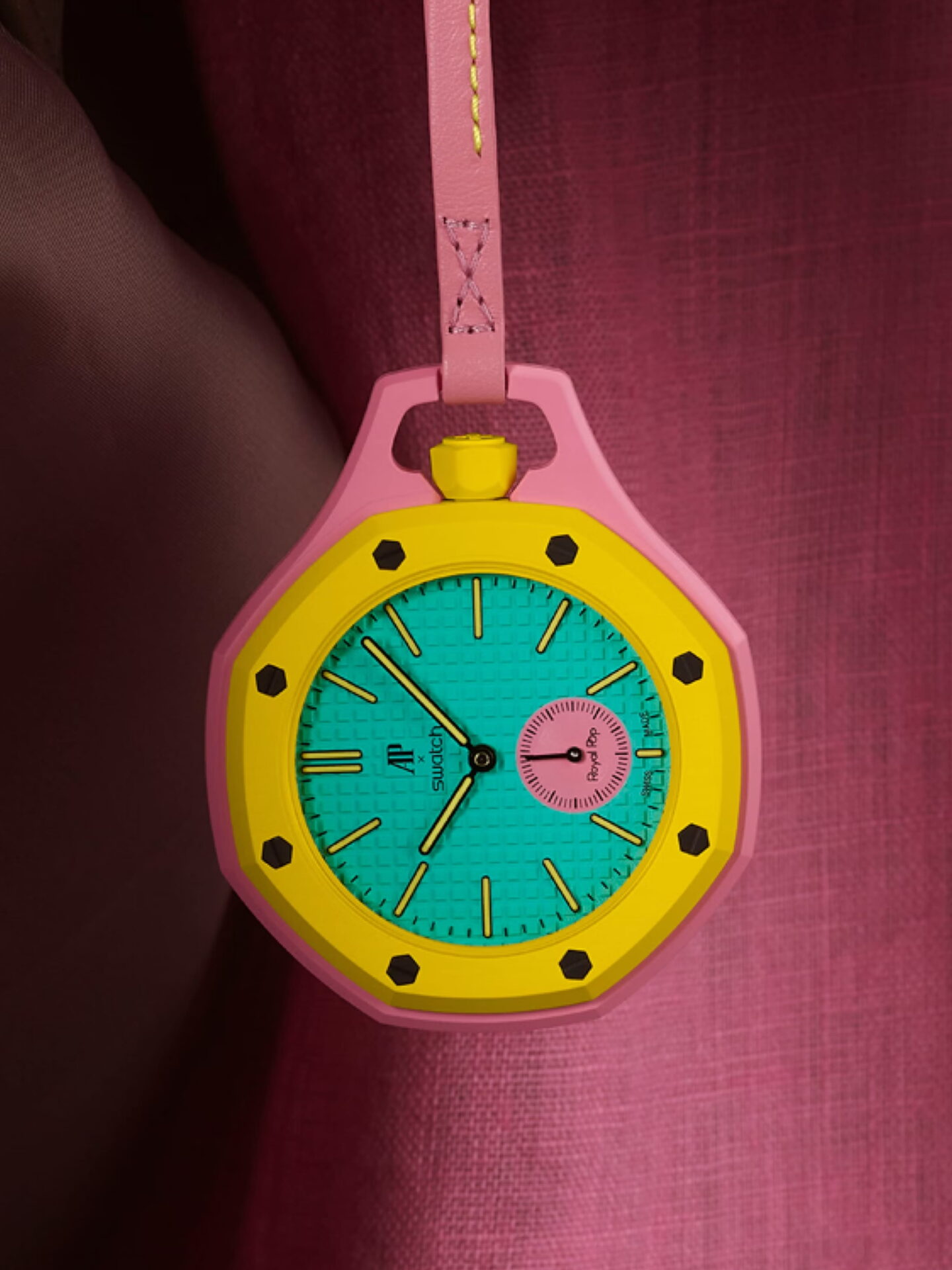
BTB PERSPECTIVES: The most interesting debates around luxury are no longer confined to the boardroom. They’re rising up through culture, often reaching the consumer before the strategy table has caught up. Which is why we’re launching BTB Perspectives, a recurring series asking industry leaders what those debates actually mean for the businesses navigating them. In our first edition, we unpack the recent Audemars Piguet x Swatch launch and the economics of manufactured desire.
Nearly three weeks after the launch of the Audemars Piguet x Swatch Royal Pop Collection, the images remain difficult to set aside. Crowds stretched around city blocks. Retail locations from New York to London shuttered amid safety concerns. In Dubai, the sales events at both Dubai Mall and Mall of the Emirates were cancelled outright. In Singapore, the Swatch boutique sold through its allocation of 40 pieces and then closed its doors, leaving hundreds of customers, some of whom had queued for over 24 hours, without recourse. Before many buyers had cleared the checkout counter, the pocket watches were already surfacing on resale platforms at prices well above their $400 retail value, according to NBC News.
What appeared on paper to be a watch launch became, in practice, something far more revealing. A case study in the architecture of modern luxury desire.
The frenzy reignited a debate that has been gathering force across the industry for years. The Royal Pop collaboration is hardly the first to deploy scarcity and anticipation as primary instruments. The waiting lists surrounding Hermès’ most coveted leathers, the cultural weight of Supreme collaborations, the original Omega x Swatch MoonSwatch launch in 2022, and the now-familiar rituals of limited-edition sneaker releases from Nike and Adidas all draw from the same playbook. Scarcity has become one of the most sophisticated tools in the modern brand kit. Increasingly, luxury houses are borrowing the grammar of streetwear, gaming, and social media culture, including urgency, exclusion, and the spectacle of the queue, to generate attention, animate conversation, and transform products into events.
Supporters argue these strategies represent a considered and legitimate response to an increasingly fractured attention economy. In a world where consumers face an unrelenting excess of choice, scarcity confers cultural relevance, sustains organic conversation, and elevates a product into a moment. The queues, the resale premiums, and the social media documentation become, in this reading, constituent parts of the product itself.
Critics see the matter differently. They contend that luxury’s growing dependence on engineered urgency and performative exclusivity risks corroding the very foundations the sector was constructed upon: craftsmanship, heritage, permanence, and the long architecture of trust. Swatch’s subsequent public clarification that the Royal Pop Collection was not, in fact, a limited edition only deepened the conversation. The irony was not lost on observers that consumers had rushed, in some cases with considerable physical risk, to secure a product that would be freely restocked.
So, does engineered scarcity remain a credible and sustainable strategy for the houses that claim to stand for something more enduring? Or is the industry approaching a threshold at which spectacle begins to hollow out substance? And where does luxury’s obligation to the consumer begin, when desire itself has become the performance?
We asked global voices across luxury, branding, marketing, and consumer intelligence for their perspective.


Betsy Grimes
Senior Vice President, Research & Insights
Jasper Colin
The luxury industry’s obsession with scarcity may be misaligned with what wealthy consumers actually value. Jasper Colin’s Experience Economy 2.0 study, which surveyed 500 high-net-worth and ultra-high-net-worth consumers across the US, UK, Germany, France, India and Singapore, found that limited availability ranked last among 12 luxury purchase drivers, accounting for just 6.4% of preference share. The findings suggest that while scarcity can generate attention, it’s not necessarily what drives purchasing decisions among luxury’s most valuable customers. The study also found that inspiration delivered negative utility across every market surveyed, raising questions about whether luxury’s traditional marketing playbook remains as effective as brands assume. If anything, the findings point to a growing gap between what creates noise and what creates value. Luxury consumers appear to be prioritising experience, meaning and personal relevance over manufactured exclusivity.
Emmanuel Tamrat
Founder
Blindspot Agency
Engineered scarcity can still work, but only when the product and the story are strong enough to carry the hype. The danger is when brands treat scarcity as a shortcut, consumers catch on quickly. You see it with many so-called limited sneaker drops that are positioned as scarce or collectible, only to appear on resale platforms barely above retail. That tells you the market never really believed the story.
The Royal Pop feels different. Whether people like it or not, it clearly struck a nerve. Customers lined up, stores managed crowds, resale prices surged almost immediately and even third-party watch strap makers reacted to the demand. That’s not simply artificial scarcity, it reflects genuine market interest. I would describe it as hype-to-market fit. The product had the right mix of familiarity, novelty and accessibility. It borrowed from one of the most recognisable silhouettes in luxury watches while making it playful and relatively attainable through Swatch. On the responsibility question, luxury brands must be careful not to insult the customer’s intelligence. Consumers are checking resale platforms, Reddit threads, TikTok commentary, watch forums and marketplace pricing in real time. If a release feels lazy, overpriced or poorly structured, people will call it out immediately.
Luxury can create theatre, anticipation and a sense of occasion, that’s always been part of the category. But there’s a line between desire and manipulation. When brands create chaos for the sake of chaos, the backlash can become larger than the commercial upside. The bigger lesson is that spectacle only works when there is substance underneath it. When the product is strong, hype amplifies brand equity. When the product is weak, hype exposes the weakness faster.


Cristy Stewart-Harfmann
Professor of Marketing
Florida Atlantic University
Collaborations such as Swatch x Audemars Piguet succeed because they combine luxury positioning with influencer culture. Influencer marketing has demonstrated the power of urgency, scarcity, social proof and fear of missing out. In many cases, consumers become so focused on not missing out that the product itself becomes secondary. Social media has created a new signal of luxury. Consumers, particularly younger generations, increasingly want products that feel difficult to obtain because scarcity itself has become a form of online social currency. They are no longer simply buying a product; they are buying entry into a viral cultural moment.
This has helped create drop culture, which stands in contrast to the traditional luxury focus on heritage, craftsmanship and timeless desirability. The significant mark-ups seen on resale platforms suggest that hype economics can sometimes eclipse product value. Scarcity remains one of the most powerful tools in modern luxury because social media has transformed exclusivity into content. But when consumers begin to feel that scarcity exists purely for spectacle, brands risk damaging the authenticity on which luxury depends. Traditional luxury marketing was built around craftsmanship and aspiration. Virality arrives quickly, but it disappears just as quickly. Visibility alone does not create long-term brand equity.
Rahni Ragins
Strategic Operations Consultant
Global Brand & Sports Marketing
One thing I’m noticing with luxury right now is that it increasingly feels like it’s about creating Instagrammable moments, anticipation and access. Living in Los Angeles, it’s wild to see lines stretching for blocks, with people often standing in them without even knowing exactly what they’re waiting for. The resale sites, social amplification and endless online commentary prove these drops are tapping into something much bigger. People want proximity to culture. They want the feeling of getting something before everyone else.
I think luxury brands are getting dangerously close to doing it all for the spectacle. Scarcity works because it feels rare and intentional. However, when consumers start feeling manipulated by fake urgency, confusing availability or manufactured chaos, the experience can begin to erode trust rather than build desire. Having worked at Patagonia, I was exposed to a very different philosophy. The brand was incredibly intentional about transparency and consistency between what it said and what it actually did. That experience shaped how I think about modern brands. Hype can absolutely create attention, but sustaining relevance and loyalty over time still comes down to credibility. Luxury is at a fascinating point between exclusivity, accessibility and cultural storytelling. The challenge will be balancing all three without sacrificing trust.


Gonçalo Teixeira
Founder
Portraits de Famille
As the founder of a brand rooted in limited-edition, artist-led capsules and transparent, community-driven drops, I see engineered scarcity as a double-edged sword in luxury. When scarcity is authentic, grounded in true limitation, craftsmanship and narrative, it can heighten desire and reinforce brand equity. However, when scarcity is manufactured purely for spectacle, it risks eroding trust and undermining the very exclusivity luxury brands seek to cultivate. If consumers sense that “limited” is simply a marketing tactic, the emotional connection and long-term loyalty can quickly be lost.
Luxury’s responsibility to the consumer begins with honesty and respect. Today’s consumers are more discerning than ever. They expect transparency about what makes a piece rare or valuable. The industry is at an inflection point. If performative desire and hype continue to overshadow substance, the backlash could outweigh any short-term commercial gain. The future of luxury lies in balancing desire with integrity, ensuring every launch is rooted in real value, provenance and a genuine sense of belonging. Only then can brands sustain both cultural relevance and consumer trust.
Camilla Carboni
Luxury Brand Messaging Strategist
The Luxury Copywriting Company
As luxury brands attempt to win market share and capture the attention of younger audiences, these types of partnerships and campaigns are certain to become more frequent. The conversation should not be about abandoning these strategies altogether, but rather about ensuring they are engineered in a way that upholds each brand’s reputation. When executed thoughtfully, scarcity can be highly effective. The opposite is equally true. Luxury’s responsibility begins and ends with trust. Compromise consumer trust and you dismantle the very driver of luxury consumerism: desire.