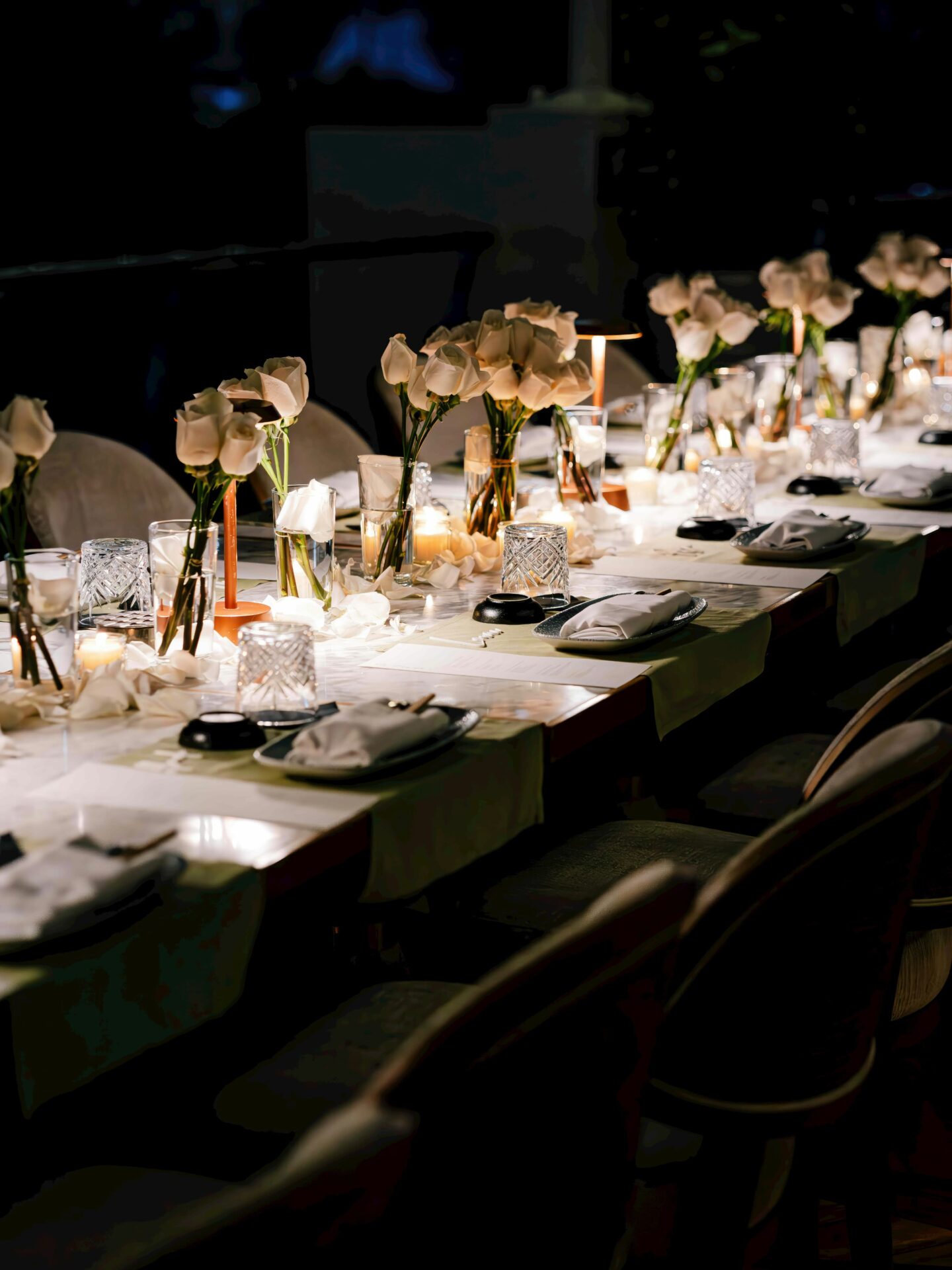
The inaugural XI:XI Circolo.Life x Beyond the Boardroom dinner in Singapore this week was part of a growing redefinition taking place across luxury itself, one that prizes conversation, perspective, and meaningful human connection over spectacle, consumption, and the performance of status.
At one end of the table, the conversation drifts towards AI and the strange psychological weight of living through yet another technological reset. Elsewhere, discussion turns to longevity (what would you do with your time if you could live for 120 years?) and the fear of building a life that looks successful from the outside but feels emotionally vacant within it. Around the compact private dining room sit a mix of 11 former DJs, content creators, founders, executives, and creatives, each defined by their passions, pursuits and purpose, but not their professions. By dessert, the conversation has become philosophical, as good dinners eventually do, circling the question of what any of us are actually here to build in the first place.
The inaugural Circolo.Life XI:XI dinner in Singapore is built for exactly this kind of conversation. Held this week in collaboration with Beyond the Boardroom, the evening brought together a deliberately assembled mix of leaders across business, culture, technology, and the creative industries at the Shophouse Suite in Singapore’s stunning Mondrian Hotel, nestled between old world and new in the heart of Duxton Hill. The name itself references alignment, a moment often associated with synchronicity, intuition, and meaningful connection, which sits at the centre of the philosophy behind the gatherings themselves. The guest list came with only one request: leave their many accomplishments at the door, no matter how storied. Not because they were unimportant, but because the evening was designed around something far rarer than status today, genuine human connection. Over the course of the night, discussion moved fluidly between ambition, reinvention, burnout, migration, identity, and meaning, creating the kind of genuine conversation amongst strangers that has become, in many ways, more elusive than luxury itself.
Watching it unfold across the table, it became increasingly clear that the dinner itself was not really the experience, the atmosphere was.
That realisation sits at the centre of an idea Álvaro Daza Hernández has spent years chasing, one that ultimately materialised through Circolo.Life, the Abu Dhabi-headquartered experience and community company he formally launched in 2021 and which now operates across 83 countries. Positioned around what it calls “legacy experiences”, the company works across governments, luxury brands, technology firms, hospitality groups, and family offices, designing environments intended to create lasting cultural and emotional impact.
To understand how he arrived there, however, you have to go back to Bogotá, to architecture school, and to the moment Daza began questioning whether the most important part of a room was ever the room itself at all. Daza grew up in Colombia inside what he describes, somewhat understatedly, as “a very particular family”. His father was a musician, his mother a fashion designer. Alongside the artistic inheritance ran his mother’s family enterprise, a multigenerational business where he worked summers long before he fully appreciated why. Over time, he came to understand the lesson sitting beneath it: people work hardest at the things that matter to them.
Architecture, when he eventually arrived at it, felt like the natural convergence point between those worlds. It rewarded aesthetics, but demanded structure. It required imagination, but also endurance, and it was art forced to become functional.
“The role of architecture is to facilitate interaction in a way that is effective,” Daza tells Beyond the Boardroom. “But architecture alone cannot always do that. Buildings themselves can only go so far. When you add moments to spaces, maybe there is a way of transforming people through them.”
As Daza moved through the curriculum, his attention began drifting away from the buildings themselves and towards the invisible dynamics unfolding within them. What fascinated him was no longer simply how a space looked, but what it allowed people to become inside it. Why did certain environments unlock openness, ambition, intimacy, or trust, while others, often equally beautiful, remained emotionally inert? Increasingly, he found himself drawn less to architecture as static form and more to the possibility of designing environments capable of shaping human interaction itself What if the room was not actually the point? What if the point was what happened once the right people entered it?
Before Circolo.Life became a business, it became an experiment. Daza spent a year and a half travelling through 64 countries and meeting more than 26,000 people. The premise was deceptively simple. He wanted to test whether exposure to rich, layered, varied experience fundamentally altered the way people moved through the world.
What he found repeatedly was that it did. The people who had experienced more, culturally, intellectually, geographically, emotionally, often possessed a different kind of confidence. They made decisions differently. They seemed more capable of building lives aligned with who they actually were, rather than simply who they were expected to become.
“People who had layers and layers of this depth of information would have much better track records of decision making,” he says. “They would be good at following their passion, good at following their dreams.”
What Daza had begun observing was that experience itself functioned as a form of infrastructure, shaping confidence, judgement, ambition, and ultimately identity.
“If I didn’t have the privilege of living so many meaningful things in life—accessing so many spaces, connecting with so many people—I would probably be a different person,” Daza opens up. “Architecture alone cannot always create those transformations. But when you add moments to spaces, maybe there is a way of transforming people through them.”
The trip revealed something else too. Organisations were globalising faster than the social systems surrounding them could evolve. Executives were relocating constantly, arriving in unfamiliar cities without community, context, or belonging. Someone needed to create the connective tissue that transformed a location into a life, yet nobody quite knew whose responsibility that was. The gap sat awkwardly between hospitality, HR, events, and brand marketing, which was precisely why an opportunity existed there at all.
When Daza returned from his travels, he began building Circolo around that insight. Not as a traditional agency, but as a company capable of conceiving, designing, managing, and executing experiences across physical spaces, events, hospitality, and community-building. Governments, luxury brands, technology companies, family offices, and hotel groups all eventually became clients.
The structure seemed unusual at the time. In retrospect, it simply mirrored the problem itself. The clients Daza identified were not looking for vendors so much as translators. People capable of moving seamlessly between strategy, hospitality, logistics, curation, and emotional intelligence without losing coherence along the way.
The company’s first major event took place in Nairobi, connecting Latin American embassies with African investors through a south-to-south framework that had rarely been explored in practice. They planned for 300 attendees. More than 400 arrived. Even the over-attendance felt revealing. The environment he had created had become one people actively wanted to enter.
The Architecture of Trust
As Circolo grew, so too did the scale of what clients began asking it to deliver. Luxury hotel groups arrived first, then governments, then global technology companies operating in blockchain, AI, and Web3. Then brands increasingly aware that affluent consumers were becoming less interested in ownership alone and more interested in how experiences made them feel. The work expanded naturally rather than strategically, less a sequence of pivots than an accumulation of adjacent capabilities.
Today, Circolo operates across 83 countries.
The story most people use to explain the company, however, remains the Dubai-to-Singapore conference. The project took four months to orchestrate: a chartered conference flight carrying 320 influencers from 41 countries between Dubai and Singapore, complete with a Shark Tank-style pitch competition held at cruising altitude.
At 10:00pm the night before departure, with all 320 guests already at the hotel and every operational detail locked, the flight licence failed to come through. No licence. No legal permission to fly. What followed was four hours of pure crisis management. By 2:00am, a new aircraft had been sourced, a new departure airport identified within the UAE, and every bus, limousine, supplier, and catering arrangement rerouted and rebuilt almost in real time. The participants never knew. The conference ultimately reached 1.5 million people across social media and 3.7 million throughout its full run.
Daza tells the story carefully, almost analytically, because for him the point is not spectacle. The point is what the incident reveals about what Circolo is actually shaping. Not events, logistics, or even experiences in the traditional sense, but certainty, and the confidence that whatever the moment requires, the moment will materialise exactly as promised.
“The fact that we managed to make something seemingly impossible happen, despite every condition working against it, was deeply satisfying,” he laughs. “It reminded us that what we are really building are moments people would otherwise never believe possible.”
From Projection to Presence
After years spent inside private dining rooms, global summits, luxury hospitality projects, and high-net-worth communities, Daza has developed a particular view about where luxury itself is heading.
For most of the last century, he argues, luxury was organised around perception and what others think when they look at someone. The architecture of modern luxury, fashion, watches, hospitality, automobiles, entertainment, was largely built around that premise. Luxury functioned as external signalling. The objects mattered because of what they projected. That system held remarkably well for nearly a hundred years. What Daza believes is happening now is not a trend, but a structural reorientation away from perception and towards perspective.
“Perspective is my view about the world,” he says. “What I think. What I want to create. The capacity of a person to live on their own terms.”
The distinction matters because it changes what consumers ultimately value. The watch still exists. The restaurant still exists. The hotel still exists. What has shifted is their hierarchy. Increasingly, the real luxury is not the object itself, but the quality of life surrounding it: time, presence, emotional intimacy, meaningful conversation, and the ability to pursue work and relationships aligned with one’s actual values.
Against that backdrop, Daza argues, global culture has simultaneously become more connected and more interchangeable. The same boutique hotels. The same coffee shops. The same aesthetic codes replicated from Seoul to Amsterdam to Los Angeles.
The role of architecture is to facilitate interaction in a way that is effective. But architecture alone cannot always do that. Buildings themselves can only go so far. When you add moments to spaces, maybe there is a way of transforming people through them.
He calls the phenomenon “contra-standardisation”, the experience economy’s version of cultural homogenisation. The consequence is that genuinely irreplicable experiences have become increasingly valuable precisely because so much else now feels algorithmically familiar. A luxury brand can manufacture another handbag. A hotel group can build another rooftop. Neither can replicate the exact chemistry of a particular conversation between particular people on a particular evening.
“People want to feel that even if they are living in a world that increasingly looks the same everywhere, they still own a piece of history that cannot be repeated,” Daza says. “A moment that was uniquely theirs.”
That moment disappears once it is over, which is precisely why it becomes memorable. One thing Daza remains careful not to monetise directly, however, is purpose itself.
“Purpose is something personal,” he says. “It’s something you find through the moments you experience. What we facilitate is the opportunity to experience those moments.”
The distinction is subtle, but important. Many companies operating within the broader experience economy now attempt to sell identity itself back to consumers. Circolo instead focuses on creating the conditions in which identity can emerge organically.
Why Singapore, Why Now?
Circolo’s arrival in Singapore follows the same logic that has shaped every stage of the company’s expansion: find the places where the future is actively being built, then build there too.
Singapore and Korea represent the company’s next major chapter for similar reasons. Korea has become one of the world’s most influential cultural exporters, shaping entertainment, beauty, fashion, and technology globally through sheer cultural force. Singapore offers something different but equally important: institutional stability, financial infrastructure, and a position at the centre of one of the world’s most economically dynamic regions. Together, they form a natural hub for the kinds of cross-disciplinary conversations and communities Circolo increasingly specialises in creating.
“For many years, we have watched Asia become one of the world’s most powerful narrative engines,” he says. “Through entertainment, beauty, technology, fashion, culture, Korea especially has shaped how people around the world think about themselves. Singapore gives that creativity structure, stability, and the ability to scale.”
Which is precisely why the partnership with Beyond the Boardroom feels less like a collaboration and more like a philosophical alignment. Both operate from a similar belief: that some of the most important conversations shaping business, culture, and leadership now happen away from stages and panels entirely.
Let’s table that.
BTB x Circolo.Life continues through 2026 with more thoughtfully curated conversations, gatherings, and cultural experiences across Singapore. Stay close for what comes next, only on Beyond the Boardroom.