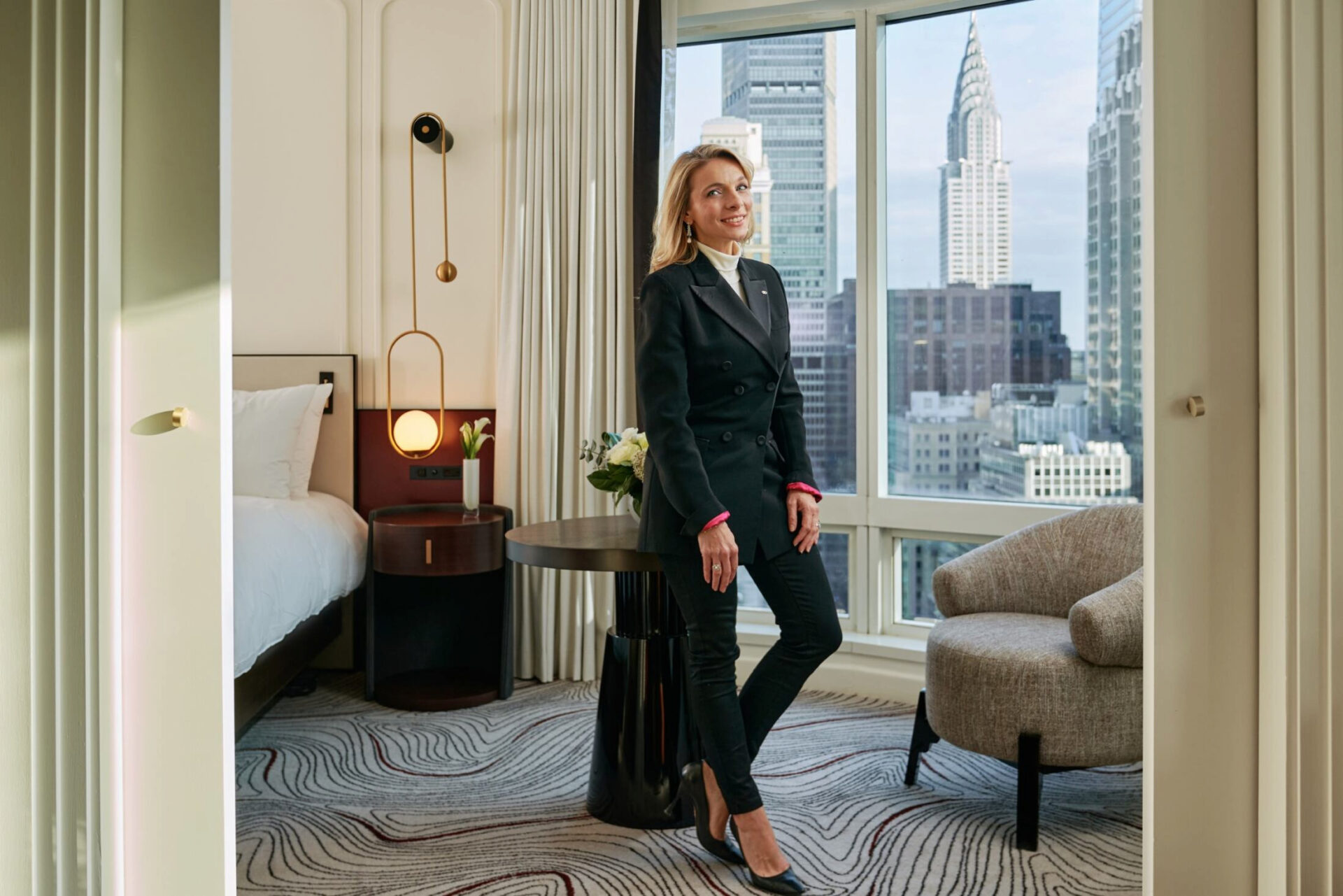
In an exclusive conversation with Beyond the Boardroom, the Global CEO of Sofitel, Sofitel Legend, MGallery and Emblems at Accor gets candid about brand mortality, the discipline of identity, and what it actually takes to resurrect a luxury name in a market growing more crowded by the quarter.
There’s a particular kind of courage required to stand in front of 170 hotel owners at a black-tie gala dinner and replace the expected with the unexpected. No keynote, no polished video reel, no glitzy presentation of stocks and numbers. Instead, a catwalk with models and real Sofitel employees, side by side, walking with equal pride in a bespoke collection designed by Cordelia de Castellane of Dior Maison. For Maud Bailly, Global CEO of Sofitel, Sofitel Legend, MGallery and Emblems at Accor, that evening in Paris in June 2025 was the springboard for the most intentional statement of brand she could make: Sofitel is very much alive, and the people who carry it every day deserve to feel that vigour in their bones.
Bailly is speaking from a car on the way to a meeting when we connect over Zoom for her first interview with Beyond the Boardroom, and the pace of her thinking matches the pace of travel. What strikes you quickly is not the energy (expected in a CEO mid-revival) but the self-awareness. Nine years at Accor, beginning as Chief Digital Officer tasked with transforming a non-digital-native group into something fit for the modern era, then three years running Southern Europe across seven countries and nearly 2,000 hotels. Bailly was at the helm of that region when Covid arrived and the industry came to a complete stop. When Accor subsequently restructured into two divisions, splitting its eco-to-premium portfolio from its luxury and lifestyle brands, Bailly was handed the latter: not 48 brands as before, but four. Sofitel, Sofitel Legend, MGallery and Emblems. The “Frenchiest” cluster in the group, the one with the most legacy, and frankly, the most to answer for.
That maison presented a challenge that is deceptively common in luxury, of a brand almost everyone has heard of, but not always for the right reasons. Bailly does not soften this. High awareness alongside inconsistent experience; beloved flagships sitting next to properties that had grown tired; a name with genuine heritage surrounded by what she describes plainly as remissness. She inherited a network of around 115 hotels and a legacy that was in her own framing, twofold: “On one hand, the awareness was strong, but sometimes for bad reasons. On the other, aging products, a neglected brand, and no real worldwide animation.” Bailly’s candour is notable; she’s not relitigating failures, simply naming the starting point to contextualise the work done since.
Brands can die. Brands can reignite. It is never a given. It is never for granted.
The framing she reaches for is not one of crisis management or turnaround strategy. It’s something more philosophically acute to the mortality of brands. She cites examples with the ease of someone who has spent considerable time thinking through them, names that reignited, names that faded, and names that did not survive the distance between their own mythology and market reality. The lesson, as she tells it, is that brand health is not an asset to be held but a commitment to be renewed, continuously and without exception. “Brands can die. Brands can reignite. It is never a given. It is never for granted.”
The Discipline of Identity
The first act of Bailly’s revival was not a campaign, it was an audit. She spent her first year assessing the entire Sofitel network—hotel by hotel, market by market—and working to close the gap between what the brand promised and what guests actually experienced when they arrived. That process, unglamorous as it sounds, was the necessary precondition for everything that followed. Renovation conversations with owners were opened, and properties that could not realistically meet the brand’s standards were exited. Today, a third of the Sofitel network is either under renovation or has recently completed one, including landmark projects at Sofitel Bangkok Sukhumvit, Sofitel New York, and Sofitel Legend Metropole Hanoi. The Sentosa property in Singapore is currently being reimagined. Several more flagship renovations are set to follow this year.
But Bailly is careful to separate the physical work from the strategic one. Renovating buildings, however necessary, does not answer the more fundamental question of what a brand stands for and why that should matter to the people who experience it. That question required a different kind of discipline, the kind she describes as a “strict methodology around what the brand stands for.” Sofitel, as she repositions it, was never going to compete with the ultra-luxe operators charging $5,000 dollars a night. That was never the proposition, and pretending otherwise would have been precisely the kind of confusion that destroys a brand’s credibility. Instead, the clarity Bailly landed on was more specific, more genuine, and ultimately more defensible: Sofitel as a little piece of France, wherever in the world it operates. Built around a heartfelt, generous culture and a genuine celebration of local culture.
That clarity once established, unlocked a series of partnership moves that have helped reframe how the brand is perceived in the market. Bailly worked with Bernardaud, the storied French tableware house, to create bespoke pieces bearing the Sofitel logo: tactile, specific, distinctly French. She signed an agreement with Air France to equip all business class cabins, placing Sofitel’s “MY BED” in a context that reinforces the brand’s positioning at every altitude. She collaborated with La Tour d’Argent, the legendary Parisian restaurant, on an event series that brought its culinary heritage directly into the Sofitel guest experience. Each of these partnerships was chosen not for scale or reach alone, but because it deepened the coherence of what Sofitel was becoming. When a brand knows precisely who it is she notes, the right partners begin to find their way to the door. “The minute you give pride and respect to your brand, people start looking at you differently.”
The commercial consequences of that repositioning have been meaningful. Pipeline, she shares candidly, had effectively dried up with developers and owners who had gone quiet. Today, the return has begun. Sofitel is on track to open 37 new hotels in the next three years. In New York, a city where the brand had accumulated years of guest complaints about product quality and value, the newly renovated flagship is now generating the kind of guest correspondence that Bailly clearly finds more meaningful than any metric, with emails from travellers saying they had missed the hotel, and were glad to have it back.
When a Brand Remembers its People
At some point during the revival, Bailly paused. The buildings were being restored, the partnerships were in place, and the campaigns were running, and yet something felt remiss. Then she landed on the question of when directing investment everywhere, who was still being left out? She found the answer in the very people delivering the brand every single day. Sofitel’s staff had lived through the difficult years right alongside the brand, many of them deeply attached to it, not as an institutional obligation but as a genuine professional identity. The renovation had given beauty back to the hotels and the guest experience. It had not yet given it back to them.
Luxury is about emotion. We were adding beauty and pride back everywhere, to the clients, to the hotel, to the product, but not to the people.
Bailly reached out to Cordelia de Castellane, artistic director of Dior Maison, Dior Baby and related houses, with an unusually direct brief. She did not want a uniform. She wanted something that would make the people wearing it feel genuinely beautiful, and that would visually embody the shift the brand was undergoing. De Castellane delivered “Le Vestiaire”: a collection of 45 pieces built around a mix-and-match logic, a palette of navy blue, coconut milk, beige and denim blue, carrying the Sofitel visual language, with enough variation in cut, weight and silhouette to work across climates, roles and cultural contexts from Singapore to Dubai to New York.
What distinguished the process was not the designer’s credentials, considerable as they are, but the method. One hundred and ten employees across six global regions tested the collection during development, trialling fit, pocket placement, button position, and fabric weight under real working conditions. Their feedback shaped the final pieces. The co-design was, Bailly says, as important as the design itself, because the worst possible outcome would have been to present the staff with something beautiful that turned out to be irrelevant to how they actually moved through their working day. The collection will be rolled out across the full network from September 2026.
The gala in Paris that June brought it all together. The catwalk reveal, with its mix of professional models and real Sofitel employees, including a trainee who had been with the brand for less than a year, produced a standing ovation from the assembled owners that Bailly describes with obvious emotion. What she appears to value most about that moment is not the spectacle, but what it meant to the people walking: that they were seen, that they were considered, and that the brand they represented considered them worthy of the same beauty it was promising its guests. “Gosh knows how much they love the brand,” she says. “They deserved this recognition.”
The French Paradox: Universal and Singular
One of the more intellectually interesting tensions in Bailly’s account of the Sofitel revival concerns the brand’s most foundational claim: its Frenchness. The aspiration to bring a little piece of France to every corner of the world is vivid and emotionally resonant, but it creates a problem that is both strategic and philosophical. How do you honour local culture with genuine depth and not as decoration, while maintaining a brand identity that guests can recognise and trust wherever they encounter it? How does a Parisian sensibility sit authentically alongside a tribute to Gaudi in Barcelona, or to the Mughal heritage of Jaipur, or to the culture of the Saudi royal family in Riyadh?
Bailly’s answer is structural. She explains the Sofitel logo carries two distinct elements. The first is the consistent promise: the same French service culture, the same sensory markers scent, the quality of the linen, the rituals, the particular kind of joyful, generous, caring attention that she describes as intrinsic to French hospitality at its finest. These elements travel, unchanged, to every property in the network. “No matter where you are,” Bailly notes, “you will find the same reassuring markers that our guests love and want to feel.” The second element is local tribute, and it is here that the brand’s most distinctive creative work happens.
In Jaipur, Sofitel Legend becomes a genuine homage to the city’s identity as the gem capital of Rajasthan—its art, its materials, its craftsmanship woven throughout the guest experience. In Barcelona, the rooms and suites blend Parisian design with pendants directly inspired by Gaudí. In Mexico City, Frida Kahlo’s spirit is present not as a postcard reference but as a deep engagement with Mexican colour, texture and cultural memory. In Riyadh, the property was developed in close collaboration with the Saudi royal family, with an explicit understanding that it should function as a meeting place for cultures rather than an imposition of one upon another. “Every Sofitel has the same promise,” Bailly says, “but it’s never commonly the same.”

This framework of universal consistency of feeling and singular expression of place is not new to luxury hospitality, but it is one that relatively few brands have managed to execute with discipline at scale. The risk in such an approach is that the local tribute becomes superficial, a curated selection of cultural references applied to an otherwise standardised product. What Bailly is describing is more demanding, and requires a genuine investment in the specificity of each location, requiring research, local relationships, and creative courage. The French zest she describes (the particular lightness and insolence, the effortless elegance that is) is the product of enormous effort and serves as the connecting thread. “Of course, it is not effortless,” Bailly laughs. “There is a lot of work behind it.” It gives each property permission to be deeply itself, because the shared identity holding the network together is strong enough to absorb and celebrate that difference.
Consistency as the Final Luxury
Asked to distil what she has learned from the Sofitel revival, Bailly returns repeatedly to a word that does not appear in most brand manifestos but which she treats as a genuine competitive principle: consistency. Not consistency in the sense of uniformity, after all the Jaipur property is nothing like the New York flagship, which is nothing like the forthcoming Mexico City hotel, but consistency in the sense of an unwavering commitment to delivering the same quality of feeling, the same level of care, the same depth of pride, regardless of the market, the ownership structure or the distance from Paris.
Brand is a humility lesson. It is the constant attention, the constant care, the constant reminder that you need to be coherent and consistent.
In a landscape where luxury has increasingly fragmented and the category now encompasses everything from ultra-exclusive, invitation-only experiences commanding thousands of dollars per night to accessible premium brands competing on design and service culture, Sofitel’s positioning is a considered bet on a particular part of the spectrum. Bailly is adamant about this. The brand is not chasing the $5000-a-night guest, and it’s not pretending to. What it is offering (and what she believes the market is genuinely hungry for) is heartfelt, generous luxury at a price point that more people can actually reach. Bailly frames this as something approaching a social position. “The minute you offer luxury and beauty to as many people as possible, you also encourage peace,” she says, “because beauty is all about peace.”
In a market where luxury has become increasingly synonymous with exclusivity to the point of inaccessibility, Bailly is making a different argument altogether. Elegance, when offered generously and consistently, is not a compromise. It might just be the hardest thing to pull off.