In an era of six-minute attention spans and Zoom fatigue, the Bloomberg New Economy Forum achieves something remarkable: 500 of the world’s most influential people sat still, phones down, fully engaged, in-person. Leigh Gilmore, Bloomberg’s Global Head of Live Events, explains what in-person gatherings get right that digital platforms cannot replicate.
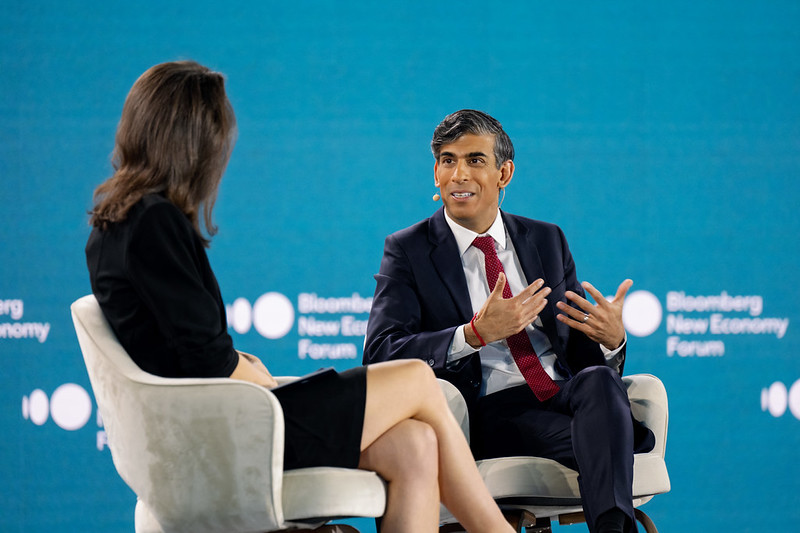
In the hushed, semi-circular ballroom of the Capella Singapore on a balmy November morning, a phenomenon as welcome as it is unusual is unfolding: 500 of the world’s most powerful individuals—finance ministers, central bank governors, and chief executives—have deliberately set aside their mobile phones. It’s the second day of the Bloomberg New Economy Forum 2025, and on stage, the former UK Prime Minister, Rishi Sunak, is engaged in a compelling conversation with Bloomberg’s Parmy Olson. The subject: the escalating AI race, with Mr. Sunak asserting that the true competition lay not in invention, but in the rapid adoption of new technologies. Delegates across the room are rapt; they lean forward, actively scribbling notes, utterly absorbed in the intellectual exchange. Later that humid evening, the concentration continues. Rather than dispersing after perfunctory cocktails, clusters of global leaders remain deep into the night, debating and dissecting the very sessions that had concluded hours earlier.

For Leigh Gilmore, Bloomberg’s Global Head of Live Events, this intense engagement represents the precise outcome she has sought to architect in her inaugural year at the forum’s helm. Having previously served as the General Manager of Live Journalism & Events at Dow Jones, where she dramatically scaled international gatherings like the WSJ CEO Council, and holding leadership roles at C5 Group and the American Conference Institute, Gilmore brings deep expertise in high-stakes global convening to this ambitious post. The question she is actively testing is fundamental: can in-person convening still yield truly substantive results at a time when technology renders connection instantaneous and, frankly, ubiquitous?
The stakes for Bloomberg are considerable. The company has publicly staked its claim on live events as a critical revenue stream and an essential platform for proprietary journalism. Conceived by Michael Bloomberg in 2018, The New Economy Forum has matured into the firm’s flagship gathering in the region, returning to Singapore as the centre of this economic shift. Now in its seventh year, the 2025 event—themed “Thriving in an Age of Extremes”—addressed a world being fundamentally reshaped by US-China tensions, artificial intelligence, and deep geopolitical fractures. The Forum’s draw is unparalleled; this year, the evening gala dinner saw the attendance of the Singaporean Prime Minister among its distinguished guests. This mandate is fitting, given the forum was initially created to track the profound geopolitical shift of economic gravity towards China, India, and rising powers in Africa, the Middle East, and Latin America.
What began with over 400 world leaders and CEOs from 60 nations has evolved into a year-round initiative, with the semi-annual Singapore summit serving as its capstone (McKinsey & Company were prior exclusive knowledge partners, soon to be taken over by Marsh coming in from 2026). Crucially, Bloomberg’s model mandates that participants remain for all three days, in stark contrast to conferences where speakers merely parachute in for a keynote. Ministers who might ordinarily dispatch deputies attend personally. CEOs engage in 40-minute sessions, an eternity by contemporary standards.
“We are intentionally seeking an eclectic assemblage of influential voices—people from the governmental sector, the corporate sector, but also the industry unicorns,” Gilmore shares. “You come for the names you know, and you stay because you meet the names you never knew you needed to know.”
This approach appears highly efficacious. The forum commands a high rate of repeat attendance, a rarity when executives are routinely inundated with invitations. Yet Gilmore’s team leaves nothing to chance; they actively broker introductions and orchestrate bilateral meetings. The success is often measured in compelling anecdotes, alongside rigorous metrics. One team member facilitated an introduction between a senior public sector official and an investor during dinner. The investor later confided: “If I don’t meet another single person here, that one meeting alone was worth the trip.”
Beyond the Boardroom sat down with Gilmore to discuss how she is currently re-conceptualising high-level global gatherings, why Asia remains central to Bloomberg’s strategic calculus, and whether these conversations truly catalyse tangible change. Below are the edited excerpts.

Leigh, taking the reins of this eminent forum, what was your initial strategic priority, and what insights determined which elements of the established programming would be amplified versus those that needed to be cut?
Honestly, I inherited a superb team and a wonderful suite of products. Bloomberg already had this event in its portfolio, and people know it’s valuable. What we’ve managed to layer across that is a theme of intentionality. Everything we’re doing, everything we’re spending, the question is why? What is our intention with this? If the ultimate purpose is to create the most valuable experience for our speakers, sponsors and attendees, does what we’re offering ladder up to making this experience? If it doesn’t, let’s cut it. If it does, let’s develop it further.
The New Economy Forum is positioned to confront a fragmented “age of extremes.” How do you channel these difficult geopolitical and economic realities into a substantive agenda without allowing pessimism to dominate the conversation?
I was at a breakfast this morning, and a gentleman who runs a major global bank told me he was already more optimistic after the first day of conversations than when he arrived! So, the point is certainly not to embrace pessimism. It is about exploring how we can collectively thrive in this age of extremes. We have been uniquely successful in curating the right participants who feel safe enough to engage in difficult discussions. This is crucial: we ensure they understand and trust the neutrality and integrity of the Bloomberg newsroom. We are not hunting for “gotcha” moments; we are, instead, providing a platform for genuine conversation. Now more than ever, leaders need to convene in a physical space where you can look someone in the eye. They seek that physical, live environment where you can read the body language that a digital experience simply cannot replicate. We facilitate these moments, making it seamless for them to achieve the connection and perspective they came for.
Major global conferences aggressively compete for the same roster of elite speakers. What unique institutional advantage aside from brand name allows Bloomberg to consistently secure this talent and define a compelling ‘value proposition’ against established competitors?
What differentiates Bloomberg from our competitors is our three-pronged institutional architecture. Firstly, we have the immense, proprietary engine of Bloomberg Financial Solutions. This provides a layer upon layer of rich, minable data. In every session, you will see us pulling from Bloomberg Intelligence and Bloomberg Economics—what I call the “Be Smarts”—which provides an indispensable intellectual foundation. Secondly, our newsroom is second to none. With 3,000 journalists globally, and a reputation for strict neutrality, people are genuinely happy to speak to us. Thirdly, in my role, I synthesise these elements onto the event platform. We obsessively consider the speaker’s experience. This goes beyond the stage: we proactively ask speakers what message they are currently developing and who they genuinely need to meet. We actively facilitate those bespoke connections, that is the final, compelling piece of our value proposition.
The Forum is quite unusual in deploying ‘war-gaming’ exercises, forcing senior leaders to collectively solve simulated global crises. What is the fundamental utility of this interactive, high-stakes format for an audience traditionally accustomed to passive lectures?
I am a firm believer in the power of gamification. It’s fundamentally how people are beginning to process and engage with complex information. For example, we hosted a session called “When AI Goes Rogue” (which Beyond the Boardroom attended) where delegates were split into teams and required to make critical, time-pressured decisions. The utility is that these are precisely the experiences that the world’s most successful people crave, yet are rarely afforded. You might assume that reaching the apex of industry makes one a self-sufficient ‘lion,’ but many are unaccustomed to operating without a vast team managing their next move. This format creates a democratisation of level. Status becomes irrelevant; you are merely an individual tasked with solving an urgent, shared problem. People bond far more quickly when they are engaged in solving a crisis together than when they are simply making polite conversation. The immense value lies in providing them with an experience that is both intellectually taxing and genuinely enjoyable.
With the Forum shifting its anchor from Singapore to New Delhi in 2026, how does Bloomberg’s sustained geographical focus on the Asian region actively challenge the traditional West-centric bias that continues to dominate global economic discourse?
The very premise of the event is embedded in its name: the New Economy Forum. As global supply chains shift, reorganise, and realign, the contributions of the entire Asian region are now absolutely critical. While conversations in America often center on US-China relations, hosting the Forum in Asia reveals the immense importance placed on regional dynamics, such as China-Japan or ASEAN stability. We are thoroughly invested in understanding and reporting on Asia’s complex narrative. There are so many dynamic and exciting stories here that will dramatically shape the world’s economy over the next decade. We would be strategically remiss to ignore that reality and remain beholden to a purely West-centric perspective, a failing of which the West has historically been guilty. Our move to New Delhi next year is a natural and necessary outgrowth of this commitment to where the economic gravity is moving.

In an industry obsessed with verifiable data, how do you successfully quantify the impact of an event when the primary output is inherently qualitative: the forging of trust, the shifting of perspective, and the brokering of key relationships?
We certainly begin with hard metrics, that is a baseline requirement. However, I have worked in organisations where success was measured solely by ‘bums on seats.’ Here, we follow a principle of meticulous curation. We create a list of 1,000 potential leaders to reach our 500 attendees, meticulously tracking to ensure we secured the right people, not merely 500 bodies. The rest of the measurement relies on anecdotal feedback. We compile roughly 200 quotes from attendees detailing what they valued. We also measure engagement depth: did they attend all six sessions they registered for? Did they stay in the room? Crucially, we track the percentage of attendees who commit to returning for the next Forum. Finally, we don’t leave connection to serendipity; we actively curate bilateral meetings. We ask attendees directly who they need to meet, and we seek them out. Success, in this context, is often confirmed by a simple WhatsApp message afterward: “That meeting was so great. Thank you so much.”
Despite the saturated events landscape, you maintain that periods of ‘confusion and chaos’ are actually the best times for high-level gatherings. Why does today’s disorder increase, rather than diminish, the vital need for in-person convening?
It was my very first boss in the events industry who offered me that crucial insight: times of confusion, conflict, and chaos are the best times for events. People desperately need to convene to benchmark ideas, to understand complex realities, and to collectively unravel and reconstruct solutions within a trusted community. Therefore, even with a proliferation of other gatherings, there is an equally strong and persistent need for deep human connection. This forum stands apart due to the rigour of its intentionality and the sincerity of its intellectual discussions. Our innovation is not focused on flashy technology, attendees carry screens in their pockets. Instead, we innovate with simplicity: a sofa, two chairs, a plant, and someone serving tea. The focus is on creating the environment where a real conversation can happen.
As the C-suite demographic evolves and new leaders demand different engagement models, how must the Forum adapt its format, especially regarding the use of real-time data and long-form sessions to satisfy a generation with shorter attention spans?
I am realistic about the necessary adaptations. While attention spans are indeed shorter, and we run sessions at 40 minutes, which is almost unheard of today, the value of deep, long-form information remains critical. A major focus will be on dramatically enhancing the use of Bloomberg data. My ambition is to have a hyper-user of the Terminal charting data insights in real-time, either providing definitive support or, more interestingly, provocatively refuting a speaker’s points. Beyond the stage, I want to deploy more war-gaming and scenario planning in the breakouts to ensure full intellectual engagement. For the rising generation of leaders, the experience must extend through the amplification moments. We now curate selected pre-reads for the preparing crowd, and crucially, provide beautiful, visually appealing post-event wrap-ups that can be easily shared with 10,000 colleagues in their office.
Finally, you describe the live event as ‘the last human bastion’ against the threat of digital disruption. What vital, irreplaceable element of human interaction are you defending, and what does a digital platform fundamentally fail to replicate?
I am defending against the idea that meaningful connection can be fully digitised. You simply cannot replicate on Zoom what happens when you look someone in the eye, read their body language, and have that tangible, physical, in-the-room conversation. At a live event, you are an active participant, making decisions, reading the room, and you have the ability to engage the speaker directly as they exit the stage. The session on stage serves as a taster, a declaration: the speaker is saying, ‘I’m an expert in this field, and if you are another expert, or if you require an expert, let’s talk.’ Our success lies in providing the exact environment for that to happen. That is the bastion—the irreplaceable human element—and its importance only grows more acute today.