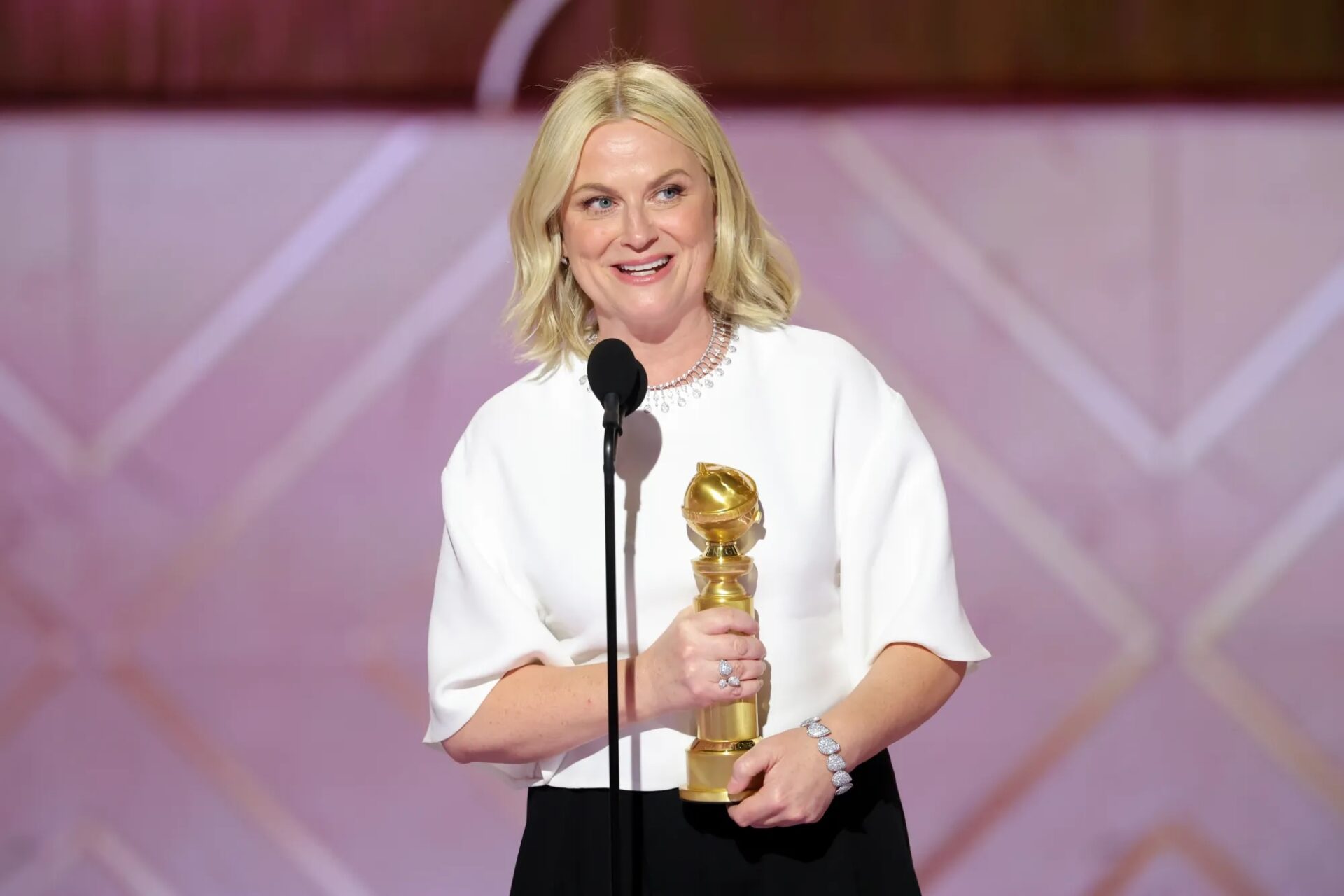
The Golden Globes used its 2026 ceremony to formally induct podcasting into its cultural hierarchy, introducing a Best Podcast category for the first time in the awards’ 82-year history. Amy Poehler’s Good Hang, launched only in March 2025, claimed the inaugural trophy, marking the first time an audio-first format was recognised alongside film and television on one of Hollywood’s most visible stages.
Nominees were selected from 25 of the most-listened-to podcasts based on platform data from Apple, Spotify and YouTube. The final shortlist leaned heavily towards celebrity-driven and institutionally backed shows: SmartLess, Armchair Expert with Dax Shepard, Call Her Daddy, The Mel Robbins Podcast, NPR’s Up First, and Poehler’s own entry. The announcement was met with immediate controversy. Several of the world’s most listened-to podcasts—including those hosted by Joe Rogan, Ben Shapiro, Tucker Carlson and Candace Owens—were notably absent, despite consistently dominating global rankings. The Golden Globes did not publicly clarify the rationale beyond eligibility criteria, submission requirements and voting processes.
The move follows the Globes’ recent efforts to modernise their remit, including the addition of a stand-up comedy category in 2024. Yet the symbolism was hard to miss: podcasting was elevated at the same time the ceremony cut Best Original Score from its live broadcast. Recognition was extended to a new medium by diminishing an old one—a trade-off that immediately raised questions about cultural priorities.
BTB So What?
With over 584 million people listening to podcasts globally in 2025, and that figure projected to reach 619 million by 2026, it was only a matter of time before mainstream recognition followed. Podcasting has moved beyond niche behaviour into habitual media consumption, particularly among younger and more affluent audiences, forcing legacy institutions to respond to where attention now sits. That said, the Golden Globes’ new podcast category is not, on its own, proof of podcasting’s cultural dominance. It is better understood as confirmation of podcasting’s commercial relevance.
Global podcast advertising spend now sits at approximately $4.4 billion, with the broader market valued at over $32 billion, driven by strong brand performance metrics. Podcast advertising consistently outperforms many digital channels on recall and trust, with studies showing ad recall rates of up to 86%, significantly higher than social or display advertising. Nearly 68% of listeners report making a purchase influenced by a podcast recommendation, positioning the medium as one of the most effective environments for persuasion rather than reach alone.
However, influence and institutional recognition are not the same thing. The Golden Globes’ shortlist leaned heavily towards celebrity-led, US-based productions, despite podcasting’s growth being powered by independent creators and global audiences. This suggests that while podcasting has earned economic legitimacy, cultural gatekeeping remains largely unchanged. Awards recognition still flows through familiar Hollywood pathways, favouring name recognition and proximity to existing entertainment ecosystems rather than audience scale or international impact.
For creators in Asia and other growth markets, this distinction matters. Podcast consumption across Asia-Pacific continues to rise steadily, with several markets now approaching or matching US engagement levels, yet this growth is not reflected in global awards visibility. The Golden Globes’ endorsement does little to materially elevate Asian-led podcasts or regional storytelling, reinforcing a long-standing imbalance in how cultural value is recognised versus where it is actually generated. Comparatively, podcasting’s influence looks different from mass-reach platforms like Netflix. Netflix commands scale, but podcasting commands intimacy. YouTube alone now reports over 1 billion monthly podcast viewers, with hundreds of millions of hours watched on connected TVs, underscoring that podcasting is not competing with traditional media so much as absorbing its functions across formats.
Ultimately, the Golden Globes’ move is less a coronation of podcasting’s power than a signal that legacy institutions are catching up to it. For brands operating outside the US, the opportunity remains where it always has been: investing in podcasting as a high-impact, culturally specific channel rather than chasing validation from awards systems still calibrated to American entertainment logic.