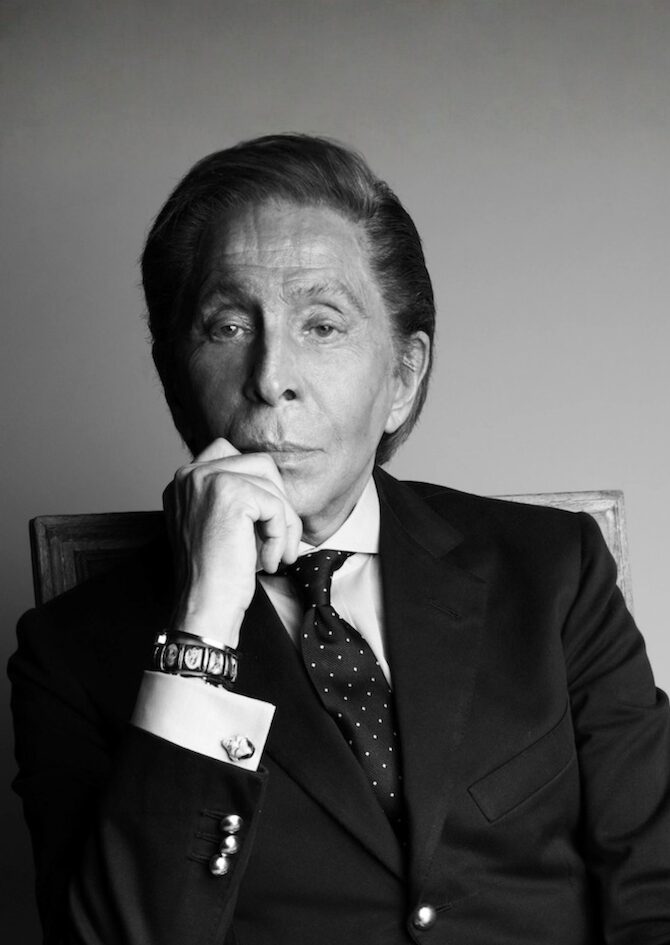
The infamous designer, fashion maverick, and industry legend built a $2 billion empire on a radical premise: that feminine beauty, pursued with absolute discipline could reshape cultural hierarchies and redefine commercial luxury. His death at 93 closes a chapter in fashion history, but the architecture he constructed where aspiration met execution, where glamour became lingua franca for power remains the foundation upon which modern luxury still operates.
There exists a particular shade of red, neither the flat crimson of tradition nor the sharp scarlet of provocation, that requires no attribution to announce its origin. There are bows rendered with such architectural precision they move beyond ornament to become sculpture. And there is a vision of femininity, at once romantic and authoritative, that belongs to no single era because it was never bound by time to begin with.
This is the lexicon of Valentino Garavani.
With the couturier’s passing at 93 in his Roman residence on 19 January, the global outpouring has made clear how deeply his aesthetic philosophy embedded itself in the cultural imagination. Vogue Italia rendered its entire digital presence red monochrome, publishing a solitary image accompanied by two words: “Ciao Valentino.” Pierpaolo Piccioli, who stewarded the maison for eight years, articulated what countless others felt: “He taught me that fashion is joy, a serious and demanding joy, and that beauty is not decoration but a refuge, a form of protection against the world.” From Bernard Arnault to Tom Ford, tributes have materialised in successive waves over the last two days, honouring not just a designer but a cultural architect who fundamentally reshaped how multiple generations understood the interplay between aesthetics, influence and cultural value.
So, how did a boy from provincial Italy ascend to define global glamour itself, transmuting the conviction that women sought beauty above all else into a $1.5 billion fortune?
The Boy Who Watched Too Many Films
Valentino Clemente Ludovico Garavani—named by his mother Teresa after the silent film star Rudolph Valentino—was born on 11 May 1932 in Voghera, northern Italy, where his father Mauro ran an electrical supplies company. By primary school, young Garavani was already apprenticing with his aunt Rosa and local designer Ernestina Salvadeo, learning the fundamentals of cut and construction that would later define his aesthetic.
But it was cinema that truly shaped his vision. “I was crazy for silver screen, I was crazy for beauty, to see all those movie stars being sensation, well dressed, being always perfect,” he explained decades later. In particular, he became obsessed with the 1941 musical Ziegfeld Girl, starring Judy Garland, Lana Turner and Hedy Lamarr. He watched it, by some accounts, more than a thousand times throughout his life, hosting regular screenings in the basement of his Roman residence for the same tight circle of friends he maintained for decades.
What did he see in that film? Perhaps the essential lesson that would guide his entire career: that glamour was architecture, carefully constructed through costume, lighting and performance. That beauty was not accidental but engineered, and that the right dress could transform an ordinary woman into mythology.
At 17, Garavani left for Paris, the undisputed capital of haute couture, where he studied at the École des Beaux-Arts and the Chambre Syndicale de la Couture Parisienne before apprenticing with Jean Dessès and Guy Laroche. When he returned to Rome in 1959 to open his atelier on Via Condotti, he brought a specifically Parisian understanding of luxury: refined, technical, and unapologetically expensive, filtered through an Italian sensibility that prioritised warmth over austerity, romance over intellectualism.
Paint the Town Red
The story of Valentino Red has acquired the patina of myth: the teenage Garavani at Barcelona’s opera house, entranced by an elderly woman in a red velvet gown, solitary and spectacular. Whether entirely factual or emotionally true, it captures something essential about his sensibility: that the right colour, deployed with conviction, could confer invincibility.
The shade he eventually developed (officially codified by Pantone) was a mix of carmine and scarlet with that crucial hint of orange, and made its debut in 1959 with “La Fiesta,” a strapless cocktail dress in draped tulle. It wasn’t the first red dress in fashion history, but it was perhaps the first to function as brand DNA, appearing in at least one iteration in every collection he produced over nearly five decades. “I think a woman dressed in red is always wonderful, she is the perfect image of a heroine,” Garavani wrote in his 2022 book Rosso.
This was colour as conviction. Where other designers used hue for seasonal punctuation or conceptual commentary, Garavani treated red as philosophy: the visual embodiment of confidence, visibility and unapologetic femininity. It announced presence, demanded attention and said, “I am here, I am glorious, and you will notice me.” Long before logomania became industry orthodoxy, Valentino had created instant brand recognition through colour alone. A flash of that particular red across a crowded room signalled not just expensive taste but membership in a specific tribe, that of women who understood beauty as both armour and advertisement, and who knew that being seen was a form of power.
In 2003, the brand launched Red Valentino, a diffusion line that democratised access to the aesthetic whilst maintaining its essential DNA. By 2015, the line accounted for approximately 10% of Valentino Group’s sales before being discontinued in 2022, having served its purpose of embedding that particular hue into the broader cultural consciousness. As Chinese fashion influencer Lolo Zhang observed at Paris Fashion Week following Garavani’s death: “I cannot forget the stunning red he created.” The colour had become inseparable from the man, transcending fashion to become what one fashion scholar called “cultural symbolism”, a shade that now exists in the collective imagination as a symbol of elegance, passion and the kind of confidence that needs no explanation.
The Art of Aspiration
If colour was Garavani’s signature, his true genius lay in understanding the mechanics of aspiration, and how desire moved through culture, who transmitted it and how fashion could position itself at the intersection of multiple forms of power. This was never more evident than in his relationship with Jacqueline Kennedy, whose friendship with Garavani elevated him from talented designer to cultural institution.
They met in 1964, shortly after President Kennedy’s assassination, when the newly widowed First Lady spotted one of his designs and immediately inquired about the creator. She purchased six couture pieces and began wearing them publicly during her mourning period—what Vanity Fair editor Graydon Carter would later call “the chicest mourning attire in history.” It was an extraordinary convergence: a woman who had become, through tragedy, the world’s most photographed figure, using fashion to navigate grief whilst simultaneously projecting continued relevance, choosing a designer who understood that clothes could function as both shield and statement. Their friendship lasted decades. Kennedy wore Valentino almost exclusively for years. Most famously, she chose a long-sleeved ivory lace dress from his Spring 1968 couture “White Collection” for her wedding to Aristotle Onassis, a garment that caused international sensation and cemented Garavani’s reputation as the designer who understood how powerful women wanted to be seen.
What Kennedy grasped—what all of Garavani’s most devoted clients intuitively understood—was not novelty, but reliability. His clothes did not promise reinvention or provocation; they offered continuity, a way of being seen that remained consistent across decades, geographies and moments of transition. Worn by women navigating public scrutiny, ceremony or power, his designs provided a stable visual language. Formal without severity, romantic without fragility, and decorative without triviality. This consistency is what allowed Valentino to move so seamlessly through culture. A Valentino gown required no explanation. Its signals craft, status, and composure were already legible. His work shaped not trends but expectations, contributing to a shared understanding of what elegance looked like when authority and femininity needed to coexist.
Welcome to the Business of Beauty
The empire Garavani built alongside his life and business partner Giancarlo Giammetti, whom he met in a Roman café in 1960, the same year he opened his atelier, represented a masterclass in brand construction that predated most contemporary luxury strategies. “To share life with a person for your whole existence—every moment, joy, pain, enthusiasm, disappointment—is something that cannot be defined,” Garavani said of Giammetti. Their division of labour was absolute: Garavani as creative visionary, Giammetti as strategic architect. After early financial setbacks (Garavani’s tastes were always lavish), they found their rhythm, building what would become one of the most successful independent fashion houses of the late 20th century.
The numbers tell the story. When they sold to Italian conglomerate HdP in 1998 for approximately $300 million, they had created something rare in a fashion house that functioned simultaneously as artistic statement and commercial juggernaut. The 2012 sale to Qatari fund Mayhoola for approximately $858 million (€700 million) reflected continued value appreciation, whilst Kering’s 2023 purchase of a 30% stake for $1.87 billion (€1.7 billion) valued the company at over $6 billion. When the brand generated $1.36 billion in revenue in 2021, 13 years after his retirement, it demonstrated that what he had created could survive succession, ownership changes and evolving market conditions. His personal fortune, estimated at $1.5 billion at his death, was the product of strategic foresight as much as creative genius.
Yet Garavani himself always maintained that commercial considerations remained secondary to aesthetic conviction. “I think I have succeeded through all these decades because I was always concerned with making beautiful clothes,” he told Vanity Fair in 2004. “Forget about fashion, the grunge look, the messy look. I cannot see women destroyed, uncombed, or strange. I want to make a girl who arrives some place and makes people turn and say, ‘You look sensational!'” Whilst contemporaries like André Courrèges and even Yves Saint Laurent responded to cultural upheavals with miniskirts, androgyny and political commentary, Garavani remained steadfastly committed to a vision of femininity that was romantic, architectural and unapologetically glamorous. The 1990s grunge movement and minimalism never appeared on his catwalk. He simply ignored trends that didn’t align with his aesthetic convictions.
The Architecture Remains
As tributes permeate the strata of fashion and culture, the dialogue has shifted. The question is no longer the magnitude of Garavani’s impact, but the resilience of the architecture he has left behind. His genius lay not merely in the silhouette, but in the structure, a system of values so precise it demands no preservation in amber, yet so fluid it invites the future.
This transfer of responsibility began long before his passing. When the house transitioned, it refused the stagnation of reverence. Under Pierpaolo Piccioli, Valentino demonstrated the true potential of stewardship. The global saturation of PP Pink was not an act of rebellion, but a masterful extension of the Garavani grammar. If Valentino Red was the colour of imperial authority and polished control, Piccioli’s pink articulated visibility and collective belonging. The shade had shifted, but the underlying logic of colour as a singular, organising principle, remained unyielding.
The market has validated this intellectual rigour with clarity. In 2024, Valentino’s revenue reached approximately $1.42 billion (€1.31 billion), while Kering’s strategic acquisition of a 30% stake in 2023—serves as more than a financial milestone. It is a testament to the brand’s vitality; proof that Valentino remains a functioning cultural system rather than a legacy brand in stasis. Now, the mantle of custodianship falls to Alessandro Michele. As he begins to imprint his own singular, maximalist touch upon the house, the transition represents the ultimate test of the Valentino framework. Successors will no longer judged by an ability to mimic Garavani’s hand, but by an aptitude for navigating his blueprint and interpreting the foundational codes through a contemporary lens.
Ultimately, Garavani’s most profound gift to culture is a framework that survives his absence. In an industry where meaning often evaporates once the author departs, he achieved the rarest of feats: the creation of a language so robust it can accommodate new voices while retaining its own grammar. That is not merely a career, it’s an enduring architecture of the human spirit.