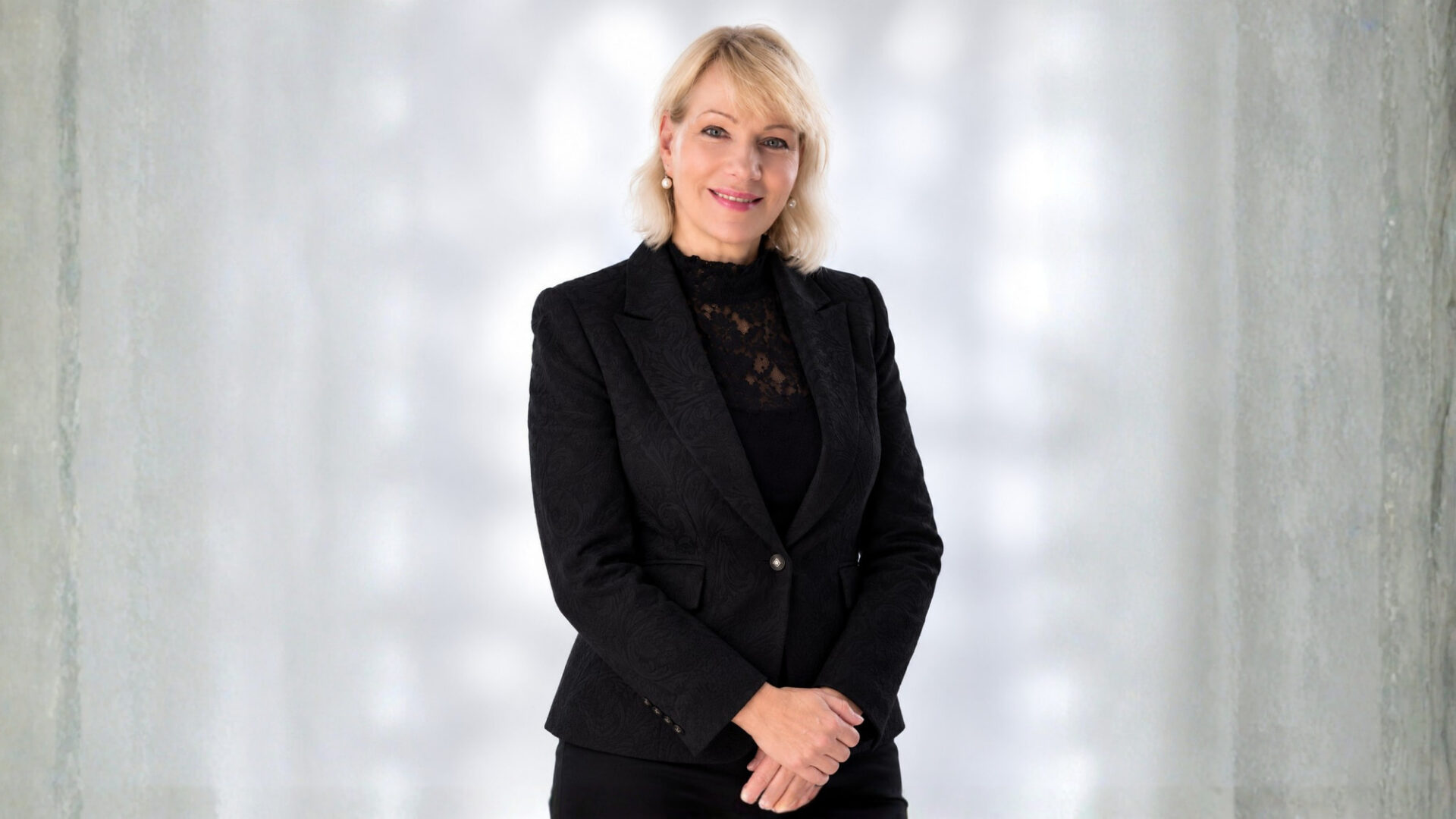
Margarita Louis-Dreyfus, Chair of the 175-year-old agricultural powerhouse Louis Dreyfus Company, believes the greatest inheritance is not wealth, but strength, character and a sense of responsibility. For our October issue, themed Succession: Luxury in Generations, we sat down with her to explore the complexities of generational leadership, the pursuit of happiness and what it truly takes to build a legacy that endures.
Ask the head of a centuries-old family enterprise about succession and the conversation tends to turn quickly to share structures, trusts and governance. Margarita Louis-Dreyfus starts with what money can’t buy.
I first meet Margarita Louis-Dreyfus in Singapore at AT ONE Impact Week, an annual gathering of business leaders, investors, family offices and policymakers exploring a deceptively simple question: “What if love became infrastructure?” Spanning conversations on well-being, education, climate, energy and food systems, the forum brings together those seeking to rethink how business and society might serve future generations.
It’s a fitting setting for the chair of Louis Dreyfus Company, one of the world’s largest agricultural trading companies. Speaking on philanthropy and the influence of digital technology on young people, Louis-Dreyfus approaches the future through two closely intertwined perspectives: that of a business leader responsible for a 175-year-old enterprise, and a mother of five and grandmother of five concerned about the world her family will inherit. It’s a conviction she’s also championed at international forums, including the World Economic Forum, where she has advocated placing children’s interests at the heart of technological innovation.
When we reconnect for our interview, it’s a Saturday morning in Switzerland, and Louis-Dreyfus is at a Latin dance competition with her daughter. As she waits for her daughter to have her hair done before taking the floor, she answers my call. “We don’t have that much time,” she tells me. Even amid the demands of overseeing a global business, she is, at this moment, a mother attending to the rhythms of family life. As our conversation unfolds, it becomes clear that Louis-Dreyfus sees little distinction between the two worlds. Whether raising children or leading a multigenerational enterprise, she believes the principles remain remarkably similar: making difficult decisions, adapting to change and above all, recognising that the choices we make today will shape the lives of those who come after us.
The Success of Succession
As Chair of LDC, Louis-Dreyfus presides over one of the world’s largest agricultural trading enterprises, responsible for approximately 10% of global agricultural trade flows. Founded in 1851, the company has remained under family control for 175 years, its longevity a testament to the enduring influence of dynastic enterprise. Yet Louis-Dreyfus’ own ascension to its helm was neither anticipated nor sought.
Her late husband, Robert Louis-Dreyfus, led the business until his death from cancer in 2009. Throughout his illness, she absorbed his ambitions for the company’s future, never imagining that she would ultimately be entrusted with their realisation. “I listened to everything he told me about his vision of the future, but I never prepared to do it myself.”
When I ask when she first confronted the magnitude of that responsibility, her recollections return not to the boardroom, but to the hospital. Robert’s care was overseen by five eminent doctors, each advocating a different course of treatment. Faced with competing medical opinions and a husband unable to make the decision himself, the responsibility fell to her. “It fell to me,” she recalls. “That was the greatest responsibility of my life.”
The experience fundamentally altered her relationship with difficult decisions. “When I chose and a life depended on it, I was afraid of making a mistake. It was an enormous weight on my shoulders.” Against the gravity of such a choice, even the most consequential business decisions would later assume a different perspective. In the years following his death, it was Robert’s vision that provided both direction and resolve. “If there hadn’t been his vision, if there hadn’t been all those talks in hospitals, I don’t know how I would have reacted.”
Initially, she understood her responsibility in deeply personal terms. “He was the owner. He was a genius in business. It was, above all, his firm. So my responsibility was to him personally—to keep his legacy.” But stewardship, she came to recognise, could not be confined to preservation. “Little by little it came to this: you simply have to adapt and make the company stronger.”
It’s a distinction that sits at the heart of her philosophy of succession. To inherit an enterprise is not merely to safeguard what previous generations have built, but to ensure its continued relevance and resilience. The obligation extends in both directions, honouring those who came before while creating the conditions for those who follow to flourish. Her own family embodies this continuity. Of her five children, her three adult sons are shareholders in the business, while her two youngest daughters are just 10. Kyril Louis-Dreyfus has established himself in professional football as Chairman of Sunderland AFC, while Maurice Louis-Dreyfus serves on the supervisory board of Louis Dreyfus Holding (LDH), the family’s holding company. Her two-year-old grandson already represents, as she puts it, the “Louis-Dreyfus sixth generation.”
Yet the privileges of a multigenerational enterprise have not insulated the family from personal sacrifice. Louis-Dreyfus speaks candidly of the years consumed by her husband’s illness, when the demands of hospital visits and medical decisions came at the expense of time with her young sons. There were aspects of motherhood she had hoped to experience more fully, opportunities that could not be reclaimed. What she sought instead was to instill an enduring understanding of their place within a larger continuum. “Responsibility to memory is the greatest one,” she says.
That conviction has also informed her experience as a woman at the helm of a traditionally male-dominated industry. Asked whether her gender has proved an advantage or an impediment, her response is unequivocal. “It helps. Definitely.” Born and raised in Russia, Louis-Dreyfus recalls encountering more overt displays of machismo in Western business circles than she had experienced growing up. Rather than challenge the assumptions made about her, she often found it advantageous to allow them to persist. “Let them think I’m weak, a blonde, a fool. It didn’t bother me at all. First, I know who I am. I don’t need anyone telling me.”
Her confidence is accompanied by a refusal to regard motherhood and corporate leadership as opposing disciplines. Indeed, she considers the intellectual and emotional demands of raising a family every bit as formidable as those of managing an international enterprise. “Motherhood demands at least as much intelligence and patience as running a company. That’s why so many people stay childless today, it’s hard.”
She recalls occasions when seemingly intractable negotiations shifted once her counterparts understood the principles motivating her decisions. “They understood that motherhood is, above all, care. For the firm, and for people.” It’s an unconventional articulation of corporate leadership, particularly in an industry governed by vast commodity flows, complex supply chains and commercial imperatives. Yet Louis-Dreyfus sees no contradiction between commercial strength and the cultivation of human relationships. Her ultimate ambition, she explains, is not the maximisation of profit at any cost, but the pursuit of harmony within the family, across the enterprise and, ultimately, in the wider society it serves.
Let them think I’m weak, a blonde, a fool. It didn’t bother me at all. First, I know who I am. I don’t need anyone telling me.
Strong Before Happy
Louis-Dreyfus traces her sense of responsibility to an upbringing in which gratitude and obligation to previous generations were deeply ingrained. Their apparent erosion in contemporary society is a growing concern. “When I compare it with my childhood, that moral responsibility was everywhere. We breathed it. Responsibility to the generations that came before, and gratitude for everything they did for us. Our parents made plenty of mistakes, but they tried their best. They sacrificed a lot.”
Such values, she argues, provide young people with a sense of belonging and an anchor against “the wind that blows in every direction today.” Without them, “they are like bubbles, feeling they owe nothing to anyone and that nothing holds them.” She’s particularly concerned about the influence of technology on younger generations. In a culture increasingly conditioned by instant gratification, the patience and discipline required to cultivate character risk being displaced by the ease of digital consumption. “It’s much easier to let go of that sense of responsibility, that connection, and simply fill yourself with the digital sugar. But then we become weak.” She describes the phenomenon as “diabetes of the brain” or “diabetes of society,” warning that artificial intelligence risks leading humanity further down this “very sweet path.”
Her response is a philosophy of child-rearing built around four foundations, beginning with a proposition that challenges contemporary notions of well-being: happiness should not be the ultimate objective. “It’s not within the power of parents. The word ‘happiness’ should be used very rarely. We can and must try to make them strong. And then, maybe, they will make themselves happy. Maybe.”

Margarita Louis-Dreyfus pictured with her son, Kyril Louis-Dreyfus, Chairman and majority owner of Sunderland AFC, and family.
Photo: Courtesy of Margarita Louis-Dreyfus.

The first foundation is character, informed by the work of Austrian-American psychiatrist Rudolf Dreikurs, whose approach to child-rearing she regards as a guide to developing “the muscles of character.”
The second is purpose, cultivated through a method she calls Purposeful Resilience Training. Beginning around the age of two, children are encouraged to recognise how their actions might benefit others. When her daughters draw, rather than simply praising their work, she asks, “Who did you draw it for?” Perhaps it is for their grandfather, to cheer him up when he has a headache. “It’s the most important question.”
Motherhood demands at least as much intelligence and patience as running a company.
The third is community. Her daughters, now 10, will not receive smartphones until they are 16, instead carrying basic Nokia phones when travelling independently. “Better to give a child a book. Let them read on the train. Or look out the window.”
She also encourages parents to establish networks of 10 like-minded families, meeting weekly to reinforce shared values and a sense of belonging. From the age of six or seven, children should participate in an hour of meaningful work, whether cleaning a beach or repairing something broken, with families taking turns to organise activities. “Coming up with a useful activity requires enormous imagination today, because nobody needs anything. There are robots and services.” The intention is to instil an understanding that belonging to a community carries an obligation to contribute.
Her fourth foundation concerns the cultivation of ambition, beginning with the idea that a child’s aspirations should extend beyond personal achievement. A four-year-old fascinated by Lego, for instance, might be encouraged with the thought, “How lucky I am. I’ll have an architect who will build us the most beautiful house.” Her views become more contentious when she distinguishes between the aspirations she believes should be encouraged in boys and girls. For daughters, she considers motherhood a defining ambition; for sons, she emphasises heroism rather than fatherhood, which she regards as less instinctive.
It’s a perspective at odds with prevailing ideas about individual autonomy and the freedom to choose whether to become a parent. Louis-Dreyfus, however, is unapologetic. “Today girls are told they will live for themselves. That they will explore the world, or save the world. But the strongest thing in a woman is her motherhood.” She recalls an exchange with a 21-year-old mathematics student at an elite American university working in AI, who suggested that she and her peers saw little difference between loving a child and loving a startup.
“She doesn’t understand what love is. Love is, above all, giving all of yourself. If you were so ill you could barely move an arm or a leg, would you go to the pharmacy to get medicine for yourself? Probably not. But if your child needed it, you’d rise from the grave.”
This emphasis on selflessness and restraint extends to the everyday rituals of her household, where she is raising her 10-year-old twin daughters, Isabella and Arina, whom she shares with Philipp Hildebrand, Vice Chairman of BlackRock and former Chairman of the Swiss National Bank. Despite the family’s wealth, her daughters receive presents only twice a year, on their birthdays and at New Year, with books the sole exception. When they ask for something, she reminds them how many months remain until the next occasion. “They have to be able to dream, to have patience, to wait for something.”
Isabella and Arina have also received pocket money since starting school, learning to save rather than expect immediate gratification. “I don’t think children need more than ten toys, and even that is too many. Five is best.” Some of their toys are eight years old, their familiarity becoming a lesson in attachment rather than disposability. “I tell them, this bear has known you since you were tiny, saw you losing your baby teeth. You can’t just throw him out and replace him.” Even relatives are asked to coordinate their generosity, limiting presents to one per family.
For Louis-Dreyfus, such practices reflect a broader conviction: that in a world of material abundance and technological convenience, patience, gratitude and an appreciation of what one already possesses are qualities that must be consciously cultivated.
[We owe a] responsibility to the generations that came before, and gratitude for everything they did for us.
Generation Next
For Louis-Dreyfus, succession is not about preserving a 175-year-old enterprise exactly as it stands, but ensuring that each generation has the judgement and independence to carry it forward. She offers the sixth generation no immutable blueprint, nor any prescription for what the company should become. “Whatever makes it stronger, that’s what they must choose.”
Her philosophy rests on a recognition that the decisions of one generation invariably shape the fortunes of the next. “If we take something for ourselves, we might get away with it,” she says. “But the problem will fall to our children. So we think far ahead.”
Perhaps therein lies the true measure of succession. Not simply in the wealth or enterprise one leaves behind, but in the strength of those entrusted with its future. For Louis-Dreyfus, the greatest inheritance is ultimately the capacity to build upon what came before, and the wisdom to leave something stronger for those who follow.