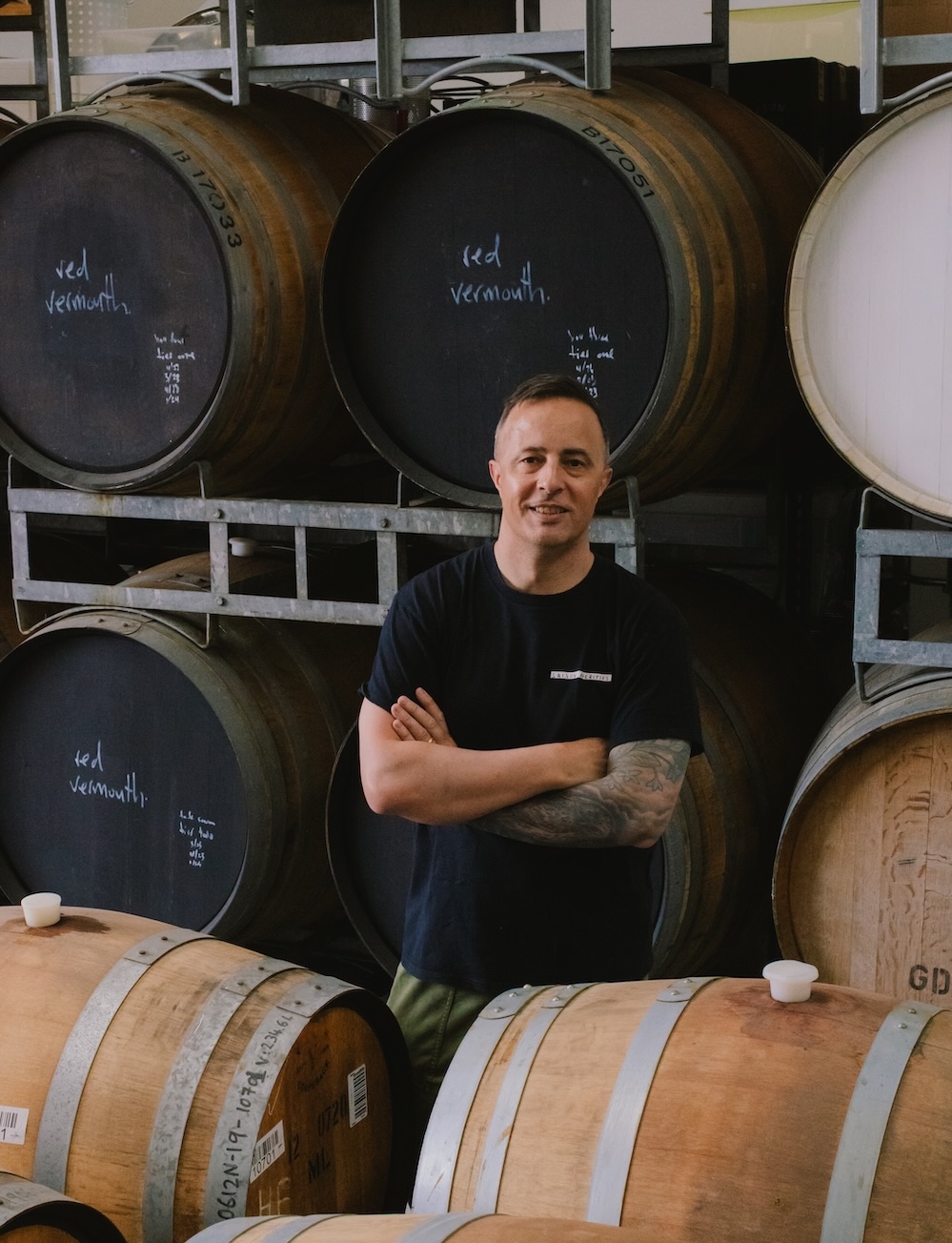
From the high-pressure kitchens of The Savoy to Melbourne’s acclaimed wine bars, Dave Verheul’s career has been a masterclass in detail-oriented culture. Now, with Saison Aperitifs, he’s successfully translated the chef’s rigorous pursuit of seasonality, transparency, and flavour into a scalable, high-growth business, setting a new standard for the global low-ABV market.
For centuries, the aperitif has belonged to Europe. Those vibrant, often bitter preparations designed to awaken the appetite have been the preserve of storied continental houses, each wrapped in mythology, their recipes guarded like state secrets. Yet the category has grown stale, obscured by dated narratives and a curious opacity around modern production methods.
In Melbourne, however, a different story is quietly unfolding.
Saison Aperitifs, the work of chef and restaurateur Dave Verheul, wants to offer something rare: a seasonally driven, transparent, chef-led approach to a world still defined by old-world convention. It’s an endeavour shaped not by inherited tradition but by discipline, clarity, and an unshakeable belief that flavour should reflect the integrity of its ingredients.
What makes Verheul’s trajectory particularly striking is how improbable it was. Growing up in Dunedin, in the deep south of New Zealand, his childhood bore little resemblance to the formative experiences that shape most chefs. “I grew up in a city that didn’t have a huge amount of food culture,” he recalls to Beyond the Boardroom. “I didn’t eat pasta until I was a teenager.” It was a town of farmers and traditional cooking, where professional kitchens existed somewhere else entirely, in a world he hadn’t imagined joining. His entry into hospitality came almost by accident—a friend’s aunt owned a Lebanese restaurant that hosted jazz nights on Tuesdays, the kind of venue where university students gathered for cheap drinks and live music. When she offered him work in his early twenties, he accepted, knowing nothing about food but curious enough to try.

Photo: Courtesy of Dave Verheul.
Before that kitchen, there had been other paths. A psychology degree at university that left Verheul cold. Time spent working construction alongside his father, which he’d enjoyed without ever feeling truly drawn to it. A fleeting fantasy about becoming a professional snowboard instructor, chasing winters around the globe—one of those plans that sounds brilliant at 18 and quietly dissolves by 25. The kitchen, though, offered something different. “I was always into kind of semi-adrenaline sports and things like that,” he explains. “And that was like a work version of that. It was fast, it was complicated, there was pressure. I really, really enjoyed it.” The spark was immediate, unmistakable.
The woman who owned that Lebanese restaurant eventually told Verheul something crucial: if he wanted to learn how to cook properly, he had to leave Dunedin. So he moved to Wellington, enrolled in combined business and cookery courses, and started working at the best restaurant in town. Then came the break that would define the next phase of his career. One of his training centres was hosting a scholarship run by Gordon Ramsay’s organisation. “I went along, introduced myself, told them I was moving to London in a month, and they told me to come and see them,” he remembers. “So I walked in the door on the first day I was there and started work on the second, completely jet-lagged.”
The years that followed were uncompromising in ways that shaped everything Verheul would later build. “When you get into the senior end of those kitchens, you’re at work before seven and you’re leaving after 11pm,” he says. Shifts stretched day after relentless day, with celebrity chef Marcus Wareing positioned cross-armed against the bench, staring without blinking for three hours straight—a particular form of scrutiny designed to expose any weakness, any lapse in technique or concentration. This was the early 2000s, when hospitality’s cultural nuances were both more visible and pronounced, and the expectation of excellence left little room for anything resembling balance. “I still learn all of the things that I learned in that kitchen, culturally and technique-wise and business-wise to this day,” Verheul reflects. The work was brutal. It was also formative.

Eventually, the darkness cracked him. Not the pressure or the hours, but the sheer absence of light. “I think I just cracked,” he admits. “I got to late January, and it’d been cold and dark for months and months and months, and all of your family and your friends are having summer holidays, and it’s just torturous.” Australia became the obvious answer. He spent five years in Sydney, working at the Bentley under Brent Savage and Nick Hildebrandt—operators known for running modern, professional businesses. Then came a return to Wellington to run the Matterhorn, before finally settling in Melbourne, where he and business partner Christian McCabe co-founded The Town Mouse and later, cult wine bar Embla.
Embla, which turns a decade old this December, has become something of a quiet phenomenon. “When we opened 10 years ago, it was us and one other place that were doing the modern wine bar with food,” Verheul recalls. “It just wasn’t a thing anywhere.” It wasn’t pitched at the highest end of the market, nor was it casual, but it occupied a sweet spot that felt almost radical in its accessibility. The design was democratic, the service professional but approachable. “You could be a young musician, or you could be someone off Collins Street hosting a business lunch, and it works the same for everyone,” Verheul explains. The philosophy, as he and McCabe describe it, is to be “extremely professional, but approachable.” The food consistently exceeded expectations, the wine list was thoughtfully curated, and the atmosphere remained deliberately un-stuffy. Now it’s become a template copied across the city.
It was in Embla’s kitchen, whilst searching for something to serve alongside his dishes, that Verheul began making his own vermouth and amaro. At first, it was simply a creative outlet, a way to stave off the monotony that afflicts even the most passionate cooks when the work becomes repetitive. “When you work in food, and you work at the pointier end of the industry, it’s all about point of difference,” he says. “Cooking professionally, while it’s tough in many ways, one of the toughest things is that it’s incredibly monotonous. If you’re not learning and progressing and moving forward, then you tend to burn out, or it’s just an incredibly boring job.”
Some chefs teach themselves to make bread, to cure meats, to push into adjacent crafts that keep the mind engaged. For Verheul, that meant crossing into the world of alcohol, teaching himself through trial and error because there was no other way to learn. “We started off making some little things in the kitchen,” he recalls. “To be fair, they started off pretty bad,” explaining that the old European families who produce these drinks guard their methods with almost comical secrecy. “All of these things, there’s no literature anywhere. There’s no recipes. You can’t Google it,” Verheul explains. “All of the information is very tightly held by the old families that create these products in Europe. The only way of finding how to make these things is being in or marrying into an old Italian or Spanish family,” he jokes.

So he experimented—obsessively, methodically—for a decade. “Everything that we do now is trial and error and self-taught,” he shares candidly. The early attempts were rough, but they improved, slowly and steadily, as he refined his understanding of extraction, balance, seasonality.
The breakthrough came just before the pandemic, during Embla’s annual review. An unassuming critic was about to have dessert when Verheul, in a moment of courage, served her one of his house-made drinks instead. “Like most hospitality people, when there’s one person deciding your points rating for the year, you’re spying on them out of some kind of crack in the restaurant,” he laughs. “She drank it, and she seemed to like it…and she did! Then, she wrote about it.”
That small endorsement became the catalyst. Verheul secured his licensing shortly before Australian lockdowns descended in 2020, then watched as Melbourne entered the longest lockdown in the world—200-plus days of restrictions that paradoxically became the perfect launchpad for a new drinks brand. People were drinking at home, seeking novelty, open to trying something different. The first batch—228 bottles—sold out within a week. “I honestly did not know if it was going to sell or not,” Verheul admits. “We were about to open a rooftop bar and cinema on the building next door to Embla for the summertime. I thought, you know what, if it doesn’t work, I’ll put it in a spritz. No harm, no foul.” The second, larger batch disappeared in four days. Every release since has sold out before launch, driven not by traditional marketing but by something harder to manufacture: genuine enthusiasm spreading through the hospitality ecosystem. “We haven’t spent any money on marketing whatsoever, really,” he says. “It’s all grown from people’s good experiences with the product, people sharing it with their friends, being adopted into the best bars and restaurants and bottle shops.”

The product itself sustains that momentum because it challenges fundamental assumptions about what vermouth should be. “If you ever sit in a little vermouth bar or wine bar in Barcelona or Madrid, you get given a vermouth that’s dark, sweet, brown and caramelly, and they give you olives and anchovies and chips,” Verheul observes. “In my mind, working with food for so long, I just couldn’t understand why you needed something else to balance it. Why can’t they be balanced from the beginning?”
So Saison’s aperitifs are lighter, cleaner, far lower in sugar and bitterness than their European counterparts. “The whole premise is that they’re seasonally matched to the season that they release in,” he explains. “The summer releases are really light and floral and pretty, and the winter releases are darker and richer, in the same way that your body craves that kind of food when you have seasons.” The drinks sit in a category of their own: “They’re not overly bitter, they’re not overly austere or spiced. They’re actually just really light drinks that are not particularly high in sugar, made from natural ingredients. There’s no flavour companies or any type of bull**** whatsoever.”

“We work really closely with a network of farms that I’ve set up over the years through the restaurant,” Verheul explains. “One guy brings me so much elderflower that you’ve never seen so much elderflower ever, once a year.” Then there are the organic farms cultivating bittering herbs, the quinces processed at their seasonal peak. “There are a lot of shortcuts that could be made, but we definitely take the harder road,” he says. “For us, that’s important, because it definitely shows in the end product when things are actually made from natural ingredients grown by good people in the right way, people that care for the land and the communities that surround their businesses.”
These relationships weren’t built for Saison; they were forged during Verheul’s restaurant years, when finding the right suppliers meant everything. Repurposing them for a different product has created a supply chain based on trust rather than scale, on quality rather than convenience. It’s also what allows Saison to occupy a distinctive position in the low-ABV drinking movement, where transparency, provenance, and flavour matter more than density or sweetness. Yet flavour, for all its supposed universality, doesn’t travel evenly across borders. “We make one from quinces, which you don’t really get through Asia or South Asia,” Verheul notes. “For us, it’s one of our best sellers here, and definitely in New Zealand it’s our best seller. But through Asia, it’s incredibly hard, because people just don’t have a base to liken it to.”
Cultural familiarity shapes taste in ways that no amount of quality can overcome, and Verheul is refreshingly frank about the learning curve, particularly when it comes to cultural education. “This question wouldn’t be applicable if you’re from Europe, where the culture of hanging out with your friends and having a vermouth is very common,” he observes. In markets less familiar with the category, he’s loved helping consumers understand not just Saison but vermouth itself. “The drinks that we make, we can slot them into all of the traditional uses, spritzers and stirred drinks and all of those things. But they also sit in a category of their own.”
Asian markets present particular opportunities: “People don’t really drink at home very much. There aren’t really very many retail stores, which is the polar opposite to how we consume alcohol in Australia,” he notes, sharing that his distributor in Singapore has been pushing for products tailored to local palates, a conversation Verheul remains open to exploring as the brand expands.
Growth brings its own complexities. Saison is now available in eight countries, about to enter several US states, and navigating the distinct regulatory environments, logistical constraints, and cultural nuances that come with each new market. As noted above, the company hasn’t spent money on traditional marketing; everything has grown organically, through recommendations and early adoption and word of mouth. “When you have that kind of trust relationship where a customer is sitting in a bar or restaurant and the person serving them says, ‘Hey, try this, it’s excellent,’ it’s honestly the best way of growing,” Verheul reflects. But that model has natural limits. Scaling requires capital, expanded production facilities, and eventually, a more structured approach to brand building. Verheul is currently raising a small round to support that next phase, though the intention remains to grow without compromising the principles that make Saison distinctive.
There’s also the question of format. Saison recently partnered with Mischief Brew, an Adelaide-based producer of natural sodas, to launch a canned amaro tonic. “We describe it as a natural spritz for grown-ups,” Verheul says with obvious amusement. In Australia, canned drinks are a way of life, though they’re often dismissed as inherently less sophisticated or higher in sugar than bottled alternatives. Saison’s version wants to directly challenge that assumption in an attempt to claim adjacent territory without diluting what the brand stands for.

Asked what advice he’d give his younger self starting out in the industry, Verheul doesn’t hesitate: “Exercise more. Cooking is such a physical job, and you’re constantly on your feet. When you’ve spent an incredibly long time skateboarding and snowboarding like I have, your body tends to hate you a little bit.”
Those principles remain remarkably consistent. Whether in a bottle or a can, Saison is built on seasonality, transparency, and restraint. It reflects Verheul’s unlikely trajectory—from a small New Zealand town with almost no distinct food culture, through the crucible of London’s most demanding kitchens, to the democratic hospitality of Melbourne’s wine bars. It’s a product that could only have been made by a chef: someone trained to think in terms of balance and seasonality and the integrity of ingredients, someone who spent a decade teaching himself a craft that was never meant to be taught, refining it through endless trial and error until it became something genuinely singular as a business.
In an industry still dominated by European heritage brands trading on romance and mysticism, Saison proposes a different Asia-Pacific-led future, suggesting that the next chapter of the category may well be written far from the Piedmontese valleys and Catalonian plazas, in a Melbourne kitchen where clarity and discipline are the only mounted stars.