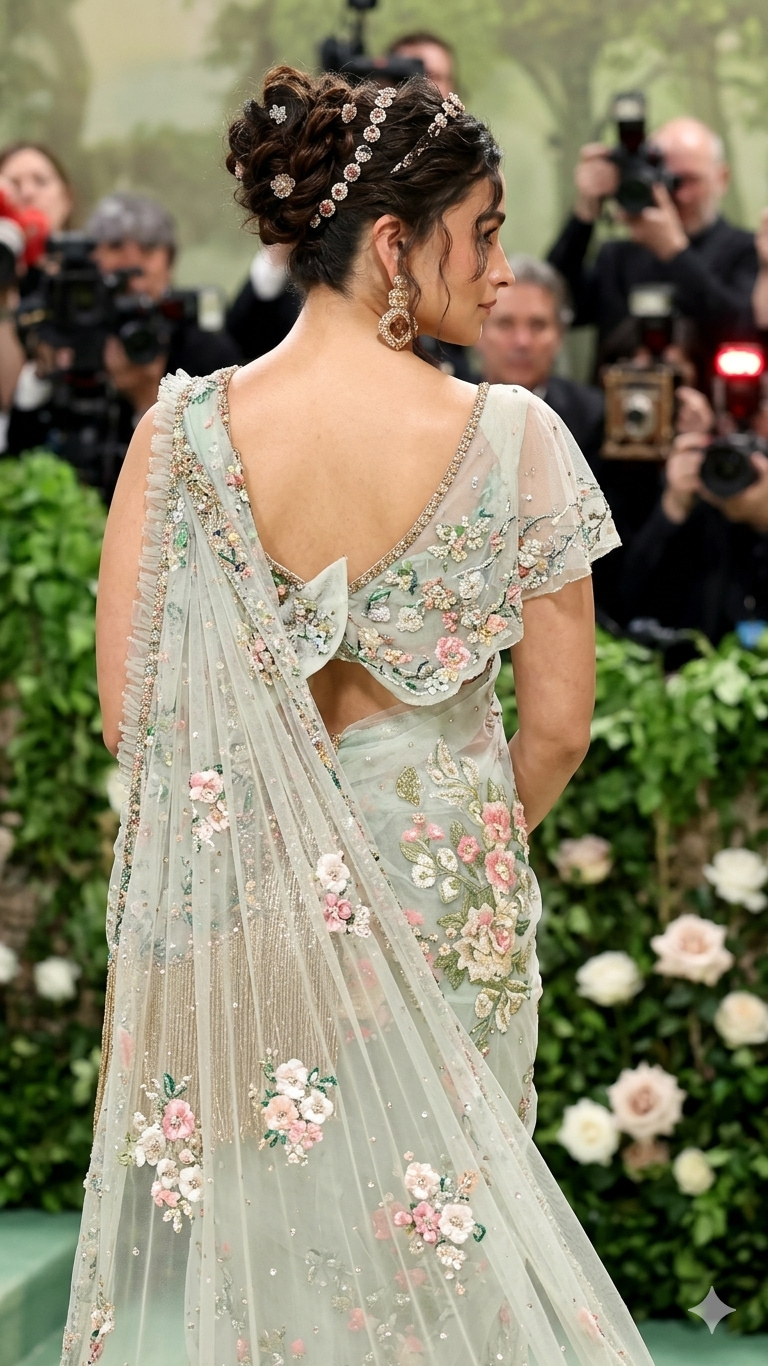
As Indian celebrities surge in influence with global luxury brands, stylists are taking on a role that goes far beyond fashion. In a market where a single look can go viral within hours and every detail is dissected online, they are no longer simply dressing stars, they’re becoming some of fashion’s most influential marketers.
Few places understand the commercial power of celebrity fashion quite like India. For decades, Bollywood has turned clothing into aspiration at a scale that most markets can only approximate. A look worn on screen could migrate from cinema halls to wedding wardrobes, from magazine covers to high streets, with a speed and cultural fidelity that no media budget could have engineered. It’s a foundational instinct that predates social media, the algorithm, and even the industry’s current obsession with virality by several decades.
What has changed is the sophistication of the machinery, and who is now responsible for running it.
As designers like Sabyasachi Mukherjee, Gaurav Gupta and Prabal Gurung command international red carpets from Cannes to the BAFTAs to the Oscars, and cultural figures like Shah Rukh Khan make landmark appearances at events like the Met Gala, an appearance or a global ambassador campaign is no longer simply a fashion snapshot, it’s the brand moment. One that can reshape the perception of a luxury house, drive consumer search across three continents, and travel from a Mumbai fitting room to a Dubai wishlist within the hour.
That shift has fundamentally changed what it means to be a stylist in India.
Today, these fashion mavericks sit at the precise intersection of celebrity, brand and audience, the people responsible for making the relationship between all three not just coherent, but commercially legible. They translate the codes of a luxury house into something that feels authentic on a specific actor, for a specific market, at a specific cultural moment. They are part creative director, part image consultant, and part brand strategist.
That is, functionally, a marketing role. It has simply never been called one.
Akshay Tyagi, Creative Director, Consultant, Costume Designer and Celebrity Stylist, understands that tension better than most. Tyagi had imagined a future as a designer or perhaps a fashion artist, a distinction he was already interrogating as a teenager at Kodaikanal International School, where his IB art project explored whether conceptual fashion could exist as a category in its own right. From there he went to Nova Scotia College of Art and Design in Canada, completed his Bachelor of Fine Arts, eventually taking a role as a visual merchandiser at Club Monaco learning, as he puts it, “business from the ground perspective” while continuing to pursue his creative ambitions alongside it.
That chapter ended more abruptly than he had anticipated. A planned move to Club Monaco’s corporate office in New York fell through unexpectedly and by 25, he found himself back in Mumbai with his parents. No clear next steps and an industry he had never planned to enter waiting just around the corner. Within weeks, a mutual contact connected him to one of India’s most established styling agencies. His first project as an assistant was on Krrish 3, the blockbuster superhero franchise led by one of Bollywood’s foremost leading actors Hrithik Roshan.
“It was my first time really seeing how this world works. The scale of it, the pace of it, how much of it is built around image and what that image signals,” Tyagi shares with Beyond the Boardroom. “It was not just fashion. It was celebrity, business and branding all happening at once.”
He stayed, and 14 years later, Tyagi is one of Bollywood’s most trusted fashion specialists (particularly in menswear) with work spanning film, advertising, editorial, red carpet and personal styling across some of the industry’s leading names, including Aditya Roy Kapur, Varun Dhawan, Allu Arjun and Mahesh Babu. His editorial credits include Vogue India, Forbes, Filmfare, Femina and The Hollywood Reporter India, a reminder that in India’s current media landscape, editorial influence rarely stays confined to a page.
The Image Economy
In India, it’s not uncommon that within hours of release, publications are clipped, reposted, dissected and debated across Instagram, fan accounts, Pinterest boards and WhatsApp groups. The audience arrives equipped with references, opinions, and a visual literacy that even the industry itself can sometimes underestimate.
“Editorials used to be more contained,” Tyagi unpacks. “Now they travel everywhere. People zoom in on everything from the styling, to the hair, to the makeup, to the accessories, and even the cultural references. The audience is so aware now. They know when something feels fresh and they know when something feels repetitive.”
For stylists, that means there is very little room to get it wrong, and increasingly little room to get it right without thinking like a brand manager.
The ecosystem of influential stylists that has built up around Indian celebrity reflects the weight of that responsibility. Anaita Shroff Adajania, whose work spans Alia Bhatt, Katrina Kaif and blockbuster Bollywood films like Dhoom and Cocktail, styled Bhatt’s now-defining 2024 Met Gala appearance—a mint green Sabyasachi sari with a 23-foot train that required nearly 2,000 hours of artisan work and became one of the night’s most globally discussed images. Shaleena Nathani’s long-running partnership with Deepika Padukone has helped construct one of the most internationally legible celebrity-luxury identities to emerge from India: Padukone became the first Indian ambassador for both Cartier and Louis Vuitton, a milestone that did not arrive by accident but through years of visual consistency built look by careful look. Others—Ami Patel, Tanya Ghavri, Mohit Rai, Eka Lakhani—have each built entire practices around the same principle: that dressing a celebrity is, at its most serious, an act of brand architecture.
Millennial fashion enthusiasts will remember seeing former Miss World-turned-actor Aishwarya Rai Bachchan become one of the first globally recognisable beauty identities to emerge from India through her long-running relationship with L’Oréal Paris. Sonam Kapoor helped further the Bollywood actor as a serious couture presence at Cannes, arriving season after season in looks that made fashion itself part of the story. More recently, Priyanka Chopra Jonas has become a face of Bvlgari, further cementing the idea that Indian celebrities are no longer simply participating in global luxury, but helping shape it.
Actors like Alia Bhatt, Deepika Padukone, Kiara Advani and Ananya Panday are not simply representing brands in India, they are embedded in those brands’ global strategies. Bhatt became the first Indian global ambassador for Gucci before later joining L’Oréal Paris. Padukone became the first Indian ambassador for Louis Vuitton and Cartier. Panday, meanwhile, became one of the global ambassadors of Chanel. These appointments reflect more than celebrity. They reflect the growing commercial weight of India itself.
India’s celebrity endorsement market is now valued at more than US$300 million, while the country’s luxury market is projected to more than triple by 2030. As luxury houses deepen their presence in India, celebrity image has become one of the most efficient vehicles for building aspiration at scale. The stylist, in that context, is no longer adjacent to the commercial conversation. They are inside it.
The Stylist as Brand Builder
What excites Tyagi most is not simply the scale of celebrity culture in India, but the fact that Indian fashion now travels globally in a way it did not even a decade ago.
“There is much more curiosity around India now,” Tyagi says. “People are paying attention to Indian designers, Indian craftsmanship, Indian jewelry, and Indian textiles. It’s not just about Bollywood anymore. There is a real appetite for what India brings aesthetically.”
That growing visibility has also made authenticity more important than ever. The strongest celebrity-brand relationships no longer work because of fame alone. They work because there is a believable fit between the celebrity, the brand and the values both are trying to communicate. Luxury audiences increasingly expect more than glamour; they want consistency, credibility and a sense that the partnership feels natural rather than transactional. That is especially true as sustainability, craft and provenance become more important to how luxury is marketed.
“There is definitely more awareness now with social media,” Tyagi explains. “People want to know where things come from, who made them, whether it feels responsible, whether it feels real. You cannot just put somebody in something because it is expensive anymore. There has to be a thought process behind it.”
He continues. “The brand is thinking about what it wants to say, but the stylist has to think about that too. You are building the celebrity’s image, but you are also building your own credibility as a stylist. People remember who put somebody in what. They remember who consistently gets it right.”
Virality has complicated that equation further. Celebrity culture itself is not new. Bollywood has always been built on aspiration and image. What has changed is the speed and intensity with which fashion moments now travel. “Virality can be amazing, but it can also be dangerous,” Tyagi notes. “People react so quickly now. Something can become iconic overnight, but something can also be criticised overnight.” Audiences are no longer just interested in the celebrity itself, but in the taste behind the celebrity.
“People want to know who made it, who styled it, what is luxury, what is affordable, what feels sustainable and what they can recreate,” he adds. “If it is street style, it has to feel a bit more accessible. If it is red carpet, it can be more glamorous. You cannot make everything feel too far away from people or it can flop.”
For brands, that makes the stylist an increasingly valuable creative partner. “Brands want you to create the ultimate version of what they stand for. You are painting the billboard for them through a person.” That pressure sits squarely with stylists, who increasingly find themselves accountable not just to celebrities, but to brands, audiences and the internet itself. In Bollywood, where everything orbits the actor, that dynamic becomes even more pronounced.
“The job is not just about clothes anymore,” Tyagi concludes. “It is about building an image, building a relationship and building a point of view that people connect with.”
Bollywood’s image-makers have always shaped how India is seen. The difference now is that the world is watching, and some of fashion’s most effective marketers are no longer sitting in boardrooms, but in fitting rooms.