At 72, the culinary legend is having anything but a retrospective year. With Osteria Mozza moving to ION Orchard and Chi Spacca making its first move beyond Los Angeles with a year-long Singapore residency, Silverton sits down with Beyond the Boardroom to discuss four decades in food, the changing culture of luxury dining, why simplicity still matters and what continues to excite her about what comes next.
Tucked behind the placards on Level 3 of ION Orchard, above the ceaseless thrum of one of Singapore’s busiest intersections, is a room that almost no one knows is there.
Step beyond the boarded entrance however, and the geography becomes strangely difficult to reconcile. This is Osteria Mozza’s new home, yet to be unveiled until 7 September, and while there are traces of the familiar austerity that defined its former incarnation at Hilton Singapore Orchard, here they’ve been allowed to deepen into something altogether more transportive. The warmth of timber, the intimacy of the room, the particular theatre of an Italian osteria; nothing feels as though it’s been assembled to persuade you of where you are. You simply arrive there. Somewhere between the entrance and the table, the shopping centre outside ceases, quite convincingly, to exist.
And at the centre of it all, seated opposite me, is Nancy Silverton.
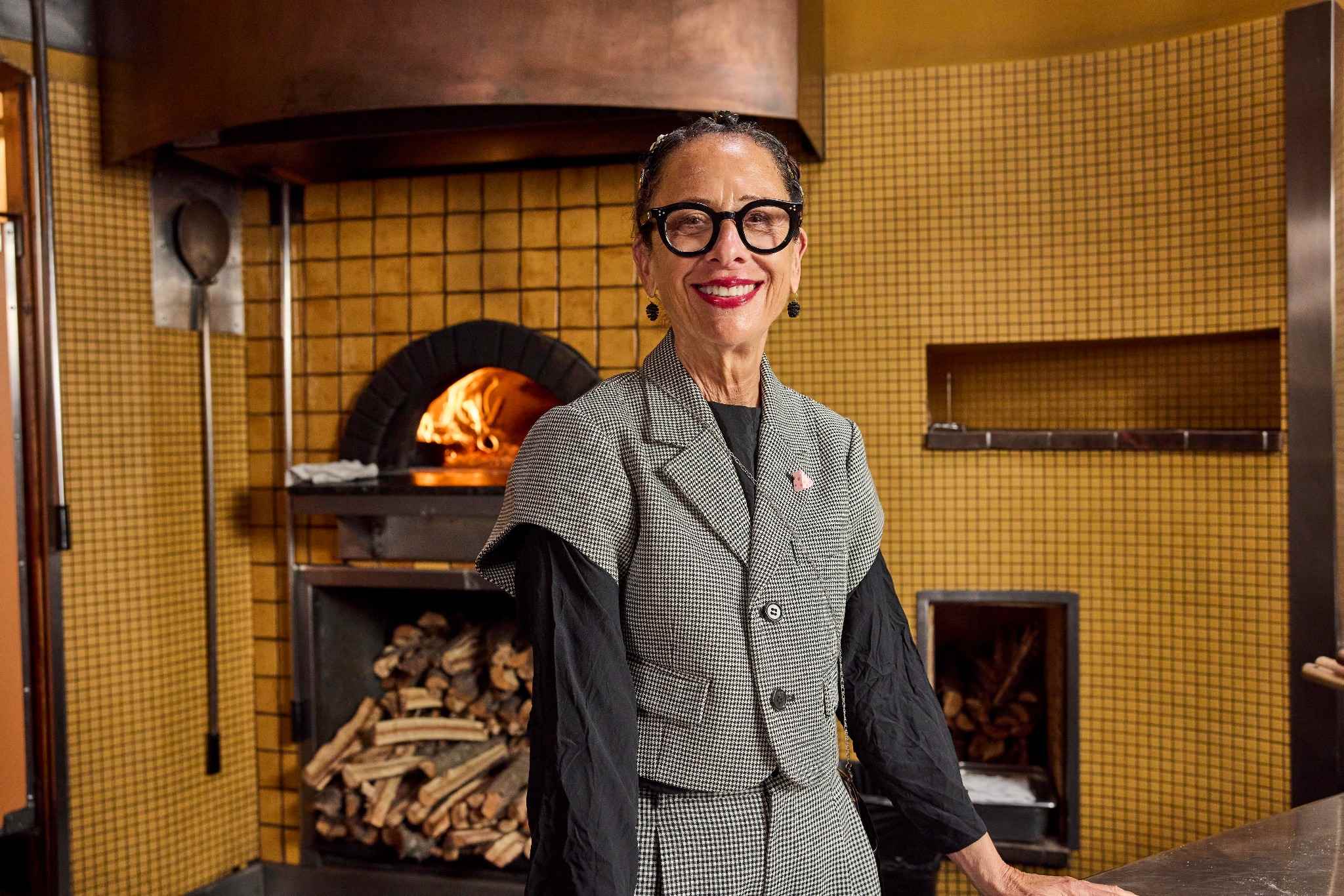
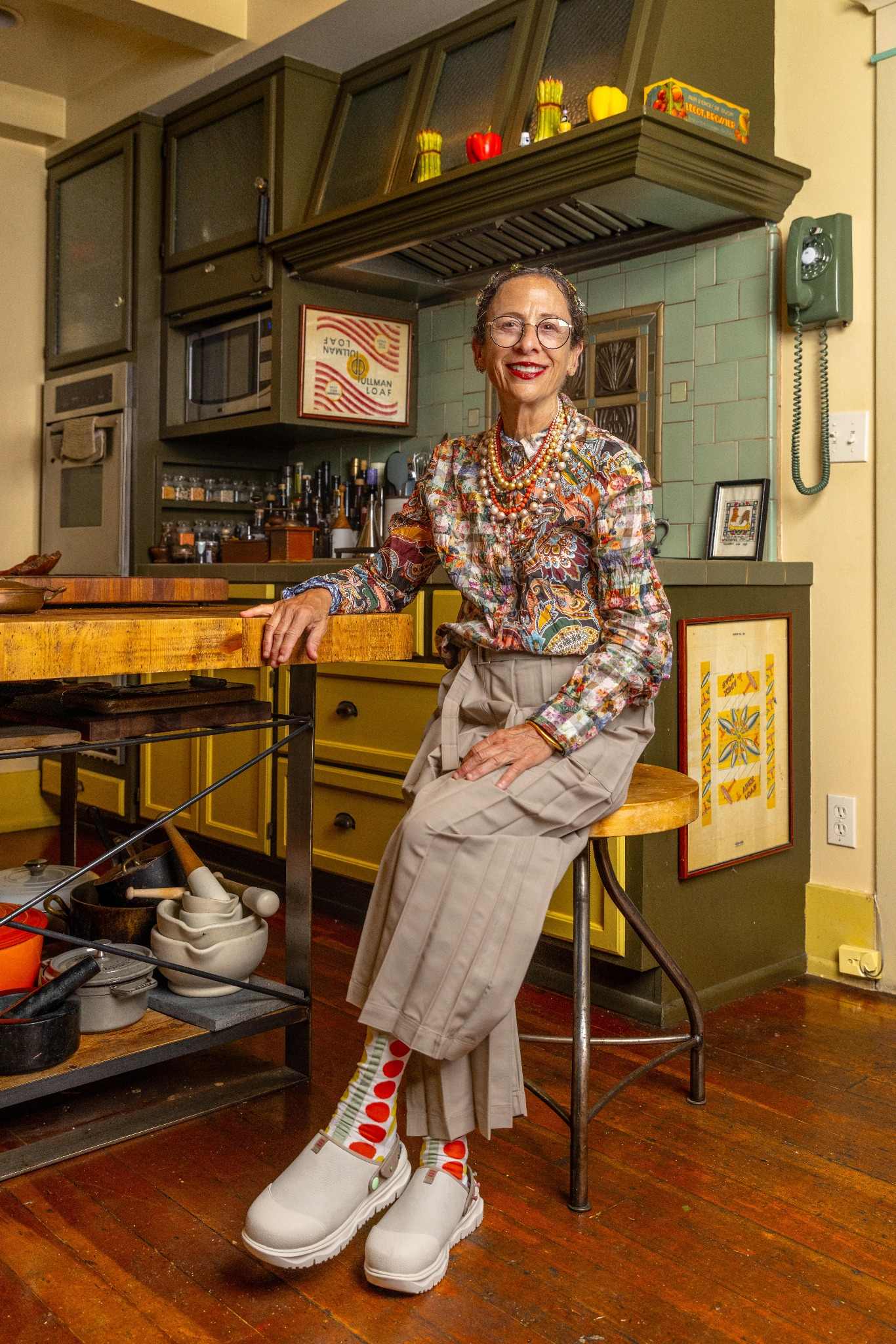
Silverton is immediately and unmistakably fabulous. Chanel clips adorn her hair, every detail considered without appearing particularly laboured over, and at 72, she possesses the sort of singular aesthetic that could make her as readily a fashion icon as a culinary one. As it turns out, the distinction between the two is one we will return to later.
For now however, there is news.
Singapore, Served Two Ways
Silverton is in Singapore not only to unveil Osteria Mozza’s new home, but to reveal what will become of the one it leaves behind. Beyond the Boardroom can reveal that chi SPACCA, Silverton’s acclaimed Los Angeles restaurant, will make its first foray outside the United States with a one-year culinary residency at Hilton Singapore Orchard, slated to open in the fourth quarter of 2026.
Its name translates loosely to “he or she who cleaves”, which offers some indication of what’s to come. Inspired by the traditions of the Italian butcher, chi SPACCA is a grill-forward ode to whole-animal cooking. Meat, seafood and vegetables approached with the same respect for produce, provenance and anatomy that a butcher might bring to the block.
But perhaps the more revealing origin is a personal one. The restaurant is in many ways, an extension of how Silverton herself cooks and eats at home in Umbria: large, bold and generous, with food intended to arrive at the centre of a table and be shared among family and friends.
There will be no pasta. No pizza. Instead, the Singapore menu, still being developed by Silverton and her team, will centre on the fire: meats and seafood from the grill, skewers, vegetables and signatures familiar to chi SPACCA devotees in Los Angeles, among them its focaccia di Recco and beef bone marrow pie. Silverton intends to preserve the restaurant’s DNA while allowing its Singapore incarnation to respond to the market around it, right down to building a local team capable of interpreting Mozza’s philosophy through a distinctly Singaporean lens.
The residency itself is an experiment of sorts. For one year, the former Osteria Mozza space will become a testing ground for chi SPACCA in Asia, an opportunity to understand how Singapore responds to it, refine what needs refining and, ultimately, determine whether there is a more permanent future for the concept here.
For a chef newly handed a lifetime achievement award, Silverton appears remarkably preoccupied with beginnings. This year alone, TIME named her among the 100 most influential people in the world, while the James Beard Foundation bestowed upon her its Lifetime Achievement Award, two honours that seem to place a rather definitive punctuation mark on a career Silverton herself speaks about as though it remains somewhere mid-sentence.
Innovation Meets Instinct
Long before Singapore, Mozza, the Michelin stars and the accolades that would eventually attach themselves to her name, there was simply an instinct that this was what she was meant to do.
Silverton was still at university when she began working in what she describes now as “very modest restaurants”, eventually dropping out towards the end of her senior year to pursue cooking seriously. Culinary school followed, and then Los Angeles, where she arrived knowing precisely which restaurant she wanted to work for, Michael’s, then at the vanguard of California’s emerging culinary identity under Jonathan Waxman, if not necessarily which job she would find when she got there.
The kitchen position she wanted wasn’t available. What was available, rather improbably, was a job involving a computer. Silverton took it.
“I knew that the way you get to where you need to get, you take anything, right?” she laughs. “And so I went and I said, absolutely.”
She was, by her own recollection, terrible at it. But proximity mattered. When an opening eventually appeared in the kitchen, it was not in savoury, where she had imagined herself, but pastry. She took that too. What began as a compromise became a vocation, leading her eventually to Wolfgang Puck’s Spago in 1982, where she became head pastry chef and began establishing the reputation that would follow.
By 1989, Silverton and her then-husband, the late chef Mark Peel, had opened Campanile on La Brea Avenue, a restaurant that would become one of the defining institutions of Los Angeles dining. Yet one of the most consequential things to emerge from it began with something altogether more elemental: Silverton couldn’t find bread she thought was good enough to put on its tables.
And so, quite literally, she made better bread.
La Brea Bakery opened alongside Campanile that same year, built around the sourdough breads Silverton had spent months learning to master. What began as a solution for one dining room would grow into a business credited with helping bring artisanal bread into the American mainstream. In 1991, Silverton became the inaugural recipient of the James Beard Foundation’s Outstanding Pastry Chef award. A decade later, she and Peel sold La Brea Bakery, by then a business vastly larger than the small bakery that had begun beside their restaurant.
Mozza would follow. Pizzeria Mozza opened in Los Angeles in 2006, followed by Osteria Mozza in 2007, beginning the restaurant family with which Silverton would become most globally synonymous. Osteria earned a Michelin star; chi SPACCA arrived in 2013, and Silverton’s particular expression of Italian cooking continued to travel well beyond the city in which it began. Eleven cookbooks, countless television appearances and collaborations followed, extending her influence far beyond the restaurants themselves.


Seen from this end of the chronology, there is a certain inevitability to it all. Silverton tells it rather differently.
“Everything I did has been very gradual,” she says. “I don’t open 20 restaurants a year. They’re very calculated, very gradual.”
There’s something disarmingly matter-of-fact about the way she recounts a career that has become canonical. No grand plan against which every decision was plotted; no attempt, decades later, to retrofit strategy onto instinct. A job wasn’t available, so she took another. The bread wasn’t good enough, so she learnt to make it. A dish hasn’t reached its potential, so she keeps working until it has. The scale changed. The instinct, apparently, did not.
“What I’m really satisfied with, what makes me feel really good, is that I am as enthusiastic today as I was when I opened my first restaurant,” Silverton tells BTB.
That enthusiasm is not some nostalgic attachment to the craft. Silverton still knows what is happening across her restaurants: what is on the menu, who is working there, what is being served. “When you taste my food, no matter where you are in the world,” she says, “I think you taste the food of somebody that’s still involved.”
And perhaps that explains why, 40-odd years later, she can still become preoccupied with something as singular as whether a dish is actually good. Silverton describes it almost as an internal calibration. She knows when something has reached its potential; when to keep working, when to remove rather than add, and when an idea simply isn’t going to get there.
I know how to add. I know how to subtract, and when necessary I can say, you know what? Let’s start over.
It’s a deceptively simple philosophy for a woman who has spent much of her career helping shape the way an industry thinks about food. But it also brings us, rather neatly, to the reason I wanted to sit down with Nancy Silverton in the first place. Because taste has become a far more complicated proposition than whether something simply tastes good. It’s a cultural currency and an aesthetic judgement; instinct and education; something increasingly mediated by algorithms, critics, Michelin stars and the images that reach us before the food ever does. Silverton’s career has spanned that entire transformation, without ever appearing particularly seduced by it.
So, after more than four decades spent exercising, refining and trusting her own, what does Nancy Silverton believe good taste actually is?
The Anatomy of Taste
There is no single answer, because Silverton understands taste in several ways at once. On the plate, as instinct and judgement; personally, as knowing what belongs to you; and as a consumer proposition, increasingly shaped by what diners consider desirable or luxurious.
On the plate, she begins with the senses. “The first thing that needs to speak back to you is that that plate says, ‘eat me’,” she explains. But a great first bite isn’t enough. “You have to design a plate of food to be eaten all of it.” Ingredients should remain identifiable, produce needn’t be forced into uniformity and sometimes, she says, something simply “should be rumpled”. Knowing when requires judgement. “That’s the part that’s very difficult to teach.”
Her own cooking is similarly unfussy. “Our food is not tricky food,” she continues, even calling it “not creative food”. The flavours are strong, distinguishable and belong together. You come, she says, “to have a delicious meal”, not to Instagram the latest trend.

Midway through our conversation, Silverton offers an unexpected analogy in Comme des Garçons, a label she loves and wears, despite its runway occasionally producing what she calls “contraptions” nobody could reasonably wear. She can admire them without wanting them herself. The same applies to experimental food. “There’s a place for that funny, whimsical stuff,” she says. “But do I want to eat it? Do I want to make it? That’s another.”
Taste then, is partly knowing the difference between appreciation and desire.
And as a diner, what Silverton desires has become simpler. Time at the table is “precious”, a philosophy she traces to family dinners growing up and her affinity with Italian culture. “The food on the table should never compete with the conversation. I think it should feed the conversation.”
The same restraint informs her view of luxury hospitality. She values knowledgeable, intuitive service, but not performance; career servers who consider hospitality a craft; and young chefs motivated by food rather than the followers, television deals and endorsements that have turned chefs into “rock and roll stars”.
What excites her instead are multi-generational and neighbourhood restaurants with a clear sense of themselves. “It’s not just about these multi-million-dollar buildouts,” she says. In Singapore, she finds the alternative at Magpie, a modest, comfortable room whose personality extends to the owner’s records, playlist and speakers, and speaks just as warmly of Scarpetta. Then there is Chef Yum Hwa’s Ben Fatto 95, an intimate private-dining model built around what its chef does best rather than what a restaurant is conventionally expected to be.
Perhaps that is why Silverton remains so compelling a judge of taste after four decades: she has little interest in telling us what to like. What matters is knowing why something works, when it doesn’t, and having enough confidence in your own judgement to tell the difference.