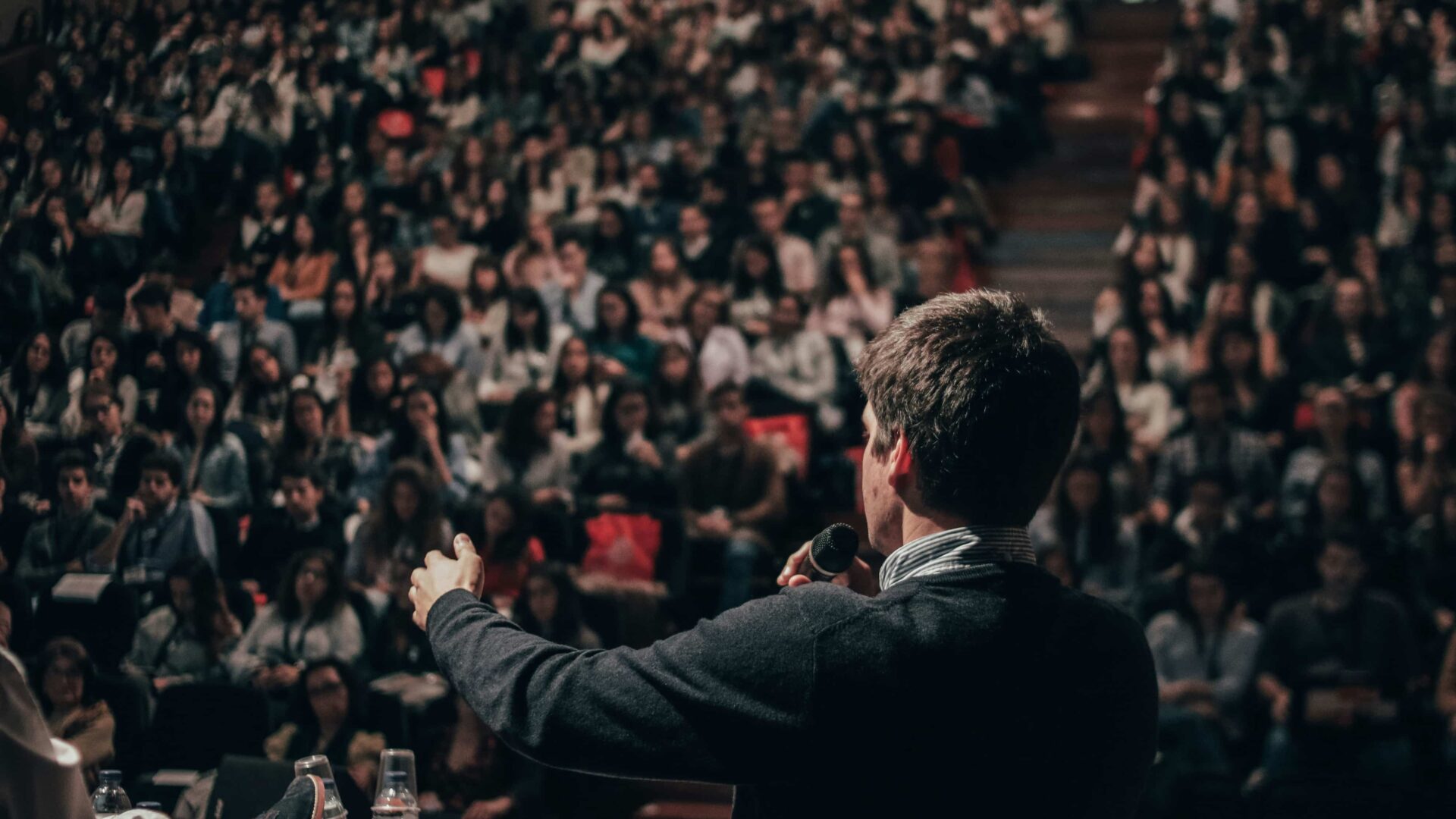
Half the world’s top podcasts are now hosted by founders, scientists and operators rather than entertainers. This month’s Beyond the Boardroom Breakfast Briefing asked what that shift actually means for brands, and why the smartest ones are starting to treat expert creators as businesses in their own right, not talent to be booked.
Everyone is fighting for attention, yet almost nobody is winning it. That was the uncomfortable starting point for this month’s Beyond the Boardroom Breakfast Briefing, our six-weekly gathering where we bring senior marketers, strategists and business leaders together to unpack exactly this kind of shift before it’s fully calcified into conventional wisdom. This edition tackled one that has been building quietly for several years and has in 2026, become impossible to ignore: the rise of the B2B and expert creator, and what it means for how brands earn trust.
The room’s opening provocation was simple. Influence once offered brands a powerful shortcut, access to an audience already assembled around an individual, with half of APAC consumers telling PwC that influencers have persuaded them to purchase a product or service, compared with 41% globally. But the model that traded on proximity and authenticity has become an industry in its own right, and with that has come commercialisation, saturation and scrutiny in equal measure. Three-quarters of APAC consumers now actively skip content they perceive as overly polished or inauthentic, according to research from Accenture Song and TikTok. The currency of influence, the room agreed, has not disappeared. The conditions under which it’s earned have simply changed.
The creator economy is growing because the definition of “creator” is growing with it. The numbers make the point on their own: the global creator economy is now worth an estimated US$314 billion, yet of the more than 303 million creators worldwide, just 14% identify as influencers and 60% hold full-time jobs elsewhere. This is not a niche of aspiring entertainers monetising a following. It’s founders, operators, scientists and specialists building audiences as a by-product of expertise, not as the goal.
Nowhere is that clearer than in podcasting, where half of Spotify’s global top ten shows in 2025—The Diary of a CEO, Huberman Lab, Modern Wisdom, On Purpose among them—are now built around knowledge rather than entertainment. Advertising too, has followed the audience. Cannes Lions this year was widely described in the trade press as the creator economy’s most important event, with LinkedIn using the festival to signal what it called the biggest identity shift the platform has made in years. The figures back up the anecdote. According to Edelman and LinkedIn’s B2B Thought Leadership Impact Study, 77% of decision-makers say they prefer hearing from subject-matter experts who go deep on specialised topics, and 67% of executives say they’d rather hear thought leadership from an identifiable author with a point of view than a faceless brand. LinkedIn’s more recent research puts it in commercial terms: 82% of B2B buyers say creator content directly influences their buying decisions, and the knowledge creator economy specifically—professional experts, consultants and educators monetising their expertise—is projected to reach US$58.4 billion by 2034.
All of this and more, was litigated in the panel discussion that closed the morning, hosted by BTB Editorial Director Rahat Kapur and bringing together four voices working at very different points of the B2B creator space: Rica Facundo, Managing Editor, Asia at WARC, where she covers marketing effectiveness and culture across the region and is a regular speaker at Cannes Lions and SXSW; Anna Ong, a TEDx speaker and former 15-year banking veteran who left finance to found WYSH—What’s Your Story Huh?—and now runs What’s Your Story Slam, Singapore’s best-known live storytelling show; Pippa Woodhead, Founder of podcast studio Cove and formerly Head of Podcasts at Tigerhall for six years, where she conducted well over 2,000 interviews with executives from the likes of Google, Meta and J.P. Morgan; and Mansi Trivedi, General Manager B2B Strategy Lead for Dentsu APAC, an 18-year agency veteran who has worked on IBM, Microsoft, Lenovo and Nestlé and now leads the region’s Superpowers Index research into B2B buying behaviour.

The conversation ranged widely, but a handful of points kept resurfacing. Brands genuinely care about this space, Trivedi argued from inside Dentsu’s own client conversations that the appetite is real, with brands actively navigating the space operationally and exploring attribution models for creator-led B2B content, even as there remains no single agreed benchmark for what ‘success’ looks like.” Facundo offered a different lens entirely, tracing the rise of the expert creator back to something less about marketing and more about the labour market: professionals future-proofing their careers and building longevity into what they do. Her sharpest point was pointed and telling, this isn’t really about “becoming a content creator,” she argued, it’s about switching on creator mode, something she described as already living within us rather than a skill to be bolted on.
Ong pushed on where Asia sits in all of this, arguing that while the region is watching women rise in the space, it’s still running behind markets like the US, not because the stories are less compelling, but because it hasn’t yet got over what she called the cringe factor. “Cringe gets you paid,” was her blunt verdict, and several attendees called it the line of the morning. And Woodhead’s frustration was more operational than any of that: with business podcasts that resort to stale conversations and regurgitated corporate messaging, and a conviction that corporate infrastructures themselves have to change to actually allow this kind of content to happen, because a CEO can no longer be neatly extricated from what they say publicly and what their company does for a living.
Underneath all of that discussion sits a shift worth naming directly: the line between B2B and B2C influence is dissolving, and increasingly, the person is the business. Today’s most powerful creators are rarely individuals with a following to rent; they are operators who have built companies, intellectual property, production infrastructure and communities around their own authority. Alex Cooper is the case study everyone in the room kept circling back to, if not always by name. What began as a podcast, Call Her Daddy, is now a media company. Cooper’s Unwell Network signs and produces shows for other creators, and her ability to package that infrastructure (not just her own audience) is what took her original $60 million Spotify deal to a $125 million agreement with SiriusXM, with her broader media business now reportedly valued at around US$500 million. When a brand partners with someone at that stage, the relationship is no longer simple endorsement. It’s business-to-business-to-consumer. The creator’s expertise and lived experience create the authority, their business gives a brand a structural way to partner with it, and their audience is what ultimately extends that authority to consumers.
“The old model treated the creator as a media buy,” added Kapur. The new model treats them as an operator you’re building something with. Those are fundamentally different conversations to have internally, let alone externally.”
That shift was visible closer to home too, with the room pointing to a growing bench of APAC voices whose authority rests on demonstrated expertise rather than follower count. AI entrepreneurs, board directors, market strategists, journalists and enterprise leaders building audiences around what they know rather than who they are.
The practical insights of the conversation and morning circles on what working with expert creators should actually look like, and the discussion kept returning to one throughline: brands need to stop treating expert creators as a cheaper, more credible version of an influencer campaign. The clearest version of that mistake is licensing someone’s audience for a single campaign and calling it a partnership, when the more durable model gives creators a genuine stake in what they help build. An entrepreneur-in-residence arrangement, a royalty, a revenue share, or real equity. P&G Ventures builds health start-ups alongside founders on exactly this logic; Nike embeds Serena Williams to incubate emerging designers rather than simply fronting a campaign; Alphabet’s X recruits founders to build spin-outs from inside the company rather than commissioning them from outside it. The commercial case is straightforward: 83% of B2B marketers now say credibility matters more than traditional brand messaging, and genuine authorship does more for a brand than sponsorship ever could.
Part of that build is bringing an expert inside a genuine business problem rather than asking them to comment on a decision the brand has already made, a hospitality entrepreneur rethinking the arrival experience, a behavioural scientist redesigning a boutique, a technology founder interrogating the connected car. Documenting expertise in action is far more credible than asking someone to endorse a finished idea, and it is precisely the discipline Woodhead was describing when she talked about corporate infrastructure needing to change: a brand cannot invite that kind of scrutiny into its process while still managing the CEO’s public voice as a separate, sanitised workstream.
People are worried about coming across as cringe when they start, but cringe is what gets you paid — Anna Ong
Treating a creator’s professional network as an asset in its own right, rather than just their visible following, matters just as much, using those relationships to curate who belongs in a room and shape the agenda around which people meet. With 70% of marketers now saying buyers rely more on peers and experts than brand-produced content, access to a trusted network can matter as much as public reach. The same logic extends to using creators to take a brand somewhere it has no natural authority: pairing a neuroscientist with a fragrance house, a behavioural economist with a resale platform, a sleep scientist with a beauty brand. Estée Lauder’s partnership with sleep scientist Dr Matthew Walker and Jaeger-LeCoultre’s collaboration with chef Himanshu Saini are both examples of brands borrowing credibility from an entirely adjacent field, rather than simply reinforcing what they already say about themselves.
The idea with the most room left to run though, is inviting expert scrutiny rather than paying for praise. Giving an independent operator real access to a product or process and explicitly asking them to interrogate it, from sourcing claims to customer experience. The tension is the point: watching a brand respond to genuine pushback builds something endorsement cannot manufacture. Consumer-facing “unboxing and investigation” formats, of the kind now common across YouTube, are the B2C version of a discipline B2B brands are only beginning to adopt.
For brands willing to give up some control over the message, the reward is a kind of trust that can’t be bought outright.
Seven takeaway questions for your brand:
- Are we booking creators for their reach, or partnering with them for their authority?
- What would it look like to give a creator a genuine stake, not just a fee, in what we build together?
- What business problem could we let an expert creator inside, rather than asking them to comment from outside it?
- Whose professional network could extend our credibility further than their follower count ever could?
- Where does our brand have no natural authority, and which unexpected expert could earn us permission to go there?
- Would we be comfortable inviting genuine scrutiny of our product or process, on camera, from someone we don’t control?
- Are we treating our creator relationships as long-term partnerships, or as one-off activations we’ll need to re-negotiate every time?
The BTB Breakfast Briefing is a six-weekly gathering of senior business and brand leaders convened by Beyond the Boardroom to unpack key topics at the intersection of business, culture and luxury. Register your interest to attend the next session here.