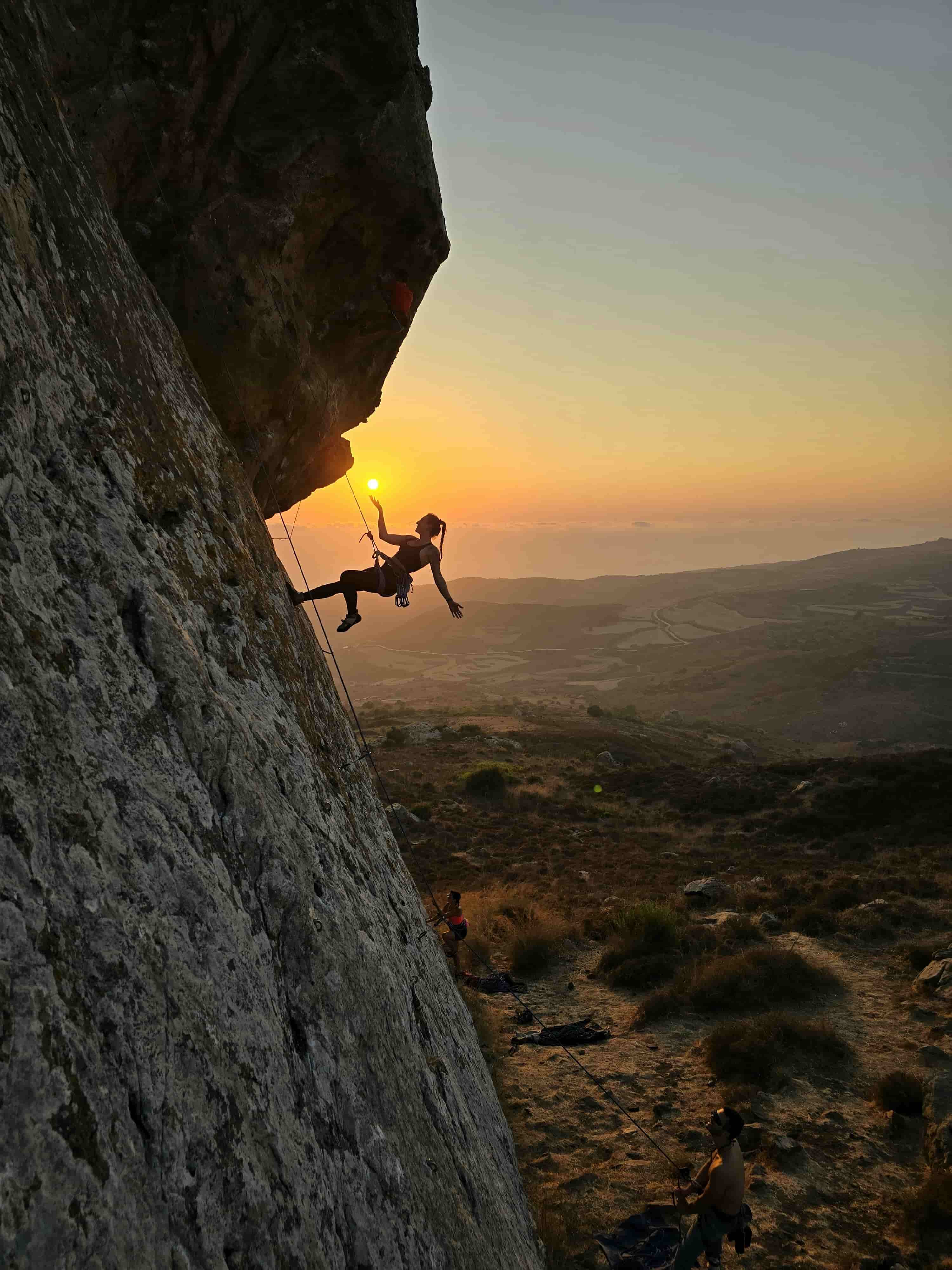
High-performing executives are swapping beach resorts for mountain summits, silent monasteries and endurance expeditions. As luxury shifts from effortless indulgence to earned experience, has discomfort become the ultimate status symbol?
“I accept.”
Those are the only words participants are permitted to say while following the ancient practices of Japan’s Yamabushi mountain ascetics. Dressed in white robes, they hike through cedar forests, meditate beneath icy waterfalls, and spend days in silence among the sacred peaks of Dewa Sanzan.
It sounds like the opposite of luxury. It is, in fact, a week-long retreat designed by the luxury travel company, priced at around US$11,000 (£8,245), and it reflects an intriguing shift in the luxury market today. Some of the world’s most successful people are no longer paying for comfort. They are paying for carefully engineered discomfort.
For a growing number of ultra-high-net-worth individuals and senior executives, this is the new definition of the ultimate luxury: voluntary hardship.
“Yamabushi monks are like the Navy SEALs of monks,” says Adam Sebba, CEO of The Luminaire, a luxury travel company that specialises in unique experiences. Adam has completed six-day ultramarathons in the Arizona desert himself and climbed Kilimanjaro with his 19-year-old son, an experience he says brought him to tears. “We’ve had successful business leaders join the retreat with Yamabushi monks, and what we’ve noticed is that they all want to learn something about themselves, to challenge themselves both mentally and physically.”
A Five-star Route To The Unknown
The higher some executives climb in business it seems, the more they’re drawn to places where control no longer matters. After building fortunes by mastering markets, teams and outcomes, they will spend $200,000 and three weeks of their lives handing that control over to a mountain.
Give up control, but on carefully engineered terms. That’s the logic behind Furtenbach Adventures, expedition operator that has built its business on precisely this promise. Its Signature Expedition to Everest costs $215,000 (€199,000): a personal IFMGA-certified mountain guide for the full expedition, two climbing Sherpas with multiple Everest summits each, and direct mentoring from founder Lukas Furtenbach. Clients get a dedicated sports dietician, consultations with a high-altitude physician before departure, and ongoing medical support throughout the climb. At base camp: a heated dome tent with a private shower and toilet, premium hotels before the ascent, VIP transfers, unlimited supplemental oxygen and at the end, a professionally produced documentary of the climb.
Earned, Not Bought
Junichiro Honjo, founder of Life on the Planet Ladakh, has guided journeys across the Indian Himalayas, one of the world’s highest inhabited regions, for more than 20 years. Modern executive life, in Honjo’s view, has minimised physical uncertainty while maximising cognitive overload, even though human biology evolved for continuous physical adaptation, not endless notifications. “Many executives describe the mountains as the only place where notifications, meetings and financial decisions simply disappear,” he says. “At altitude, the body imposes a new hierarchy: breathing, walking, weather, teamwork. Decision-making becomes simpler and clearer.”
There’s a psychological dimension too. Honjo describes what psychologists call “earned confidence”, a form of self-assurance that, unlike status built on wealth or position, cannot be purchased. “Crossing a high Himalayan pass at over 5,000 metres creates an internal reference point that often shapes how leaders later approach uncertainty, risk and pressure in business,” he says. Tellingly, he adds, these travelers are rarely chasing danger for its own sake. They’re chasing authenticity, something no assistant, no technology, no amount of money can outsource. “In Ladakh, we often see a transformation. Many executives arrive wanting to conquer a mountain. They leave talking instead about silence, humility and perspective.”
Escape, Wearing Better Shoes
Before she became an executive coach and social systems scientist, Carol Grojean spent 22 years inside corporate leadership, including a long stretch at Microsoft. What she carried out of that world was a question: why are high performers so skilled at effort, and so poor at feeling alive? “High performance tends to sever people from the felt sense of being human beyond their output,” she says. “On a mountain, or at mile 80, you cannot be anywhere but here, in this body, in this breath. The appeal isn’t only that suffering feels productive to people who fear rest. It’s that the edge is often the one place they can still feel fully alive. It’s close to primal, a body insisting on contact with its own aliveness after years of being run like a machine.”
Is there a real transferable skill between enduring an expedition and leading under pressure, or is it simply reward-seeking dressed up as growth? Grojean draws a careful line. “What carries over is the capacity to stay regulated under load, to keep making clear decisions while the body is flooded with stress signals,” she says. “That’s trainable, and it shows up in a crisis. What doesn’t transfer is the belief that more suffering equals more growth. Past a point, the expedition is just the same avoidance the person runs at work, wearing better shoes.”
Difficulty is one route back to feeling alive. Stillness is another and for people who fear rest, it’s often the harder, more transformative one.
The hunger to feel alive, she says, is real and worth honoring. The risk is outsourcing it entirely to extremity, until the edge becomes the only place a person can feel anything, and ordinary life goes flat by comparison. A brutal quarter at the office and a punishing climb register, physiologically, as the same kind of load: one reads as work, the other as escape, but the wear on the system is the same currency. “When someone can only feel alive by suffering, they never actually down-regulate. They mistake exhaustion for recovery,” she says. The tell, in her view, is escalation: “If each trip has to be harder than the last to deliver the same aliveness, that isn’t recovery. That’s tolerance—the way it works with any other stimulant.”
The leaders paying to suffer on a mountain, Grojean notes, and the ones she takes onto the land to do almost nothing at all, are reaching for exactly the same thing. “Difficulty is one route back to feeling alive. Stillness is another, and for people who fear rest, it’s often the harder, more transformative one.
Why Discomfort?
It’s tempting to write this off as midlife crisis or status signalling. But that misses what executives themselves say is happening.
Michael Easter’s The Comfort Crisis has become something of a shorthand in leadership circles for a broader idea. Modern life has engineered discomfort out of existence so efficiently that something essential—resilience, perspective, and the capacity to sit with difficulty—has begun to atrophy along with it. Easter’s own answer was a 33-day hunting expedition in Alaska: a “misogi,” an ancient ordeal designed to push physical and mental limits, undertaken with basic supplies alongside experienced outdoorsmen on a caribou hunt in brutal conditions. He later visited Bhutan, where Gross National Happiness serves as an alternative to GDP, to explore the relationship between simplicity, discomfort, and contentment. His conclusion was that personal growth tends to lie outside the comfort zone, and that the challenges most worth pursuing are those that expand human potential and deepen one’s connection to the natural world.
The appeal of these expeditions lies not simply in adventure but in the qualities they cultivate: tolerance for uncertainty, sound decision-making under fatigue, and the ability to keep functioning when outcomes are genuinely in doubt, the very traits that distinguish resilient leaders.
For now, this remains the preserve of executives and entrepreneurs who can write a six-figure cheque for the privilege of suffering well. Yet even within that circle, leaders are reimagining what off duty should look like. Where success was once expressed through effortless indulgence—the villa, the spa, the do-nothing holiday—it is increasingly signalled through voluntary hardship. It offers something modern life rarely does. Challenge, perspective, and the satisfaction of earning an experience that money can buy access to, but never fully purchase.