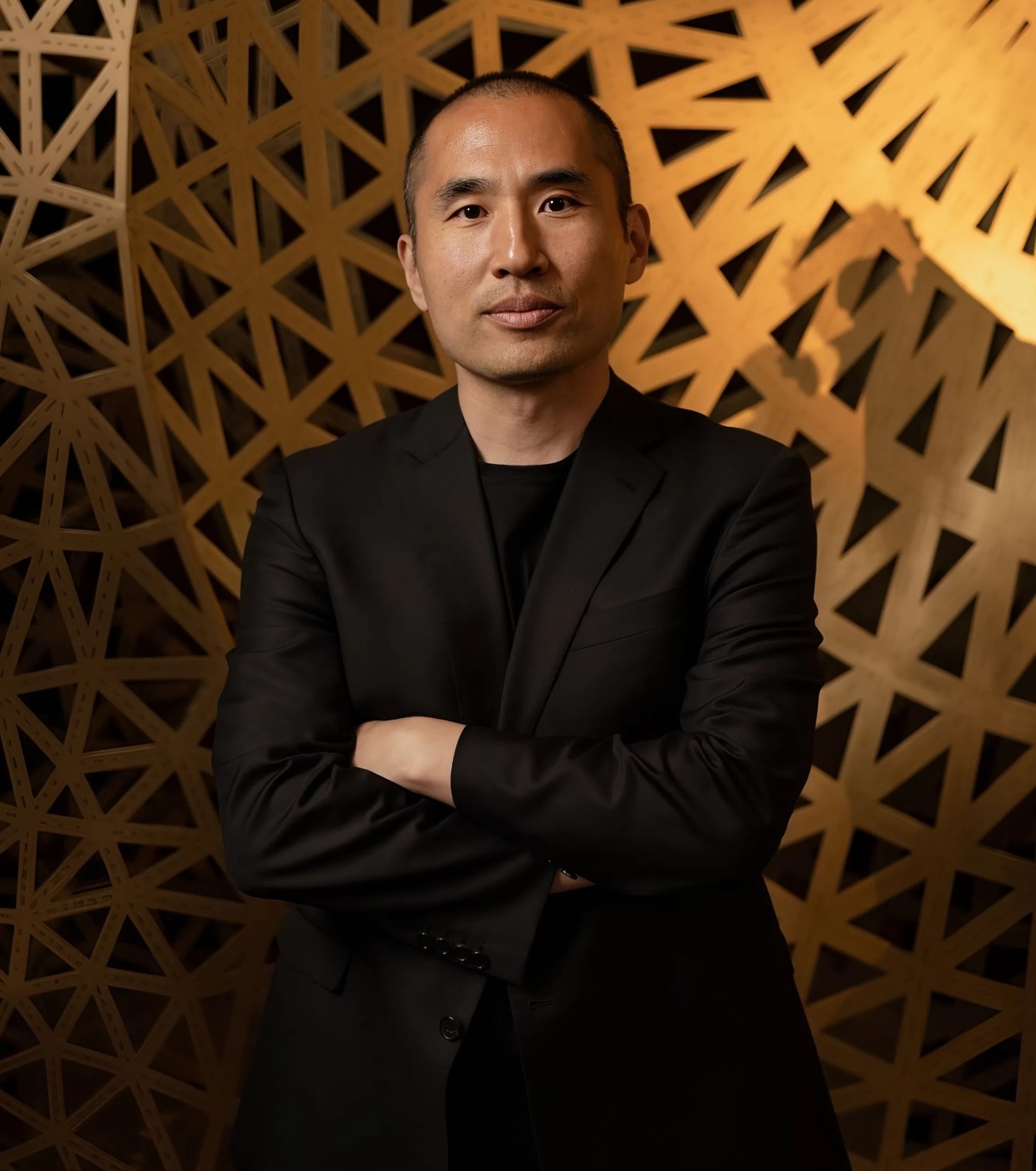
After a decade working with famed designer Zaha Hadid’s side-by-side, Princeton and Yale-educated architect DaeWha Kang is charting a bold course through the high-end landscape. By layering radical innovation onto the “cultural cachet” of historic stones, he is proving that the future of luxury isn’t a digital rendering, it’s the “calm wow” found at the intersection of Ivy League precision and ancient wisdom.
In an era defined by what DaeWha Kang observes as ‘AI slop’—the proliferation of algorithmic renderings and image-based architecture designed for immediate visual impact—the 48-year-old London-based architect offers a compelling counter-thesis: the future of luxury design isn’t about clearing the slate. Known for his ability to weave together the spiritual and the structural, Kang argues that the next frontier of design is not found on a blank page. Instead, it is about creating what he terms the ‘calm wow,’ that charged moment when ultra-contemporary interventions enter into a meaningful dialogue with stones once walked upon by Winston Churchill and Lawrence of Arabia.
This philosophy, simultaneously reverent and forward-looking, marks a graceful evolution from his former mentor, the late Zaha Hadid. Kang spent a formative decade working side-by-side with the Iraqi-British architect renowned for her radical deconstructivist designs and pioneering neo-futurism. As one of her trusted designers in her studio, he helped steer some of the most ambitious global projects of the century. Where Hadid embodied the iconoclastic spirit of the 1970s, a movement Kang notes was often about a bold departure from the past, the Princeton and Yale-educated Kang represents a more nuanced synthesis. He belongs to a generation grappling with how to honour heritage whilst refusing to be imprisoned by it, layering radical innovation atop sites that already possess what he calls ‘cultural cachet.’
From his origins in Eugene, Oregon, where his mother’s audacious choice prioritised boundless spatial freedom over East Coast prestige, to his current practice defined by the tagline ‘Beauty built with wisdom,’ Kang’s journey offers a masterclass in how environment shapes adult philosophy. His portfolio spans continents and high-stakes milestones, from the Living Lab at the iconic Shard in London, where he pioneered biophilic “regeneration pods” to boost worker wellness, to the Rainbow Publishing Headquarters in Korea, a building where every bookshelf represents a year of the last century.

His most recent work at The OWO (Old War Office) in London, featuring a rippling mirror-stainless steel pavilion, has cemented his reputation as a designer who can make the future sit comfortably in the lap of history. Beyond the Boardroom sat down with Kang to discuss the intellectual leap from neuroscience to architecture, the “sleepy village” of Gyeongju that defined his aesthetic, and how his mother’s decision to choose a place where her son could ‘run and run and never hit a fence’ continues to inform his vision of the world.
You have a very unique background—born in Korea, raised in the American Pacific Northwest, and now working globally from a base in London. Your parents chose to settle in Eugene, Oregon rather than pursue opportunities on the East Coast. How did that environment shape your understanding of space?
It traces back to a decision my mother made when I was two years old. Years later, whilst I was at Princeton, I went back and asked them: why Oregon? You had an offer at Brown University in Providence. We could have grown up in the Northeast, had access to all that cultural infrastructure, that network. My mother said something I’ve carried with me ever since. She told me that when I was a toddler, her primary concern was simple. She wanted me to be able to run freely, just run and run, and no matter how far I went, I wouldn’t hit a fence. That idea became foundational to how I think about space. I grew up with the Pacific Ocean 40 minutes west and the Cascade Mountains forty minutes east, some of the largest temperate rainforests in the world. My childhood was spent walking amongst Douglas fir trees that had been standing for two centuries, beneath waterfalls that seemed to materialise out of the canopy. It instilled in me a particular understanding of what space should offer: the capacity to move without constraint, and to exist without artificial boundaries pressing in on you.
If you grow up in that kind of environment, you don’t later design buildings that hem people in. You think about how to create a sense of openness, even in dense urban contexts. The Pacific Northwest taught me that architecture should accommodate movement and possibility rather than restrict it.
You moved from that wilderness into the Gothic architecture of Princeton and Yale. You’ve described institutional architecture as “water” that fish don’t realise they’re swimming in. What did those environments teach you?
Architecture is a medium you often don’t register consciously when you’re immersed in it, it’s the water you’re swimming in. Yale and Princeton look like Oxford and Cambridge for a reason. It’s architecture designed to project authority and permanence, the kind of setting where you’re meant to imagine yourself governing, making decisions that matter. That seeps into how you see yourself. It provides a form of cultural capital that operates unconsciously, you feel entitled to occupy certain rooms, certain conversations. But I’ve also seen the inverse. If architecture doesn’t accommodate your body or your needs, it does the opposite, it erodes your sense of belonging. If you’re in a space that doesn’t work for how you move or how you live, you’re constantly negotiating with your environment just to function. When the architecture suits you, you can focus on everything else. When it doesn’t, you’re expending energy on basic navigation that should be automatic.

At Princeton, you were studying neuroscience and computational neuropsychology, working towards modelling consciousness electronically. Why leave that for architecture?
I was planning to do an MD-PhD, researching consciousness through computational models of the brain. Given where tech went in the years after I would have graduated, that path probably would have been lucrative, potentially a nine-figure exit by now. It’s an efficient route to wealth!
Architecture isn’t. It’s slow, capital-intensive, and the risks are substantial. My mother suggested I do a career discovery programme at Harvard one summer, just to be certain about the direction. That’s where I realised the trade-off I was actually making. My impact might be smaller in architecture, but the work itself would be more tangible, more immediately satisfying. I told my mother: the day-to-day might be harder, but it will be more rewarding. I wanted to make things you could walk through, touch, experience physically. There’s something about that material reality that working in computational models couldn’t offer me. I chose the pleasure of making beautiful things every day over the abstraction of a larger mission lived entirely on screens.
Your father wanted to become a doctor in Korea but couldn’t afford medical school. Do you see your work in architecture as continuing what your parents started?
I think about it often. My father grew up poor in rural Korea. He had the academic ability to study medicine but no money for it. He gave up that ambition to immigrate and establish something my generation could build from. My parents followed a pattern you see in developing economies—Singapore is a good example. The first generation focuses on survival: medicine, law, engineering. These are professions that guarantee stability, that ensure you can support a family in a new country. The second generation, once that foundation exists, moves into culture and the fields that shape identity rather than simply ensuring security. My parents were ahead of their time in making that sacrifice. They built the groundwork. My career is the second act of the risk they took leaving Korea. I’m working from a platform they created but could never have built on themselves. That’s the arc of immigration and how each generation enables the next to pursue something that would have been unthinkable before.
A torn Achilles tendon a few years ago also seems to have fundamentally altered your perspective on accessible design. What happened?
I’m obsessive about tennis, and I tore my Achilles during a match a few years back. At the time, we were living in a converted piano factory in London—high ceilings, good light, the kind of space I’d always advocated for. But there was no lift. We were only on the second floor, but that meant 25 steps. I couldn’t use crutches, so I had to haul myself up backwards using just my arms. Every day. It was humbling. Here was this beautiful space that I would have praised in any professional context, and it had become actively hostile to my circumstances. It clarified something for me: if architecture doesn’t accommodate the reality of bodies—including bodies that are injured or aging or simply different—then it’s failed, regardless of how it photographs. We use the word “uplifting” to describe architecture, but if you’re struggling just to reach your bed, that aesthetic quality becomes meaningless. Architecture has to function for you at your most vulnerable before it can be evaluated as art. It needs to work when you’re weak, not just when you’re strong.
You spent a decade working with Zaha Hadid. What was that like, and what did she tell you when you left to start your own practice?
Zaha was an iconoclast in the truest sense. I once asked her for smaller projects to build experience. She looked at me and said: No, you need to do even bigger things. She had no interest in incremental thinking. Scale and ambition were the only registers she understood. When I told her I wanted to start my own office by 35, she paused—which was unusual for her—and said: Don’t rush. I wish I’d had more experience before I started my own studio. It was surprisingly candid coming from someone who had always pushed for more, bigger, bolder. I left with no contracts. It was difficult. I quickly understood that commissioning a building is an irrational act, you’re asking someone to invest millions in something uncertain, slow, and complicated. But Zaha taught me that an architect is really a channel for a client’s courage. You’re there to honour someone willing to stake a lot of money on a philosophical idea. That’s the actual transaction in architecture, you’re not just selling a building, you’re selling belief in what could be.
You’re now converting a building you originally designed with Zaha into a fine arts museum. How do you approach working with her architecture without either copying her or erasing what she built?
It’s a strange position to be in. But I’m deliberately not designing the conversion as Zaha would have. Her generation—the iconoclasts of the 1970s—wanted to demolish what came before and start from scratch. Erase the past to make space for the future. That was the revolutionary gesture. But repeating that approach now would itself be nostalgic. To distinguish yourself from the flood of digitally generated imagery we see now, a building needs an authentic relationship with history. It needs layers. I’m mining the original structure for what’s valuable rather than clearing it away. The tension between what she built and what I’m adding is the point. If you only pursue novelty, you lose the cultural weight that makes a space feel inhabited rather than just rendered. Buildings need evidence of the past to give the future any resonance. That accumulation is what creates depth, what makes something feel real rather than virtual.
At The OWO for Raffles, you inserted liquid metal pavilions into an Edwardian building. Why not just match the original architecture?
Do we really want more Corinthian columns in 2026? That kind of historical pastiche feels dishonest, as though we’re pretending to be Edwardian when we have different materials, different technologies, and different concerns. For The OWO, we used ultra-thin mirror stainless steel that reads as liquid metal. It’s soft and organic rather than industrial. I call it a calm “wow”—it catches your attention without shouting. We’re respecting the stones that Churchill walked on, but we’re not pretending the last century didn’t happen. When you create that dialogue honestly—when you’re clear about what belongs to which era—you get something richer than either period could produce alone. You build a bridge between past and present that you can’t achieve with either pure restoration or pure invention. It’s about using contemporary materials, and thinking about carbon, about what modern engineering can actually do, in conversation with historical craft and weight. That tension is where the real interest lives, not in gold taps or expensive stone.


You’ve described some buildings as “selfish”—architecture that gives nothing to its surroundings. How do you convince clients to think beyond their property line?
My first client after leaving Zaha was in Seoul. They’d bought a building that occupied significant space but offered nothing to people walking past it. No public amenity, no gesture of openness. Just maximised rentable area. I told them we needed to open it up. We designed a mirrored silver tree and created public outdoor space in a neighbourhood that was still forming. At the opening, I made a point: the story isn’t about me as the architect. It’s about a client willing to sacrifice some commercial space for a philosophical position. Architecture gets used politically to divide people, we see it constantly. The alternative is to design with hospitality, to use buildings as instruments of openness rather than exclusion. I asked everyone there: if every building on this block made the same choice, what would the city look like? It’s about treating architecture as a form of civic engagement, a way of saying you trust your neighbours and believe in shared space.
What do you see as your key imperatives for the coming years, both for your practice and for architecture more broadly?
There’s an unfinished conversation about architecture’s role in collective survival. Real sustainability isn’t just technical metrics or carbon reduction, it’s about environmental psychology and what I’d call spatial diplomacy. We’ve seen how physical spaces like the White House or the United Nations either build diplomatic ties or undermine them, depending on who’s granted access and how the architecture frames those interactions. My background in neuroscience informs how I think about designing spaces that support consciousness and mental well-being. In a political climate that’s increasingly polarised, where architecture often gets deployed to build walls and enforce divisions, I want to work in the opposite direction. I want to create environments that reflect our better instincts, where old and new exist in productive tension rather than erasure.
At the end of my career, I want to look back and know I didn’t just build structures, I built connections that gave people access to the kind of freedom I experienced in Oregon as a child. Where no matter how the world shifts around them, they don’t encounter walls at every turn.