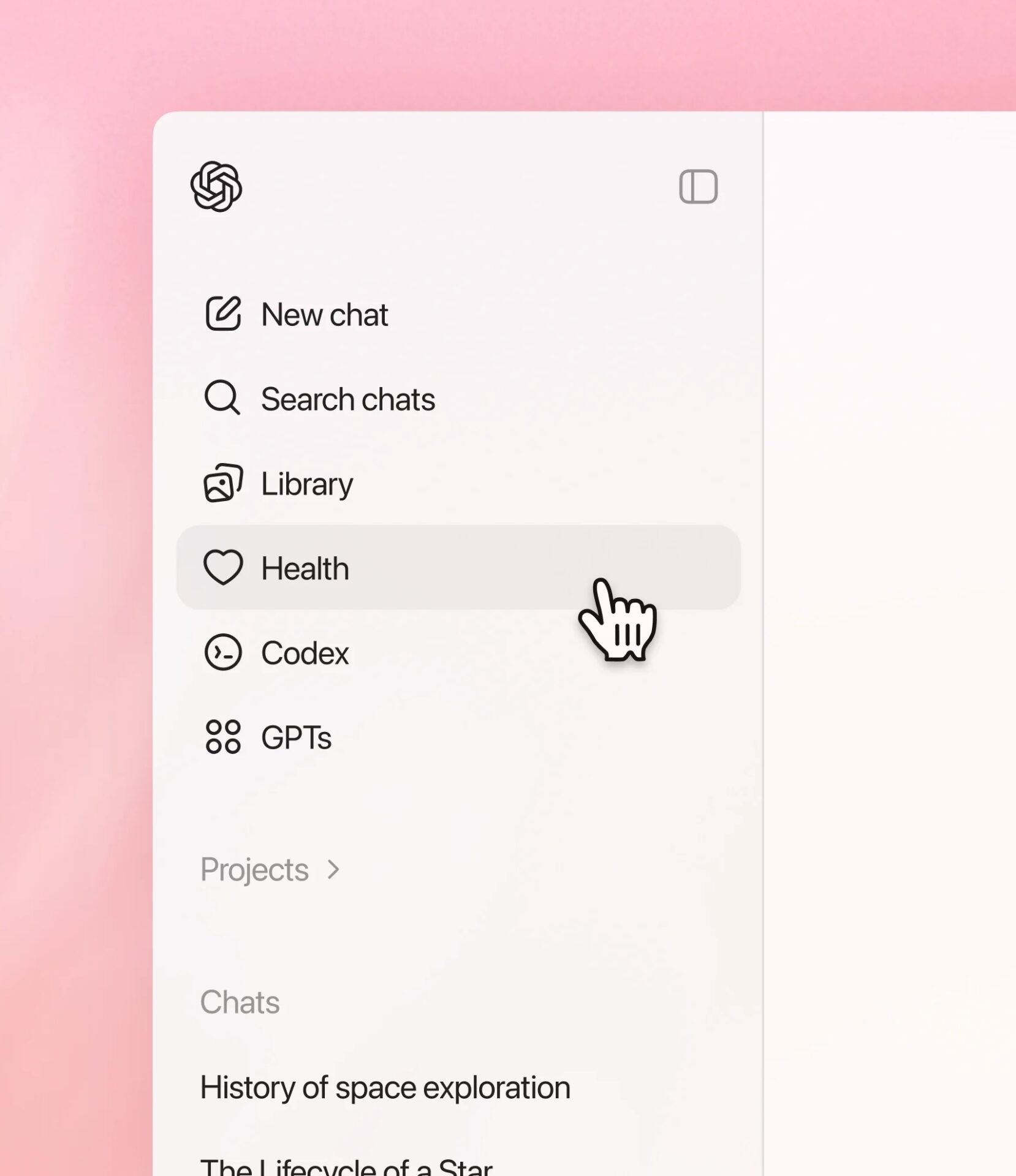
OpenAI has launched ChatGPT Health, a dedicated space within the platform where users can securely connect medical records and wellness apps like Apple Health, Function, and MyFitnessPal. The startup has partnered with b.well to provide the health data connectivity infrastructure that will allow users to share their medical records. The service helps users interpret lab results, prepare for appointments, and navigate healthcare decisions by grounding responses in their personal health data. Health operates as a separate space with enhanced privacy to protect sensitive data, including purpose-built encryption and isolation to keep health conversations protected and compartmentalised. Available initially to a limited group of early users outside the EU, Switzerland, and UK, with plans to globally expand in the coming weeks. Medical record integrations are available in the US only, and OpenAI said conversations within ChatGPT Health will not be used to train its foundation models. The company reports that one in four of ChatGPT’s 800 million weekly users submits a healthcare-related prompt, with more than 40 million people using it daily for medical questions.
BTB So What?
Nearly one in four Gen Z adults saying they’d rather give up social media including TikTok and Instagram than lose access to ChatGPT or similar AI tools, the statistic demonstrates a generational declaration of where influence now resides. ChatGPT has crossed a threshold that took social media a decade to reach: it’s become infrastructure people can’t imagine losing. It also signals something far more consequential, which is that AI is becoming the primary interpreter of reality for an entire generation, particularly when it comes to their bodies.
Utah’s decision to allow AI to autonomously prescribe medications is a public acknowledgement that people are trusting machines with judgements traditionally reserved for trained professionals. Doctronic’s co-founder claims the AI is “infinitely safer than a human doctor”and performs more checks than a typical physician visit. The company’s data shows a 99.2% match rate with physician treatment plans across 500 urgent care cases. Whether or not that’s true, the fact that regulators found it compelling enough to grant legal authority reveals the tipping point we’ve reached—trust in algorithmic judgement now rivals, and in some contexts exceeds, trust in human expertise.
This shift will prove instrumental for the healthcare industry, not because patients will abandon doctors, but because providers will be compelled to make a strategic choice: partner with AI platforms such as OpenAI, or fundamentally evolve their business models. The pattern is already visible in mental health, where soaring therapy costs, often exceeding $150 per session in major markets, have driven younger patients towards AI-enabled support as a first line of engagement. Recent studies indicate that more than one in eight young adults have already turned to generative AI tools for mental health guidance, not as a replacement for clinicians, but as an always-on, affordable layer of support.
If large AI platforms begin to offer widely trusted health guidance, the challenge facing healthcare and wellness brands will be existential. Advice that once flowed through doctors, insurers, or branded programmes would increasingly be delivered through a single interface, often before a patient or consumer engages with any provider at all. In that scenario, healthcare organisations are no longer competing primarily with one another, but with the platform that shapes the first interpretation of symptoms, risk, and behaviour. The implications may well even extend beyond hospitals and insurers to sports and wellness brands such as Nike, whose value has long rested on motivating and guiding physical performance. If AI systems become the primary source of personalised health and fitness recommendations, brands risk being reduced to suppliers of products rather than sources of insight. For many, survival will depend on whether they can integrate into these platforms through partnerships, data interoperability, or clinical validation rather than operating independently of them. Those that cannot may find that even strong brand recognition offers limited protection in a market where authority is increasingly conferred by whoever controls the interface.